
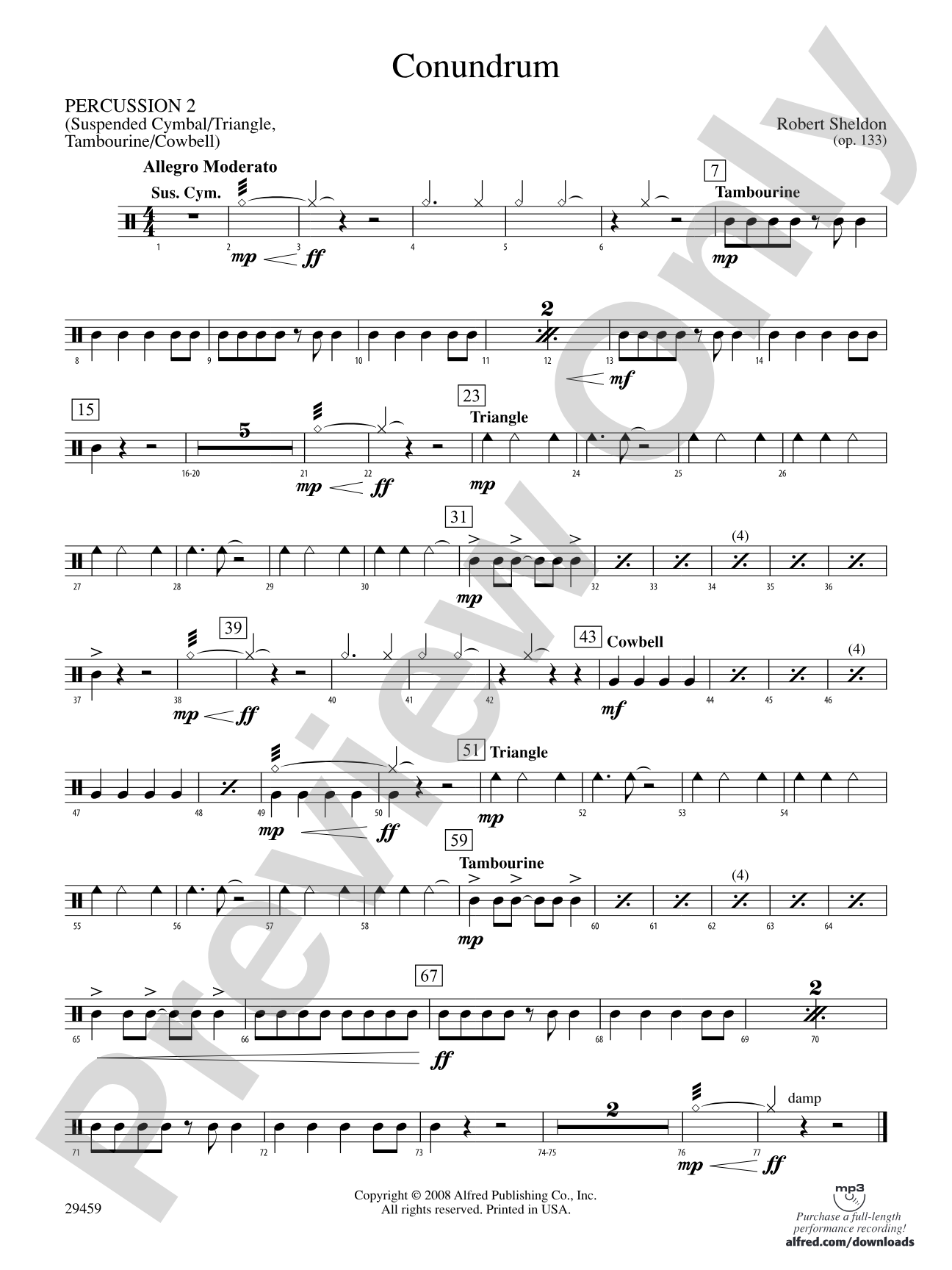

Conundrum: 2nd Percussion
By Robert Sheldon
Grade: 1.5 (Easy)
Item: 00-PC-0001416_PC2
$3.00
Pickup currently not available
Description
A conundrum is defined as a question or problem having only a conjectural answer, but your audience will have no questions or problems enjoying this tasty musical offering. The rhythmic groove, imaginative textures, and colorful scoring will make this a favorite on your next concert -- and with a title like this, of course . . . it has great drum parts! (2:20) This title is available in MakeMusic Cloud.


Don't just read it, hear it, play along with it, and watch your students grow with it. In MakeMusic Cloud, Conundrum: 2nd Percussion comes alive with professional accompaniment, adjustable tempo, and built-in practice tools that turn solo practice into real progress.
Open in the Player
Jump straight in and assign it today.
Start Your Free Trial
Open this title and explore the full library in minutes.
Sample Audio
1
Audio File
--:--
0:00
0:00
Sample Video
No sample videos found.
Additional Details
Series:
Alfred Debut Series
Publisher:
Alfred Music
Page Count:
124
SKU:
00-PC-0001416_PC2
More about this title
About the Composer: Robert Sheldon

Robert Sheldon stands among the most frequently programmed composers for wind band repertoire in the United States and internationally. His works appear regularly on state and national contest lists, and his commissions continue to shape the standard concert band canon. Sheldon has received honors from the American School Band Director's Association, Phi Beta Mu, and ASCAP, and he served as lead author of Sound Innovations for Concert Band, establishing himself as both a prolific composer and influential music educator.
Beyond the page, Sheldon maintains an active schedule as guest conductor for all-state and honor bands, and he conducts clinics and seminars across North America, Europe, Asia, and Australia. His compositions have been performed at Carnegie Hall, Orchestra Hall, Boston's Symphony Hall, the Sydney Opera House, and the Kennedy Center. VanderCook College of Music awarded him an honorary doctorate in 2020.
Why we love this
Sheldon writes for easy bands with genuine sophistication. The rhythmic backbone and textural variety here give young players real material to sink their teeth into, while the standout drum parts ensure percussion students feel the energy and responsibility of the groove rather than playing time-marking patterns.
What to expect
Contemporary, groove-driven, and immediately engaging. The rhythmic momentum propels the piece forward while the imaginative instrumental combinations create moments of color and surprise, keeping the ear interested across its two-and-a-half-minute arc.
Who it's for
Developing concert bands at the early intermediate level who want to program something energetic and musically rewarding without technical overreach. Directors seeking contest or concert repertoire that balances accessibility with genuine musicality will find a flexible, reliable work.
How to get the most out of it
- Lock the rhythm section first. Establish the groove in percussion and low brass independently, then layer in the melodic voices. A tight pocket makes everything else sound more polished.
- Highlight the colorful scoring by balancing the harmonic voices. Don't let the melody dominate; let saxophones, clarinets, and lower woodwinds breathe as equals so the textures read clearly.
- Bring attack and articulation precision to the rhythmic figures. Clean tonguing and crisp articulation across the ensemble will make the groove sing rather than blur.
- Give the drum parts room to shine. This isn't background accompaniment; Sheldon wrote these parts as active musical contributors, so let soloists or confident players carry the weight.
How to use it
Program this as an opener or closer to establish energy and modern sensibility. It works equally well on a festival program or as a concert showcase piece that demonstrates your band's rhythmic precision and textural balance without demanding the maturity or range required for more complex works.
Skills your students will build
- Maintaining steady groove and rhythmic precision across changing textures
- Balancing individual voice lines within a composite harmonic sound
- Articulation control in rhythmic figures at moderate tempos
- Listening and blending within the rhythm section (percussion, tuba, trombone)
- Reading ensemble parts that prioritize rhythmic accuracy over technical facility