
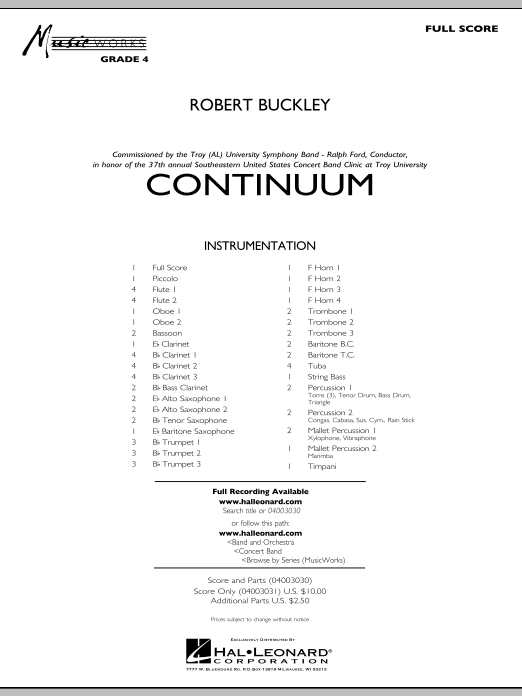

Continuum: Concert Band Conductor Score & Parts
By Robert Buckley
Grade: 4
Item: 35-PK00181151
$80.00
Pickup currently not available
Buy Extra Parts (Digital PDF Download)
Parts Added to Cart!
Description
This exciting, innovative new work from Robert Buckley was commissioned by the Troy University Symphony Band in honor of the 37th annual Southeastern United States Concert Band Clinic in Alabama. Using a recurring two-measure loop, this uniquely constructed piece is built up around various musical building blocks that are constantly evolving and transforming. The music is dramatic and dynamic, with full-blown ensemble passages suddenly dropping to quiet, powerful moments without ever losing the music's continuous drive. Following an exotic, bluesy middle section the piece builds, accelerating to a thrilling, rhythmic, percussive finish. A real tour de force! Dur: 7:00


Continuum: Concert Band Conductor Score & Parts isn't in MakeMusic Cloud just yet...but it could be. Let us know you'd like to see it, and you'll help shape what comes next. In the meantime, start a free trial and dive into thousands of interactive titles your students can play along with today.
Request This Title
Tell us you want it.
Start Your Free Trial
Explore everything that's ready to play right now.
Sample Audio
No sample audio found.
Sample Video
No sample videos found.
Additional Details
Publisher:
Hal Leonard
SKU:
35-PK00181151
More about this title
Why we love this
Buckley's structural approach here is genuinely inventive. Rather than relying on traditional form, he commits fully to a looping framework that becomes a vehicle for harmonic and textural transformation. Directors will appreciate how the recurring two-measure loop actually makes the piece teach itself to the ensemble; once that kernel locks in, you're building upward instead of fighting foundational instability. The dramatic contrast between full ensemble moments and stripped-down textures gives you natural rehearsal points and keeps student attention sharp across the full seven minutes.
What to expect
Buckley builds momentum through accumulation and repetition, making every new layer feel consequential. The piece pulses with forward momentum even in its quieter moments, then breaks open with percussive energy and rhythmic drive that feels almost primal. There's a contemporary confidence throughout, especially in how the exotic middle section disrupts the listener's expectations without breaking the overall arc.
Who it's for
Grade 4 bands ready for contemporary writing that respects their musicianship without patronizing them. This works for groups seeking festival or contest material with real structural sophistication and dramatic range. Ensembles wanting to program something current and compositionally adventurous will find the innovation here genuinely exciting.
How to get the most out of it
- Establish the two-measure loop as your primary rehearsal unit early. Get that pattern rock solid in the rhythm section before layering melodic and harmonic material around it.
- Shape the dynamic drops with intention. When the music pulls back from full ensemble, those quiet moments carry more weight if the players understand exactly where the energy goes.
- Let the middle section breathe with its exotic, bluesy character. This is where the piece shifts moods completely; resist the urge to rush through it just because the surrounding sections are kinetic.
- The final accelerando into the percussive finish demands precision from mallets and timpani. Start working that rhythmic clarity early so it doesn't become chaotic at performance tempo.
How to use it
This reads perfectly as a centerpiece for a contemporary music set or as the closing number of a concert section where you want to leave audiences energized. Pair it with a more traditional ballad or baroque-influenced work to highlight how distinctly modern the compositional voice is here. The seven-minute length and festival pedigree make it ideal for spring concert programming or for preparing material that contests will take seriously.
Skills your students will build
- Maintaining internal pulse while navigating repetitive harmonic loops
- Balancing ensemble weight through dynamic contrast and selective voicing
- Executing precise rhythmic figures in the percussion section at accelerating tempos
- Interpreting contemporary compositional techniques and non-traditional formal structures
- Sustaining focus and musical engagement across repetitive material without losing expressiveness