
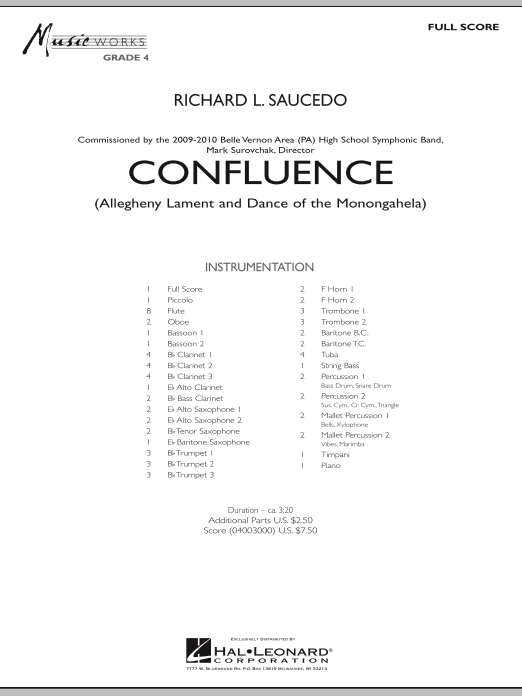

Confluence: Concert Band Conductor Score & Parts
By Richard L. Saucedo
Grade: 4
Item: 35-PK00155526
$75.00
Pickup currently not available
Buy Extra Parts (Digital PDF Download)
Parts Added to Cart!
Description
In downtown Pittsburgh, the Allegheny and Monongahela Rivers come together to form the Ohio River. This confluence of mighty waterways served as inspiration for this dynamic work for band. The impassioned "lament" features expressive melodic lines, followed by the "dance," which utilizes mixed meters and a relentless underlying pulse. Dur: 3:15


Confluence: Concert Band Conductor Score & Parts isn't in MakeMusic Cloud just yet...but it could be. Let us know you'd like to see it, and you'll help shape what comes next. In the meantime, start a free trial and dive into thousands of interactive titles your students can play along with today.
Request This Title
Tell us you want it.
Start Your Free Trial
Explore everything that's ready to play right now.
Sample Audio
No sample audio found.
Sample Video
No sample videos found.
Additional Details
Publisher:
Hal Leonard
SKU:
35-PK00155526
More about this title
About the Composer: Richard L. Saucedo

Richard L. Saucedo shaped the Indiana band landscape over three decades as Director of Bands at Carmel High School, where his ensembles claimed state championships, multiple appearances at the Music for All National Festival, and consistent recognition at the national level. Beyond the high school podium, Saucedo has influenced the marching arts as brass arranger and composer for the Cavaliers, contributing to five DCI world titles, and currently serves as music coordinator for the Blue Devils.
His work extends across multiple mediums. As a freelance composer and arranger, he writes for marching bands, concert bands, choral ensembles, and orchestras. Saucedo holds membership in the American Bandmasters Association, was named Indiana's Bandmaster of the Year in 1998-99, and received induction into both the Music for All Hall of Fame (2015) and the Drum Corps International Hall of Fame (2022). He continues as a Senior Educational Consultant for Music for All and serves as Chief Judge Team Leader for Bands of America.
Why we love this
Saucedo captures something rare here: a piece that satisfies both emotional depth and rhythmic sophistication without sacrificing accessibility at Grade 4. The contrast between the expressive lament and the propulsive dance creates natural programming momentum, and the mixed meters challenge students to grow their rhythmic literacy without overwhelming them. You get compositional substance with pedagogical wisdom.
What to expect
The lament unfolds with introspection and yearning, inviting players into intimate, expressive playing before the music shifts into something urgent and rhythmically alive. The dance section propels forward with relentless momentum, built on shifting meters that keep both ensemble and audience alert. Two rivers becoming one river: separate currents merging into something larger and more powerful.
Who it's for
Concert bands at the upper intermediate level seeking a work that demonstrates compositional craft and emotional maturity. The Grade 4 designation makes this accessible to strong high school bands and advancing middle school ensembles while offering enough textural and rhythmic complexity to engage mature ensembles.
How to get the most out of it
- Shape the lament's melodic lines with long-term phrasing rather than bar-by-bar articulation; let your first chair players demonstrate how individual phrases connect into larger arcs.
- Establish the underlying pulse in the dance section during sectionals before bringing the ensemble together; mixed meters feel secure when the fundamental beat is rock solid.
- Balance the impassioned character of the opening against the relentless energy of the second section; these aren't just contrasting moods but two different physical approaches to sound production.
How to use it
This pairs well on a concert featuring other contemporary American works, or open a program with the lament as an emotional anchor before moving into lighter repertoire. The three-minute-fifteen-second duration fits neatly into festival or concert programming, and the thematic connection to place makes it a natural conversation starter if your band is doing community-engaged performances or exploring regional composers.
Skills your students will build
- Expressive phrasing and long-line melodic shaping
- Reading and performing in mixed meters (particularly the alternation in the dance section)
- Balancing harmonic complexity with clear ensemble blend
- Rhythmic precision within a relentless underlying pulse
- Contrasting interpretive approaches to distinct musical sections