Concerto in G Major: 1st Violin Sheet Music Preview

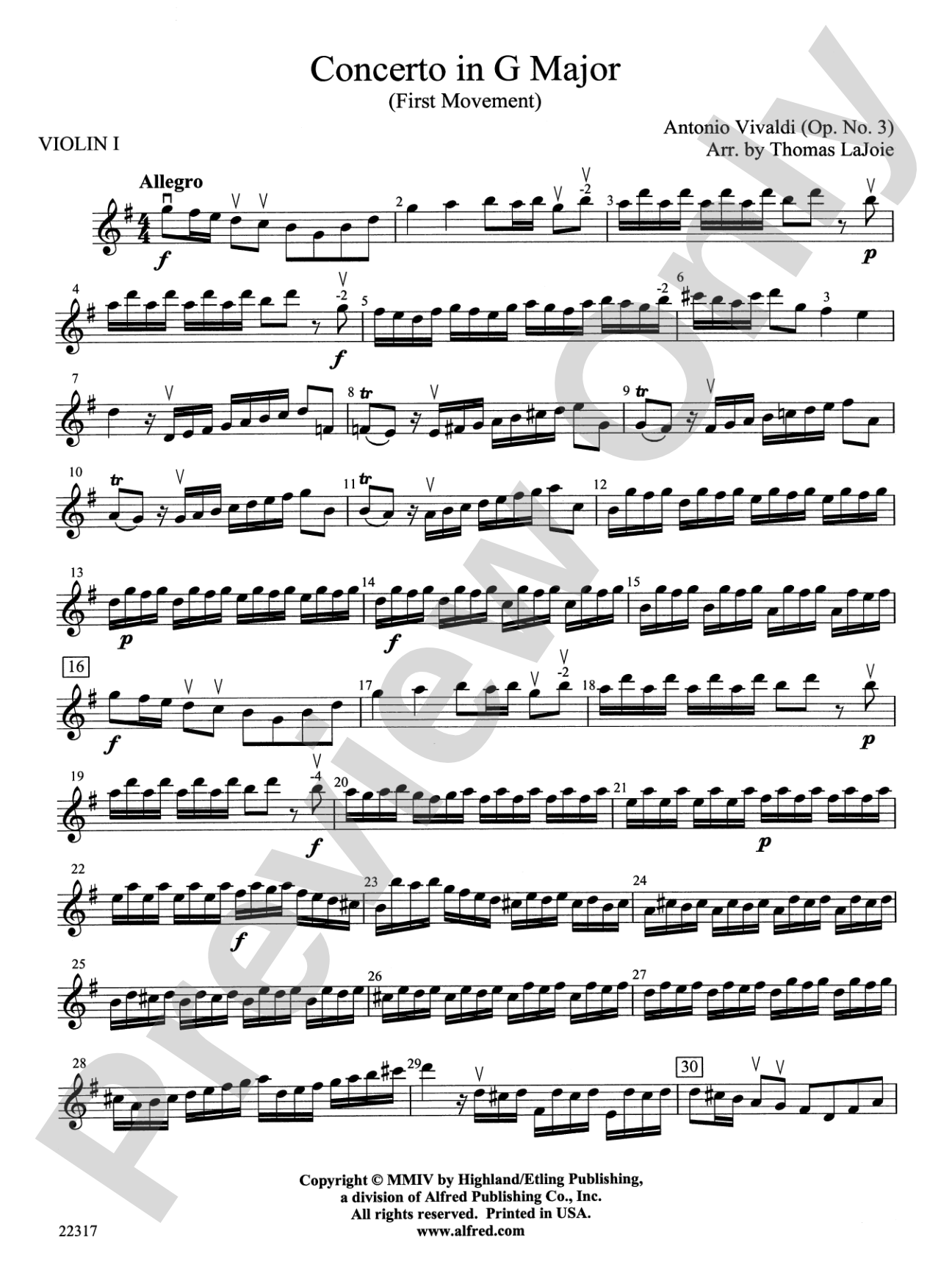
Concerto in G Major: 1st Violin

(First Movement)

By Antonio Vivaldi / arr. Thomas LaJoie

Grade: 3.5

Item: 00-PC-0000566_VN1

Digital Download
$5.99
Description
This work was arranged for the Myers Park Repertory Orchestra. The concerto is the third from the set of opus 3 concerti titled L'estro Harmonico ("The Harmonic Inspiration"). The work, originally for solo violin and orchestra, has been adapted for 1st violins and ripieno parts distributed amongst the 2nd violins, violas, and basso continuo.

Don't just read it, hear it, play along with it, and watch your students grow with it. In MakeMusic Cloud, Concerto in G Major: 1st Violin comes alive with professional accompaniment, adjustable tempo, and built-in practice tools that turn solo practice into real progress.

Sample Audio
0:00
0:00
Sample Video
Additional Details
Series: Highland/Etling String Orchestra
Publisher: Alfred Music
Page Count: 94
SKU: 00-PC-0000566_VN1

More about this title

About the Composer: Antonio Vivaldi

Antonio Vivaldi (1678-1741) was a Venetian priest and virtuoso violinist whose compositional output shaped the Baroque concerto into the form we recognize today. His mastery of instrumental color and rhythmic drive influenced countless composers across Europe, and his ability to write idiomatically for strings remains a benchmark for understanding string writing at every level.

L'estro Harmonico stands as one of Vivaldi's most performed and celebrated collections. These twelve concerti demonstrate his gift for balancing technical brilliance with compelling melodic writing, making them essential repertoire for string orchestras seeking to develop musicianship grounded in the Baroque era.

Why we love this

Thomas LaJoie's adaptation maintains the crystalline clarity of Vivaldi's original writing while distributing the solo material across first violins in a way that allows your ensemble to experience the concerto's architecture without requiring a virtuoso soloist. At Grade 3.5, this arrangement opens a door to genuine Baroque masterworks that your students will recognize and respect as authentic concert repertoire, not a simplified version.

What to expect

Sunlight and motion. The concerto propels forward with characteristic Vivaldi drive, featuring that Baroque balance of cheerful energy and elegant restraint. The interplay between the featured first violins and the supporting sections creates a sense of conversation and mutual respect rather than one voice commanding attention.

Who it's for

String orchestras at the intermediate level who are ready to engage with Baroque repertoire as serious musicians. This arrangement works equally well for festival submissions, spring concerts, or as a centerpiece for a Vivaldi-themed program.

How to get the most out of it

  • Shape the opening ritornello with clean articulation and rhythmic precision; the ensemble texture depends on unified tonguing and bow placement across all voices.
  • Bring out the interplay between first violins and the ripieno sections (2nd violins, violas, continuo) by adjusting dynamic levels slightly; the concerto grosso principle invites conversation between these groups.
  • Use the first and second violin dialogue passages as opportunities to develop independence within your ensemble; mark which players carry the primary line and ensure they voice it above the accompanying figuration.
  • Balance the basso continuo carefully with the upper voices; this foundation anchors the harmonic progression and allows faster passagework to speak clearly.

How to use it

Program this as a contrast to contemporary works on your concert, or build an entire Baroque section around it. In festival competitions, it demonstrates your ensemble's ability to execute period style with transparency and command.

Skills your students will build

  • Baroque articulation and phrasing conventions
  • Independence within the ensemble (distinguishing solo material from accompaniment roles)
  • Harmonic awareness in continuo-based texture
  • Dynamic control and sectional balance in concerto grosso form
  • Reading multiple coordinate lines (score study for section leaders)

You May Also Like