
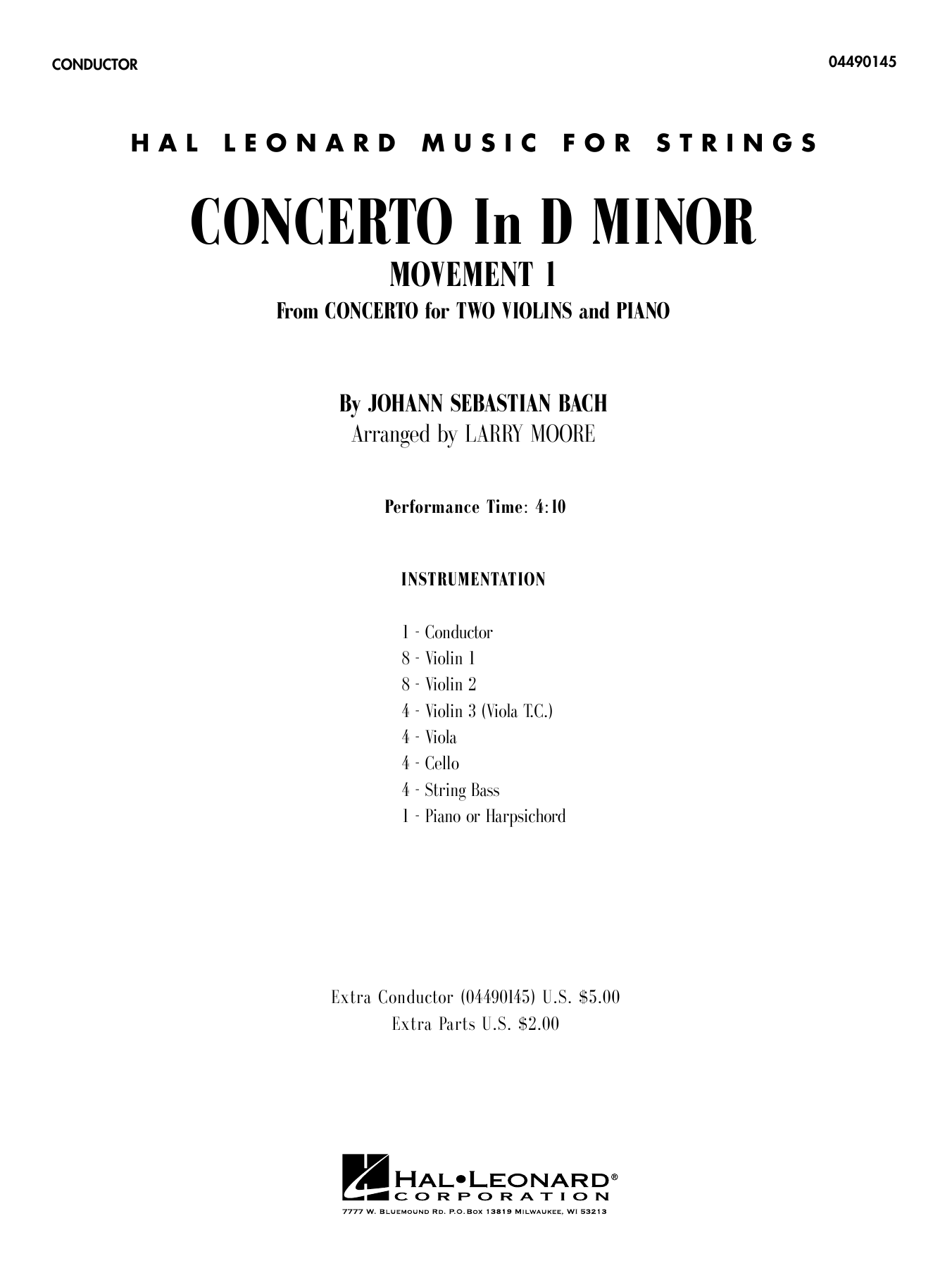

Concerto In D Minor (Movement 1) (arr. Larry Moore): String Orchestra Conductor Score & Parts
By Johann Sebastian Bach / Arranged by Larry Moore
Grade: 3-4
Item: 35-PK01412570
$50.00
Pickup currently not available
Buy Extra Parts (Digital PDF Download)
Parts Added to Cart!
Description
One of the all-time favorites in string pedogogy literature, here is the "Bach Double" superbly arranged for string ensemble, retaining the original violin parts and now supported by well-scored ensemble parts (with optional keyboard). Larry Moore's arrangement is a welcome edition for today's string ensembles.


Concerto In D Minor (Movement 1) (arr. Larry Moore): String Orchestra Conductor Score & Parts isn't in MakeMusic Cloud just yet...but it could be. Let us know you'd like to see it, and you'll help shape what comes next. In the meantime, start a free trial and dive into thousands of interactive titles your students can play along with today.
Request This Title
Tell us you want it.
Start Your Free Trial
Explore everything that's ready to play right now.
Sample Audio
No sample audio found.
Sample Video
No sample videos found.
Additional Details
Publisher:
Hal Leonard
SKU:
35-PK01412570
More about this title
About the Composer: Johann Sebastian Bach
Johann Sebastian Bach (1685-1750) was a German composer and musician whose vast catalog of works laid the foundation for Western classical music. His mastery of counterpoint, harmonic language, and structural form established compositional techniques that composers still study and emulate today. Bach held posts as a church musician, court composer, and cantor throughout his life, and he composed prolifically across nearly every genre available to him.
Why we love this
Moore's arrangement preserves the violin solos that make the Bach Double so rewarding for advanced students while making the piece accessible to ensembles without elite first violin players. The addition of thoughtfully scored ensemble parts fills out the texture without overshadowing the dialogue at the heart of this masterwork, and the optional keyboard part gives directors flexibility depending on their instrumentation.
What to expect
The piece unfolds with baroque elegance and intellectual clarity. Two violins dance around each other in perpetual conversation while the ensemble provides warm harmonic foundation, creating a sense of courtly refinement without heaviness.
Who it's for
String orchestras working at the intermediate to early advanced level who want to program a piece of genuine substance without wrestling with the technical demands of a full concerto. Directors seeking a showpiece that develops musicianship while remaining manageable for mixed ability levels will find this arrangement particularly useful.
How to get the most out of it
- Balance the two solo violin parts as equal partners rather than treating one as the primary voice. This dialogue is the work's fundamental idea, and both lines deserve clarity and presence.
- Shape each phrase with the baroque approach of beginning gently and building toward natural peak points, then releasing. Avoid the sustained, romantic phrasing that often creeps into later interpretations.
- Keep the ensemble parts rhythmically precise and lightly articulated so they support rather than compete with the soloists. Crisp attacks on eighth-note figures will help maintain the architecture.
- Take the time to lock the harmonic progression between soloists and ensemble in rehearsal. The contrapuntal lines move quickly, and ensemble players need to hear exactly where each chord lands.
How to use it
This arrangement sits naturally on a concert that aims to showcase baroque and classical foundations. It works equally well as a spring recital feature or as part of a thematic program exploring the evolution of the concerto grosso. The balance of intellectual interest and audience appeal makes it valuable for both student-centered and public performances.
Skills your students will build
- Identifying and balancing multiple independent melodic lines (counterpoint)
- Playing with baroque articulation and phrasing conventions
- Accompanying while listening actively to soloists
- Sustaining ensemble cohesion across harmonic progressions with baroque rhythmic movement
- Reading and performing with the precision required for rapid note sequences