
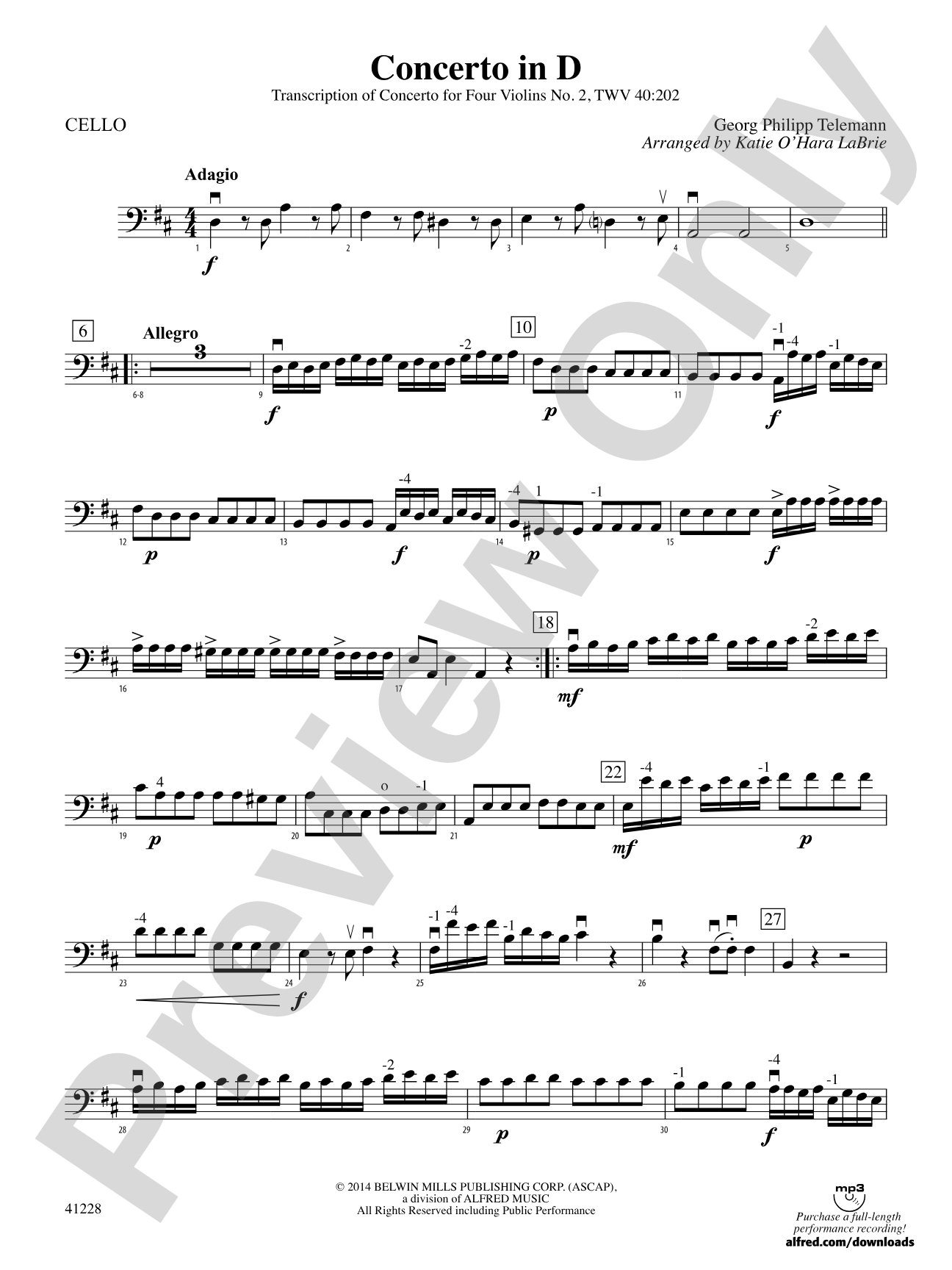

Concerto in D: Cello
Transcription of Concerto for Four Violins No. 2 TWV 40:202
By Georg Philipp Telemann / arr. Katie O'Hara LaBrie
Grade: 3.5
Item: 00-PC-0016352_VC1
$5.99
Pickup currently not available
Description
A favorite in the violin ensemble repertoire now available for string orchestra! In this Telemann masterpiece made up of four short movements, everyone gets a chance to play the melody! Perfect for that year when advanced lower string players are ready to shift into upper positions, it allows your orchestra to explore the creativity and beauty of Baroque music. (6:30) This title is available in MakeMusic Cloud.


Don't just read it, hear it, play along with it, and watch your students grow with it. In MakeMusic Cloud, Concerto in D: Cello comes alive with professional accompaniment, adjustable tempo, and built-in practice tools that turn solo practice into real progress.
Open in the Player
Jump straight in and assign it today.
Start Your Free Trial
Open this title and explore the full library in minutes.
Sample Audio
1
Audio File
--:--
0:00
0:00
Sample Video
No sample videos found.
Additional Details
Series:
Belwin Concert String Orchestra
Publisher:
Alfred Music
Page Count:
124
SKU:
00-PC-0016352_VC1
More about this title
About the Composer: Georg Philipp Telemann
Georg Philipp Telemann (1681-1767) was one of the most prolific composers of the Baroque era, producing over 3,600 works across all genres. A contemporary of Bach and Handel, Telemann held prestigious positions in Frankfurt, Paris, and Hamburg, where he directed the city's five main churches and composed regularly for the concert hall. His music balanced learned counterpoint with accessible melody, making it ideal for both professional musicians and ambitious amateurs.
Telemann's string writing is particularly elegant and singable. He understood how to distribute motivic material across an ensemble so that every player feels engaged, a quality that makes his concerti enduring favorites in education settings. His prolific output and clarity of voice have kept his music in steady circulation for three centuries.
Why we love this
This arrangement opens the Baroque concerto repertoire to orchestras still building confidence in ensemble balance and part independence. Katie O'Hara LaBrie has crafted the score to honor Telemann's original brilliance while giving lower string players genuine musical moments in upper positions, transforming what could be a technical exercise into a rewarding musical experience. The four-movement structure and frequent melody sharing mean rehearsal time yields visible results across your section.
What to expect
Elegant and transparent, with the kind of perfect proportions that make Baroque architecture feel satisfying. The four movements flow from brightness to introspection to liveliness, giving the orchestra a sense of journey without the complexity of larger Classical forms. Telemann's gift for memorable melody shines through every staff; players consistently feel they're making music rather than reading notation.
Who it's for
String orchestras at the Grade 3.5 level with strong second violin and viola sections ready to carry thematic material. This works well for groups seeking concert-quality Baroque repertoire that doesn't require soloists and showcases the full ensemble's musicianship.
How to get the most out of it
- Shape each phrase with clear articulation in the opening movement; Baroque style depends on elegant attack and release rather than romantic swelling
- Balance the first violin line carefully when it passes to second violins or violas to maintain forward momentum and prevent the melody from disappearing
- Support the solo violin passages with transparent accompaniment from lower strings, resisting the urge to add weight beyond what the score indicates
- Treat the shorter movements as character studies: the Andante rewards sustained, singing tone while the final movement thrives on rhythmic precision and lighter articulation
How to use it
This sits naturally in a concert featuring Baroque and Classical string works, or as a confident programming choice for festival competition. At six and a half minutes, it fills a concert slot without demanding a full hour of rehearsal per week, making it ideal for a school year where you're balancing multiple repertoire priorities.
Skills your students will build
- Playing in upper positions on lower strings with secure intonation
- Sustaining and shaping Baroque phrases without modern vibrato or dynamic swelling
- Passing thematic material between sections while maintaining melodic continuity
- Reading and performing multiple movement forms (fast-slow-minuet-fast structure)
- Balancing ensemble tone when melody distributes across different instruments