
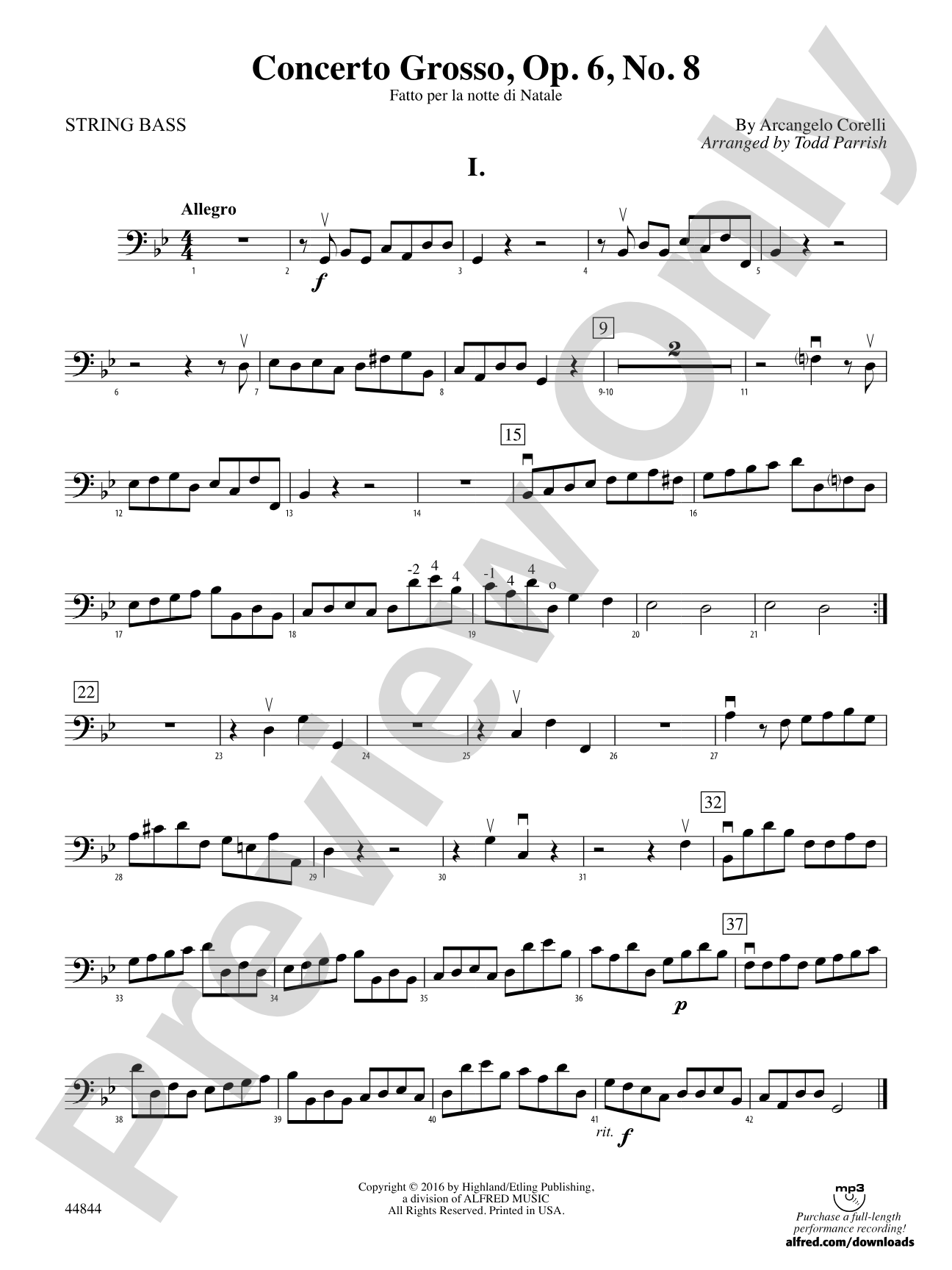

Concerto Grosso, Op. 6, No. 8: String Bass
Fatto per la notte di Natale
By Arcangelo Corelli / arr. Todd Parrish
Grade: 3
Item: 00-PC-0017361_SB
$5.99
Pickup currently not available
Description
Subtitled Fatto per la notte di Natale, or "made for the night of Christmas," Corelli's Christmas Concerto stands as one of the finest concerti grossi of the Baroque era. All solo parts have been incorporated into a string orchestra version that retains the original key signatures. Arranged by Todd Parrish, this collection contains three of the movements in a fast-slow-fast format. (6:15) This title is available in MakeMusic Cloud.


Don't just read it, hear it, play along with it, and watch your students grow with it. In MakeMusic Cloud, Concerto Grosso, Op. 6, No. 8: String Bass comes alive with professional accompaniment, adjustable tempo, and built-in practice tools that turn solo practice into real progress.
Open in the Player
Jump straight in and assign it today.
Start Your Free Trial
Open this title and explore the full library in minutes.
Sample Audio
1
Audio File
--:--
0:00
0:00
Sample Video
Additional Details
Series:
Highland/Etling String Orchestra
Publisher:
Alfred Music
Page Count:
124
SKU:
00-PC-0017361_SB
More about this title
About the Composer: Arcangelo Corelli
Arcangelo Corelli (1653-1713) shaped the sound of the Baroque string orchestra more than any composer of his generation. His twelve concerti grossi, published posthumously as Op. 6, became the foundational repertoire for ensemble string playing and established the concerto grosso as a major Baroque form. Working in Rome during the late 17th and early 18th centuries, Corelli developed a compositional language that balanced brilliant passage work with sustained melodic beauty, creating pieces that remain astonishingly effective in performance.
His Christmas Concerto (No. 8) stands apart even within the Op. 6 set as perhaps the most beloved and frequently performed work. The piece's gentle opening and its structural elegance have made it a staple of winter programming for nearly three centuries. Corelli's influence on string technique, intonation standards, and ensemble balance continues to shape how string orchestras are taught and rehearsed today.
Why we love this
This arrangement preserves the essential character of Corelli's original concerti grosso idiom while making the piece genuinely playable for Grade 3 orchestras. The three-movement fast-slow-fast format gives you a concert work that unfolds with real architectural weight, and the fact that Todd Parrish has woven the solo parts into the string orchestra texture means your entire ensemble stays engaged throughout. Few pieces at this level carry such authentic Baroque prestige and such immediate audience appeal, especially during the winter concert season.
What to expect
The opening Vivace sparkles with courtly grace and crystalline joy, establishing an atmosphere of celebration without sentimentality. The slow movement deepens into lyrical meditation, offering moments of genuine harmonic richness before the final Allegro returns with infectious, dancing energy that feels both festive and formally satisfying.
Who it's for
String orchestras at the Grade 3 level, including middle school ensembles with solid fundamentals and high school groups looking for genuine Baroque literature. This arrangement also works for community orchestras and recital groups seeking a repertoire piece that combines accessibility with musical substance.
How to get the most out of it
- Shape the opening Vivace with clear articulation on each note; resist the temptation to over-sustain. Baroque bowing favors separation and precision over legato.
- Balance the lower strings in the slow movement so the harmonic foundation supports the melodic line without muddying it. Corelli's harmony is transparent by design.
- Keep the final Allegro energetic but unhurried. The piece's impact depends on clarity of rhythmic figures rather than speed.
- Let the violins lead the phrasing in the opening movement; second violins and violas should lock into the primary melodic idea to maintain textural cohesion.
How to use it
Program this as the centerpiece of a winter or holiday concert, pairing it with lighter contemporary works or a cappella choral selections. Its six-minute duration and three-movement structure give you a substantial anchor piece that demonstrates your orchestra's musicality and ensemble discipline while remaining approachable for audiences of all ages.
Skills your students will build
- Baroque phrasing and articulation conventions
- Reading figured bass harmonies and understanding harmonic progression
- Balancing tutti and soli sections within an ensemble texture
- Sustained intonation in slow movements
- Period-appropriate bow control and rhythmic precision
- Concert repertoire performance at Grade 3 level