
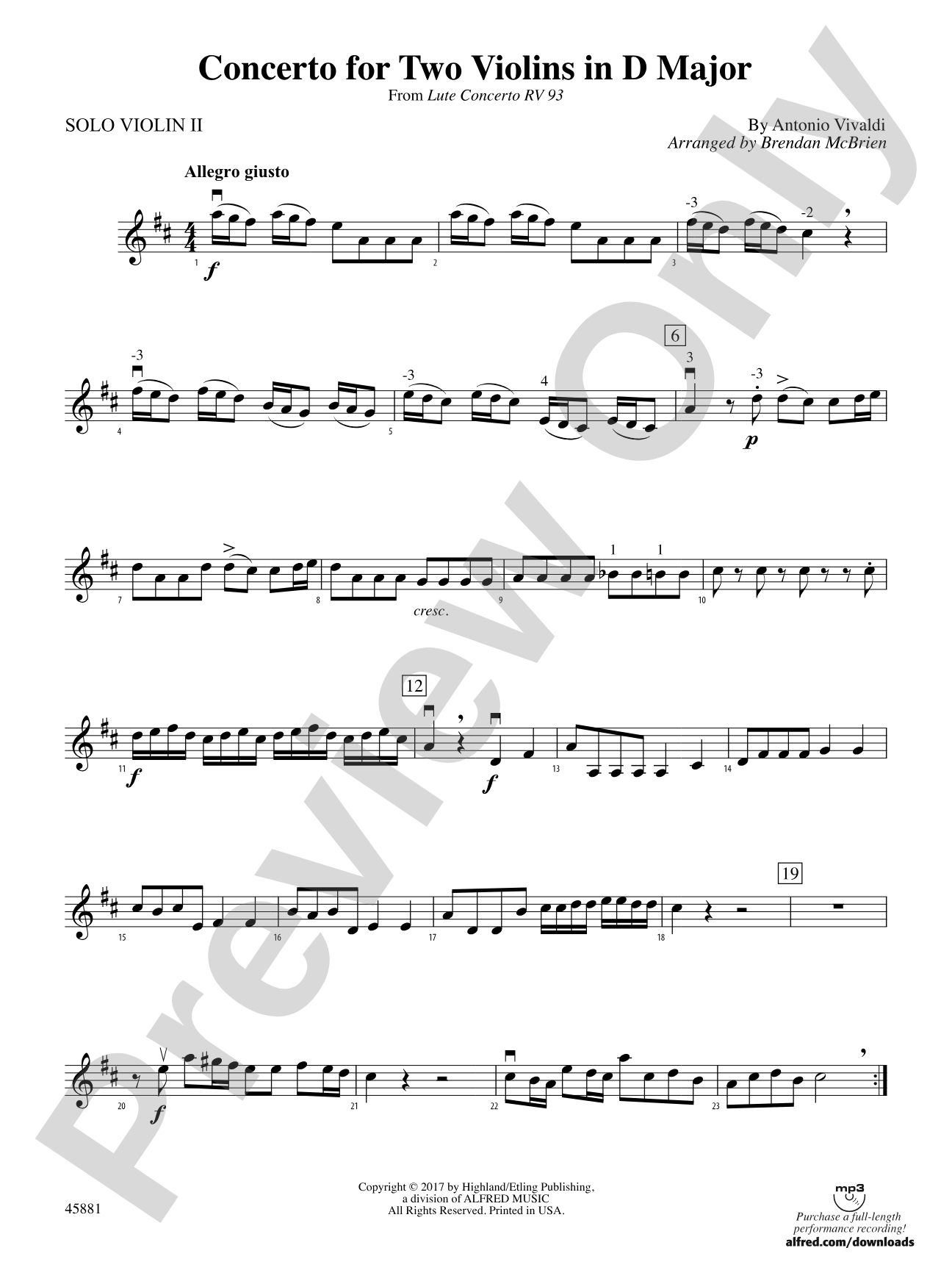

Concerto for Two Violins in D Major: Solo 2nd Violin
From Lute Concerto RV 93
By Antonio Vivaldi / arr. Brendan McBrien
Grade: 3
Item: 00-PC-0017679_SVN2
$5.99
Pickup currently not available
Description
Adapted from Vivaldi's Lute Concerto in D Major, this arrangement for two solo violins and orchestra creates an opportunity to feature your top violinists in the opening movement of this classic work. Your musicians and audience will be charmed by this Italian masterpiece which includes passages for solo cello and optional keyboard accompaniment to lend it that authentic flavor. (3:40)


Don't just read it, hear it, play along with it, and watch your students grow with it. In MakeMusic Cloud, Concerto for Two Violins in D Major: Solo 2nd Violin comes alive with professional accompaniment, adjustable tempo, and built-in practice tools that turn solo practice into real progress.
Open in the Player
Jump straight in and assign it today.
Start Your Free Trial
Open this title and explore the full library in minutes.
Sample Audio
1
Audio File
--:--
0:00
0:00
Sample Video
Additional Details
Series:
Highland/Etling String Orchestra
Publisher:
Alfred Music
Page Count:
84
SKU:
00-PC-0017679_SVN2
More about this title
About the Composer: Antonio Vivaldi
Antonio Vivaldi (1678-1741) composed over 500 works across nearly every Baroque genre, yet remained largely forgotten after his death until the 20th-century revival of his music. His prolific output and innovative instrumental writing made him a cornerstone of Venetian musical life, and his influence on the concerto form shaped how composers approached solo writing for decades. Today, his works remain essential to string programs at every level, offering both technical challenges and immediate musical rewards.
Why we love this
McBrien's adaptation transforms a lute work into a showcase for your strongest violinists without overwhelming the rest of the section, striking an ideal balance for Grade 3 orchestras. The inclusion of optional keyboard and solo cello passages adds textural interest and keeps the ensemble engaged throughout, while the three-and-a-half-minute length fits naturally into any concert without demanding extended rehearsal time on a single piece.
What to expect
Elegant and luminous, with the brightness characteristic of D Major and the characteristic Baroque drive that propels the opening movement forward. The interaction between the two solo violins creates an intimate dialogue that contrasts beautifully with the fuller orchestral tuttis, giving the whole piece a conversational quality that audiences find engaging and approachable.
Who it's for
String orchestras at the Grade 3 level looking for a Baroque masterwork that allows featured players to shine without requiring soloists of advanced technical ability. This arrangement works equally well for festival programming, solo-with-ensemble festival entries, or as the centerpiece of a concert exploring Italian Baroque music.
How to get the most out of it
- Balance the two solo violins carefully in the opening; they should blend as a team rather than compete. Ask them to listen intently to each other and match tone quality, even if one player is technically stronger.
- Bring out the solo cello passages with clear articulation and a warm tone; these moments provide textural relief and deserve attention from the audience despite their supporting role.
- Keep the string section light and transparent underneath the soloists. A heavy orchestral foundation will bury the delicate dialogue Vivaldi intended.
- If using the optional keyboard part, ensure it sits behind the strings rather than pushing forward; it should enhance authenticity without overwhelming the string writing.
How to use it
This works beautifully as an opening number for a concert, establishing an Italian theme that might continue with other Baroque works or transition into later Classical writing. It also serves as an excellent choice for festival competition, pairing naturally with other arrangements from the Highland/Etling series for a cohesive orchestral experience.
Skills your students will build
- Balancing solo and ensemble textures within a single movement
- Baroque articulation and phrasing conventions
- Accompanying and supporting featured players
- Ensemble listening and rhythmic precision across sections
- Interpretation of ornamentation in period style