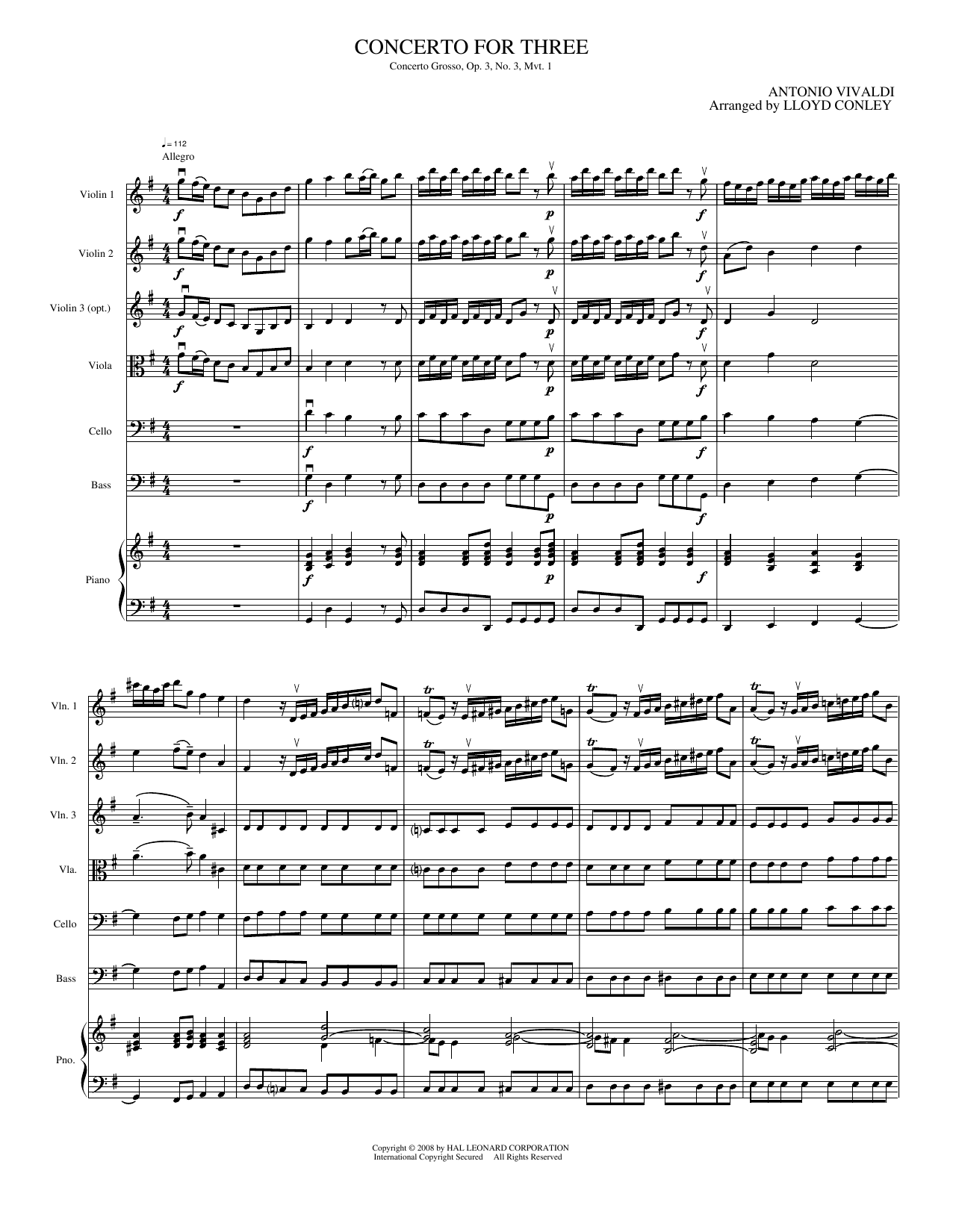
Concerto for Three Sheet Music Preview

Concerto for Three: String Orchestra Conductor Score & Parts

By Antonio Vivaldi / Arranged by Lloyd Conley

Grade: 3-4

Item: 35-PK00426809

Digital Download
$45.00

Buy Extra Parts (Digital PDF Download)

Product Price Quantity
Concerto for Three - Full Score $45.00

Parts Added to Cart!

Description
Concerto for Three

Concerto for Three: String Orchestra Conductor Score & Parts isn't in MakeMusic Cloud just yet...but it could be. Let us know you'd like to see it, and you'll help shape what comes next. In the meantime, start a free trial and dive into thousands of interactive titles your students can play along with today.

Sample Audio
No sample audio found.
Sample Video
Additional Details
Publisher: Hal Leonard
SKU: 35-PK00426809

More about this title

About the Composer: Antonio Vivaldi

Antonio Vivaldi (1678–1741) shaped instrumental music as we know it. His prolific output of concertos established the form's architecture: the fast-slow-fast framework that composers across Europe adopted. He wrote for the instruments available to him at the Ospedale della Pietà in Venice, where he taught young musicians, and his ear for idiomatic writing makes his scores sound as natural on student instruments today as they did three centuries ago.

Vivaldi's gift was translating virtuosity into teachable material. He understood how to write lines that sit well for developing players, how to build momentum through rhythmic patterns rather than technical fireworks, and how to layer simple ideas into rich textures. This is why his concertos remain central to string education: they show students how architecture and craft matter more than complexity.

Why we love this

Vivaldi's three-movement concerto structure gives you a blueprint for teaching musical form that your students can hear and play in one rehearsal. This arrangement pitches the work squarely into the intermediate repertoire zone where most student orchestras need reliable, musically substantive material that doesn't demand weeks of preparation.

What to expect

Bright, purposeful, and architecturally clear. The outer movements sparkle with forward motion and clean rhythmic profiles, while the slow movement opens into genuine lyricism where every voice contributes to the harmonic story. This is Baroque energy without the fussiness.

Who it's for

Intermediate string orchestras ready to move beyond unison repertoire into transparent part writing. Directors seeking a piece that teaches structural listening while remaining accessible to players still developing consistent intonation and rhythmic independence.

How to get the most out of it

  • Bring out the violins' dialogue in the first movement by asking them to shape phrases as conversations rather than simultaneous statements; this clarifies the concerto's architecture for listeners.
  • Keep the slow movement's tempo steady and unhurried; students often rush when navigating fewer notes, so mark a tempo that gives every voice room to breathe.
  • Lock the rhythmic foundation in the finale by rehearsing the lower strings independently first, then layering violins on top once the pulse is solid.
  • Balance the violas and cellos equally in the harmonic texture; they carry as much musical weight as the violins and should never recede into accompaniment.

How to use it

Pair this as a centerpiece for a Baroque themed concert, or slot it into a classical structures unit where you're teaching students to recognize and analyze fast-slow-fast form. It works equally well as a season-opening piece that reminds orchestras why they play together.

Skills your students will build

  • Recognizing and internalizing three-movement concerto form
  • Playing transparent inner voice lines with harmonic awareness
  • Maintaining steady tempo across tempo changes
  • Balancing multiple independent melodic lines
  • Reading compound rhythmic patterns in moderate tempo

You May Also Like