
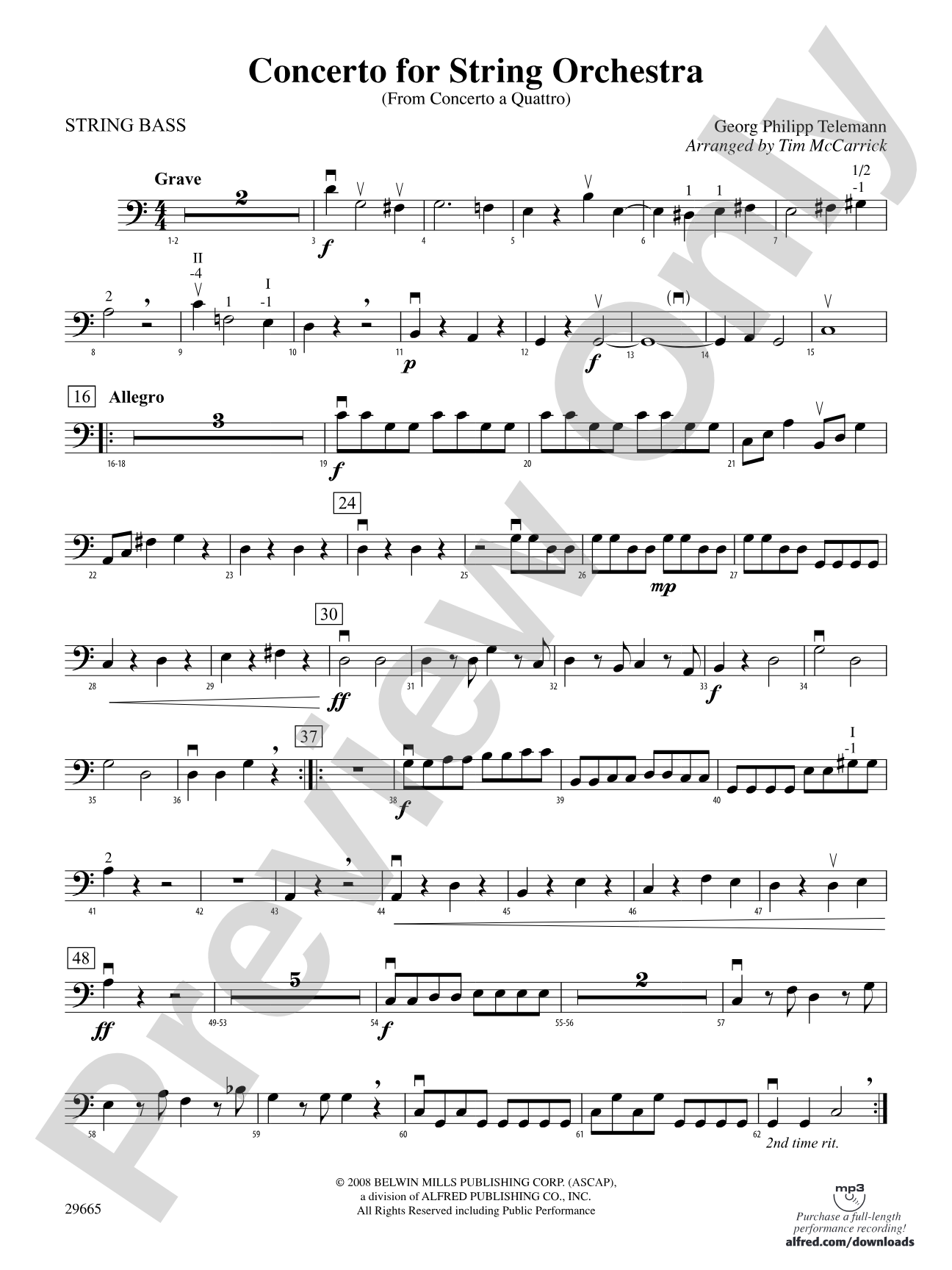

Concerto for String Orchestra (from Concerto a Quattro): String Bass
By Georg Philipp Telemann / arr. Tim McCarrick
Grade: 2.5
Item: 00-PC-0001540_SB
$5.99
Pickup currently not available
Description
This fascinating work is a clear example of why Telemann is considered a master of Baroque string music and will provide great skill development! First, the opening Grave calls for a sustained dark and brooding tone, then, the bright and vibrant Allegro will bring out their precision playing of the fast notes, with some third position for your first violins! It's enough activity to almost leave you breathless! From the vigorous bowing, dramatic dynamics, and his occasional use of a daring harmony, Telemann shows his unique style as separate from Bach and Handel. It is music strings love to play and audiences love to hear! (4:30) This title is available in MakeMusic Cloud.


Don't just read it, hear it, play along with it, and watch your students grow with it. In MakeMusic Cloud, Concerto for String Orchestra (from Concerto a Quattro): String Bass comes alive with professional accompaniment, adjustable tempo, and built-in practice tools that turn solo practice into real progress.
Open in the Player
Jump straight in and assign it today.
Start Your Free Trial
Open this title and explore the full library in minutes.
Sample Audio
1
Audio File
--:--
0:00
0:00
Sample Video
Additional Details
Series:
Belwin Intermediate String Orchestra
Publisher:
Alfred Music
Page Count:
67
SKU:
00-PC-0001540_SB
More about this title
About the Composer: Georg Philipp Telemann
Georg Philipp Telemann (1681-1767) was one of the most prolific composers of the Baroque era, with a catalog that rivals Bach's in sheer volume. While often overshadowed by his contemporaries, Telemann's gift for melody and orchestration made him the most performed composer of his own lifetime, and his string writing remains some of the most idiomatic and rewarding in the Baroque repertoire.
Telemann's approach to composition prioritized clarity and accessibility without sacrificing sophistication. His instrumental works, particularly those for strings, demonstrate a keen understanding of what players could achieve and what audiences wanted to hear. This practical musicianship made him an ideal composer for both court musicians and amateur ensembles, a quality that endures in modern performances.
Why we love this
Telemann gives you the Baroque string sound your ensemble needs without the performance complexity of Bach or Handel. The arc from brooding Grave to propulsive Allegro creates natural drama that audiences recognize immediately, and the orchestration stays transparent enough that players at this level can hear their individual parts matter.
What to expect
The piece opens with an almost ominous gravity, strings suspended in a minor-key melancholy that feels genuinely dramatic for a Baroque work. When the Allegro arrives, the mood transforms entirely into restless energy, with rapid scales and driving rhythms that feel almost contemporary in their vigor.
Who it's for
String orchestras at the intermediate level (Grade 2.5) who are ready to tackle Baroque style with conviction. This arrangement works well for ensembles that have solid intonation and ensemble discipline but are still building independence in third position work among the violins.
How to get the most out of it
- Shape the opening Grave by sustaining a consistently dark, resonant tone across the full string section; reserve vibrato strategically at phrase endings rather than throughout to preserve that austere character.
- In the Allegro, emphasize the precision of the fast passagework without rushing; the excitement comes from rhythmic clarity and coordinated bowing, not tempo acceleration.
- Lock the first violin and cello lines during the rapid figures in the Allegro; these voices anchor the texture and keep the ensemble unified through the busier passages.
- Use dynamic contrast to spotlight Telemann's harmonic boldness; let unexpected sonorities breathe by pulling back slightly before them, then restoring full volume for the resolution.
How to use it
Program this as a concert opener to establish sophistication and command attention immediately, or pair it with a Baroque suite for a full-period concert block. It also works as a festival or contest selection because the clear structure and distinctive character make strong impressions on adjudicators.
Skills your students will build
- Baroque articulation and style appropriate to string idiom
- Sustaining a unified dark tone in minor-key music
- Third position work for first violins in rapid passagework
- Coordinating rapid figuration between first and second violins
- Dynamic control and harmonic awareness in Baroque harmony