
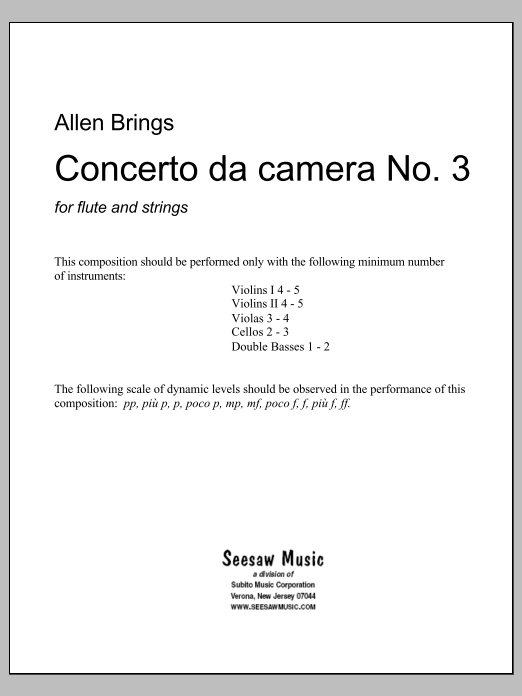

Concerto da Camera No. 3: String Orchestra Conductor Score & Parts
Arranged by Allen Brings
Item: 35-PK00268742
$16.10
Pickup currently not available
Buy Extra Parts (Digital PDF Download)
| Product | Price | Quantity |
|---|---|---|
| Concerto da Camera No. 3 - Full Score | $4.65 | |
| Concerto da Camera No. 3 - Full Score | $2.70 | |
| Concerto da Camera No. 3 - Flute | $1.20 | |
| Concerto da Camera No. 3 - Violin | $1.20 | |
| Concerto da Camera No. 3 - Violin | $1.20 | |
| Concerto da Camera No. 3 - Viola | $1.35 | |
| Concerto da Camera No. 3 - Violoncello | $0.90 | |
| Concerto da Camera No. 3 - Contrabass | $0.90 |
Parts Added to Cart!
Description
for Solo Flute and Strings Duration: 09:00


Concerto da Camera No. 3: String Orchestra Conductor Score & Parts isn't in MakeMusic Cloud just yet...but it could be. Let us know you'd like to see it, and you'll help shape what comes next. In the meantime, start a free trial and dive into thousands of interactive titles your students can play along with today.
Request This Title
Tell us you want it.
Start Your Free Trial
Explore everything that's ready to play right now.
Sample Audio
No sample audio found.
Sample Video
No sample videos found.
Additional Details
Publisher:
Hal Leonard
SKU:
35-PK00268742
More about this title
About the Arranger: Allen Brings
Allen Brings is a composer and arranger with deep roots in American classical music, known for creating accessible yet musically substantial works for student and amateur ensembles. His arrangements prioritize clarity and pedagogical value, making standard repertoire engaging for developing musicians without sacrificing artistic integrity.
Brings has devoted particular attention to the string orchestra genre, understanding how to write for young players while maintaining the expressive range and technical demands that keep both performers and audiences invested in the music.
Why we love this
This concerto gives your string section a genuinely rewarding solo vehicle that doesn't demand a virtuoso flutist to succeed. The orchestral writing is transparent enough that ensemble intonation issues won't derail the performance, yet the part writing remains musical and engaging; Brings avoids the thin, accompaniment-only textures that plague many student-level concertos.
What to expect
Elegant and conversational, with the flute moving through a landscape shaped by the strings' harmonic and textural support. The nine-minute duration allows for real musical development without stretching young players' focus or stamina, balancing lyrical moments against passages of nimble interplay between soloist and ensemble.
Who it's for
String orchestras with a capable flutist and players who have moved beyond first-year experience. This work sits comfortably for groups at the intermediate high school or confident middle school level, and it gives adult amateurs a structured chamber concerto that maintains genuine musical substance.
How to get the most out of it
- Establish the flute soloist as the focal point through sensitive dynamic shaping in the string parts rather than through volume alone. Your accompaniment should breathe with the soloist's phrasing.
- Balance the exposed divisi passages in the violins by rehearsing each line independently first. Intonation will settle faster when players understand their individual melodic shape.
- Record a sketch of the flute part early in rehearsal so string players can hear the complete musical architecture. Nine minutes of music reveals its structure more clearly when the solo line is audible throughout.
How to use it
Feature this as a secondary soloistic work on a concert that also includes a larger ensemble piece. The Concerto da Camera format makes it ideal for a chamber orchestra concert or a program exploring baroque and classical forms with contemporary ensembles.
Skills your students will build
- Supporting a soloist through dynamic and textural restraint
- Maintaining ensemble cohesion across sustained divisi passages
- Responding to solo phrasing and rubato in real time
- Reading orchestral textures that distribute melodic material across multiple sections