
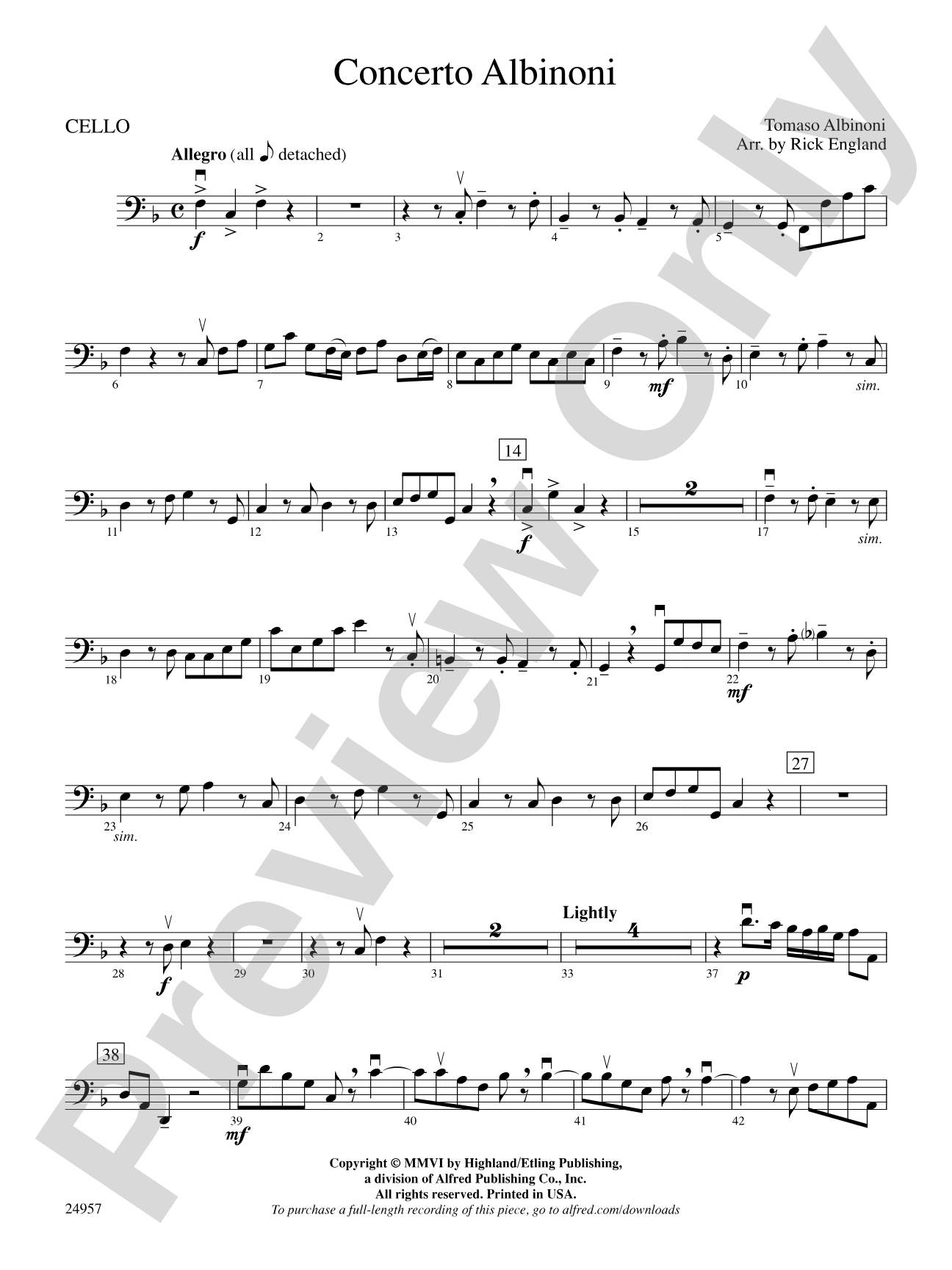

Concerto Albinoni: Cello
By Tomaso Albinoni / arr. Rick England
Grade: 3
Item: 00-PC-0000949_VC1
$5.99
Pickup currently not available
Description
Tomaso Albinoni (1671-1751) reigned as one of the most famous composers of Venice, some say even more famous during his lifetime than his contemporary, Antonio Vivaldi. Among his notable compositions are 59 concerti. Orchestras that enjoy music of the Italian Baroque will surely want to perform this arrangement by Rick England. Technical demands are reasonable with opportunities for challenging florid sixteenth note passages in most instruments. Alternate parts for viola and cello are included for performers not ready to venture out of first position.


Don't just read it, hear it, play along with it, and watch your students grow with it. In MakeMusic Cloud, Concerto Albinoni: Cello comes alive with professional accompaniment, adjustable tempo, and built-in practice tools that turn solo practice into real progress.
Open in the Player
Jump straight in and assign it today.
Start Your Free Trial
Open this title and explore the full library in minutes.
Sample Audio
1
Audio File
--:--
0:00
0:00
Sample Video
No sample videos found.
Additional Details
Series:
Highland/Etling String Orchestra
Publisher:
Alfred Music
Page Count:
122
SKU:
00-PC-0000949_VC1
More about this title
About the Composer: Tomaso Albinoni
Tomaso Albinoni (1671-1751) was a Venetian composer and virtuoso oboist who dominated the musical life of his city throughout the Baroque era. A prolific creator of instrumental music, he wrote 59 concerti alongside numerous sonatas and operatic works that established him as a major voice in Italian Baroque composition. His reputation rivaled that of his contemporary Vivaldi, and his music was widely published and performed across Europe during his lifetime.
Albinoni's concertos showcase the hallmarks of Venetian style: lyrical melodic writing, clear harmonic structures, and opportunities for both ensemble cohesion and individual brilliance. His influence extended well beyond his death, with composers like Bach and Quantz drawing on his musical language. Today, his works remain central to string orchestra repertoire, offering students access to the elegance and craftsmanship of early 18th-century Italian composition.
Why we love this
Rick England's arrangement captures the lyric beauty of Albinoni's concerto writing while keeping technical demands practical for Grade 3 orchestras. The inclusion of alternate viola and cello parts makes this genuinely accessible to developing ensembles without compromising the Baroque idiom or the florid character passages that engage more advanced players.
What to expect
The Concerto unfolds with the grace and clarity characteristic of Venetian instrumental music. Lyrical melodic lines move gracefully above steady harmonic foundations, with moments of gentle flourish that reward ensemble precision and individual musicianship. The overall effect is one of elegant restraint punctuated by passages that sparkle with sixteenth note figuration.
Who it's for
This score and parts set serves orchestras working at Grade 3 level who want to program Baroque repertoire without the demands of contemporary string writing. Directors will appreciate that the arrangement preserves Albinoni's musical voice while the alternate parts ensure that less advanced cellists and violists can participate meaningfully alongside more experienced string players.
How to get the most out of it
- Shape the sixteenth note figures with clarity rather than speed. These passages should flow naturally within the harmonic structure, not rush ahead. Rehearse them at a moderate tempo first, establishing the articulation pattern before adding pulse.
- Balance the melodic line across the ensemble so that the concerto's lyrical phrases sing consistently. In string writing of this era, the top line carries the argument, and sustaining tone quality matters as much as intonation.
- Use the alternate parts strategically during rehearsal, not just for performance. Rotating younger cellists and violists through the simplified positions builds confidence while keeping the full ensemble sound intact.
- Observe the Baroque convention of slight rubato in cadential gestures. Allow the ensemble to ease into final phrases rather than maintaining metronomic precision through the conclusion.
How to use it
Program this concerto alongside other Italian Baroque works or as an accessible entry point into the concerto grosso tradition for developing orchestras. The lyrical character also makes it effective as a standalone concert opener or as a bridge between contemporary and historical repertoire in a mixed program.
Skills your students will build
- Reading and performing florid sixteenth note passages in Baroque style
- Maintaining lyrical phrasing in sustained melodic lines
- Coordinating ensemble articulation within baroque idiom
- Playing extended positions on cello and viola (with option to use first-position alternatives)
- Understanding concerto structure and harmonic language of the Italian Baroque