
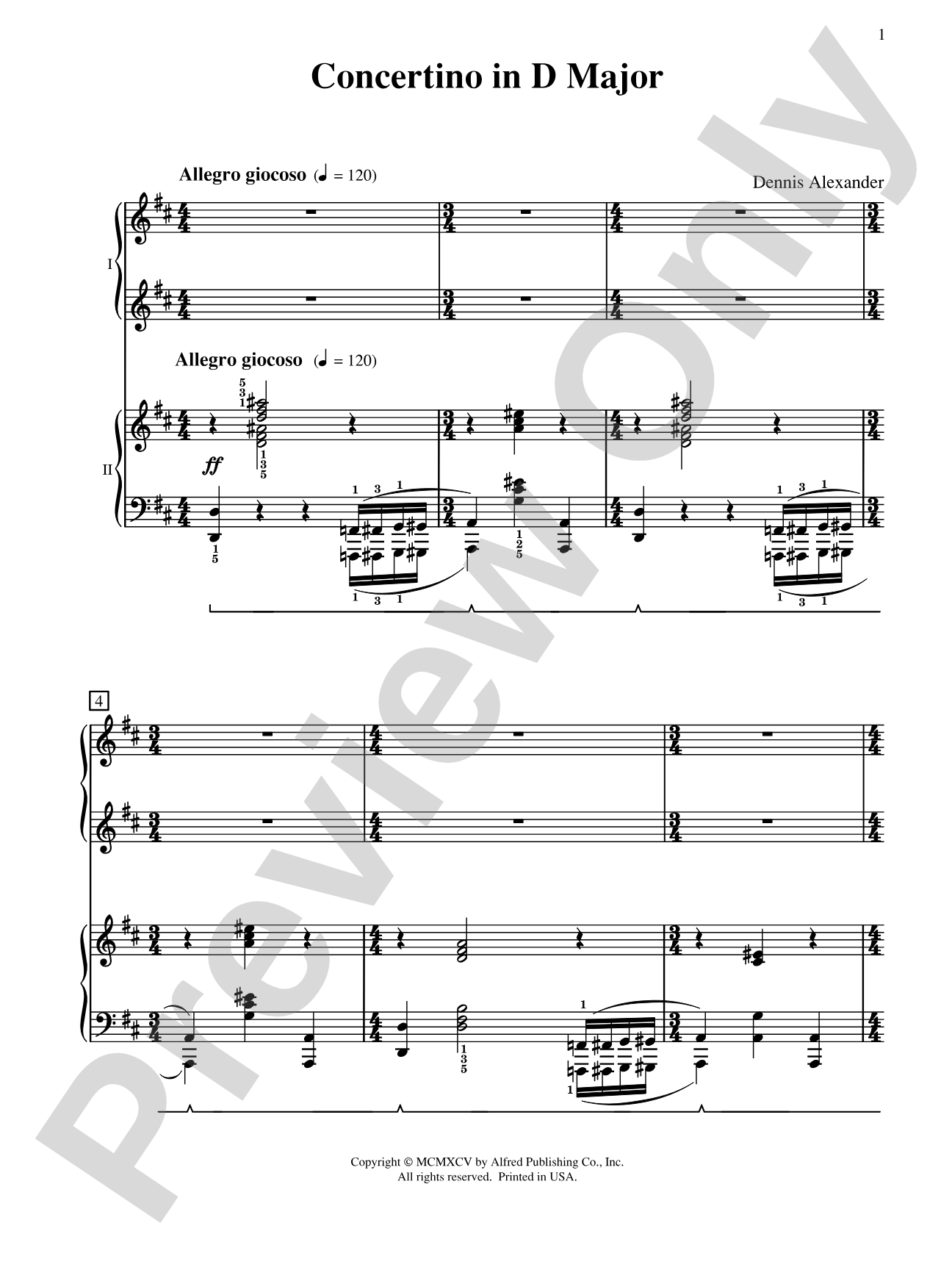

Concertino in D Major - Piano Duo (2 Pianos, 4 Hands): Piano Duets & Four Hands
By Dennis Alexander
Level: Late Intermediate
Item: 00-PS-0016202

$5.99
Pickup currently not available
Related Items
Concertino in D Major: Piano Duo (2 Pianos, 4 Hands) Sheet (2 copies included) |
$5.95
|
View |
Description
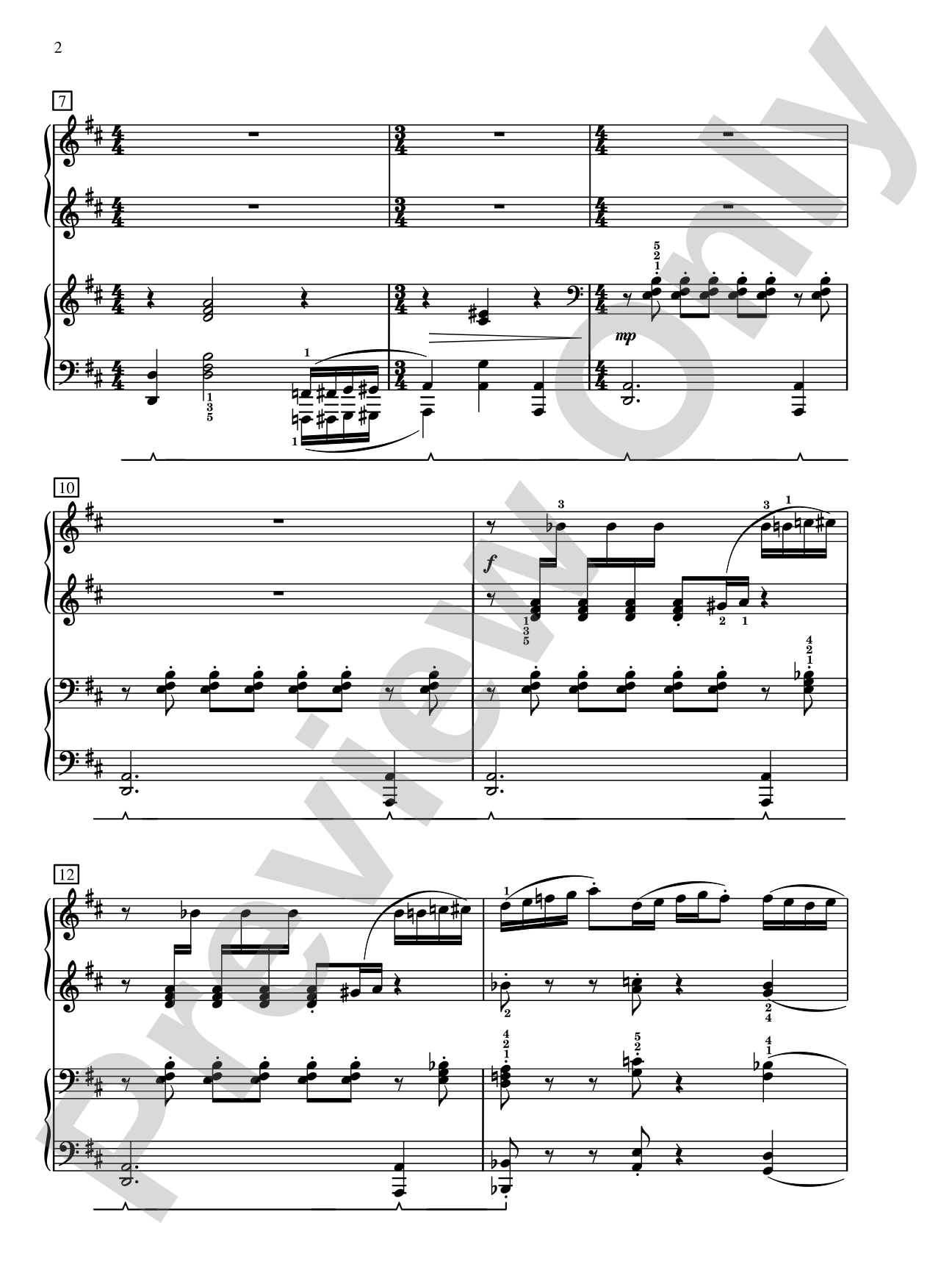
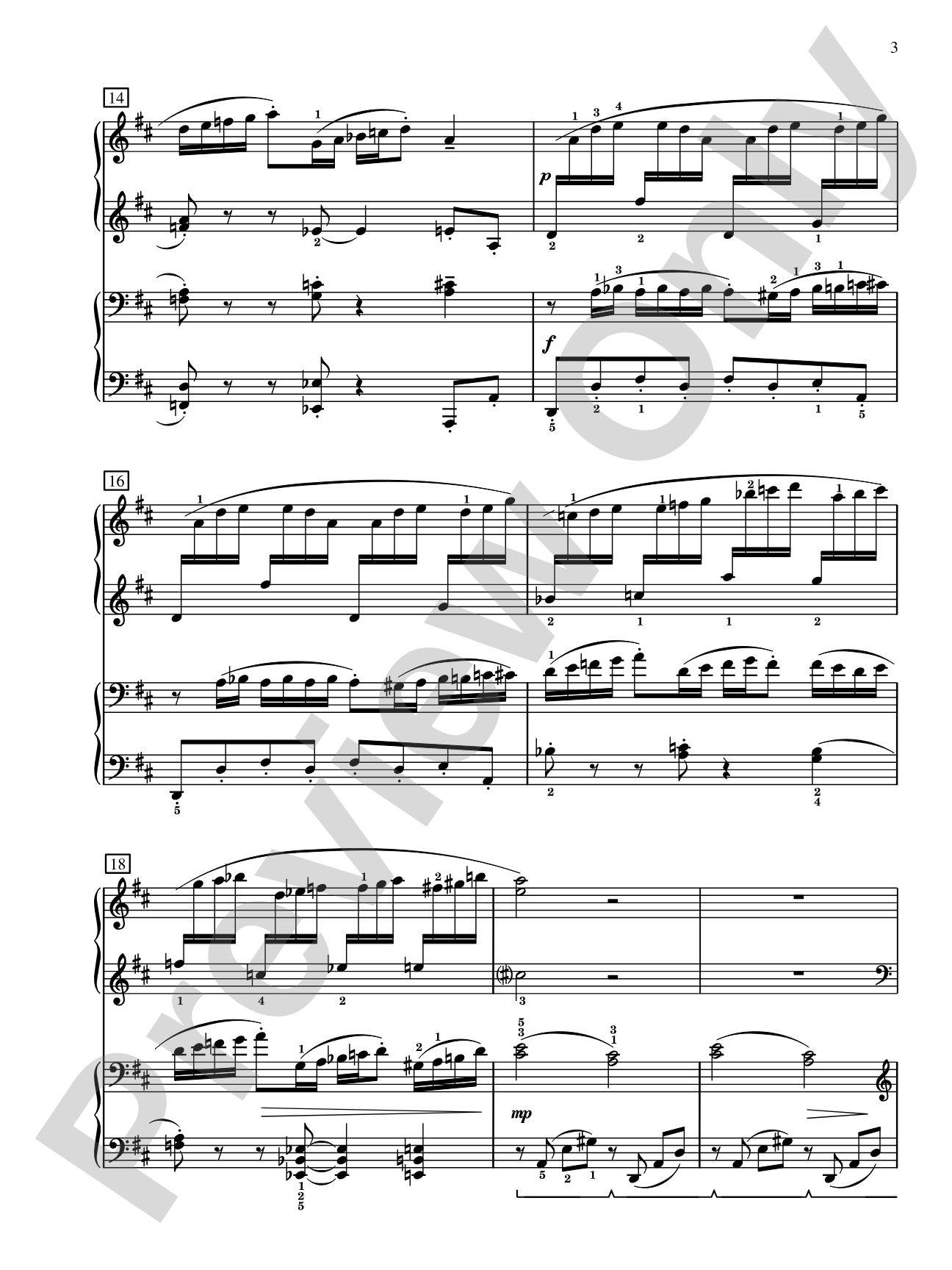
This exciting piece in one movement for two pianos showcases the interesting rhythms and tonalities for which Dennis Alexander is so well known. A General MIDI disk, available separately, includes a full piano recording and background accompaniment. The two parts are equal in difficulty, and both are included. A Federation Festivals 2016-2020 selection. A Federation Festivals 2020-2024 selection. A Federation Festivals 2024-2028 selection.


Don't just read it, hear it, play along with it, and watch your students grow with it. In MakeMusic Cloud, Concertino in D Major - Piano Duo (2 Pianos, 4 Hands): Piano Duets & Four Hands comes alive with professional accompaniment, adjustable tempo, and built-in practice tools that turn solo practice into real progress.
Open in the Player
Jump straight in and assign it today.
Start Your Free Trial
Open this title and explore the full library in minutes.
Sample Audio
No sample audio found.
Sample Video
No sample videos found.
Additional Details
Series:
The Alfred Ensemble Series
Publisher:
Alfred Music
Page Count:
32
SKU:
00-PS-0016202
More about this title
About the Composer: Dennis Alexander

Dennis Alexander has shaped educational piano repertoire for nearly four decades through his work with Alfred Music Publishing, beginning in 1986. His catalog of over 400 published works and recordings has established him internationally as a leading composer of pedagogically sound piano music across all student levels. Alexander earned his degree from the University of Kansas and spent 24 years teaching piano pedagogy at the University of Montana, where he also served as department chair. After relocating to California, he taught at Cal State Fullerton and Cal State Northridge before settling in Albuquerque, where he remains actively engaged in composing and conducting clinics.
Beyond the studio and page, Alexander has maintained a performing career that includes a 1987 New York debut at Carnegie Recital Hall and collaborative work with internationally recognized soloists and chamber ensembles. He has served as a clinician at state and national music teachers conventions and was invited to conduct an intermediate-level master class at the 2009 MTNA national convention. His international reach extends to performance tours and judging assignments in Asia, and numerous state organizations have commissioned original compositions from him over the years.
Why we love this
This piece demonstrates why Alexander's duets have become festival staples across three consecutive selection cycles. The equal difficulty between parts means both pianists remain fully engaged throughout, and the rhythmic vitality and tonal color Alexander brings to a single-movement form makes this feel substantial without requiring a multi-movement structure.
What to expect
A energetic, forthright piece that showcases contemporary harmonic language within a tonal center. The rhythmic interplay keeps both performers alert and engaged, creating a dialogue that feels more like a musical conversation than a solo with accompaniment.
Who it's for
This duet suits late intermediate pianists preparing for festivals, recitals, or ensemble performance experiences. Two equally matched students benefit most, though one player might be slightly more advanced if the less experienced pianist focuses on the second part.
How to get the most out of it
- Balance the parts by listening to what your partner is doing melodically; in duet writing, the lead voice should project clearly, but neither player should dominate the texture throughout.
- Work through the piece slowly at first to coordinate rhythmic entrances and releases, especially where the two pianos interlock rather than move in parallel motion.
- Use the optional General MIDI accompaniment recording to hear how the piece sits with full orchestration, which can clarify the harmonic role each piano part plays.
- Attend to Alexander's dynamic markings closely; they shape the narrative arc and prevent the piece from feeling static despite its single-movement design.
How to use it
Program this as a bridge between traditional piano duo literature and more contemporary ensemble writing. It works equally well in a studio recital, a festival competition, or as an opener on a chamber music concert where it can grab attention before larger ensemble works.
Skills your students will build
- Ensemble listening and balance between two equal parts
- Rhythmic precision and coordinated attacks in contemporary meters
- Harmonic awareness through active participation in Alexander's tonal language
- Pedal coordination between two instruments sharing the same acoustic space
- Score reading and musical independence (each part has distinct material)