
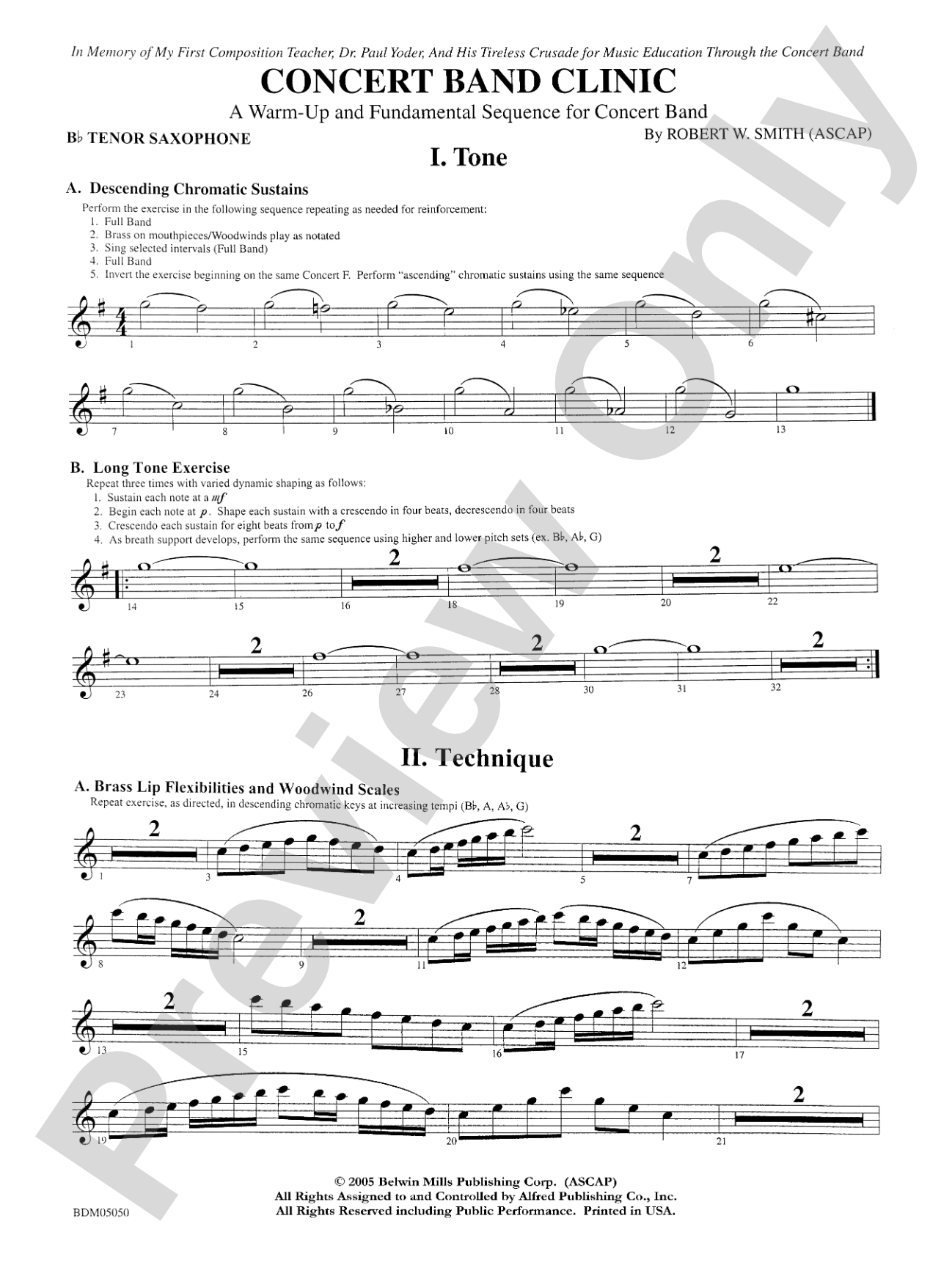

Concert Band Clinic (A Warm-Up and Fundamental Sequence for Concert Band): B-flat Tenor Saxophone
A Warm-Up and Fundamental Sequence for Concert Band
By Robert W. Smith
Grade: 3 (Medium Easy)
Item: 00-PC-0002208_TX1
$3.00
Pickup currently not available
Description
Progressive in depth and organization, this is the third of four comprehensive warm-up programs used by Robert W. Smith at the podium of every honor band he guest conducts. This warm up program is designed for use in any key with just a standard student part to be included in the band's folders. This Clinic will provide everything you need for your daily warm-up and support your teaching objectives, as well as accommodate the National Standards for Music Education. There are four segments in each Clinic: tone, technique, theory and composition, and chorale. The recording included is only the fourth portion; the chorale. (chorale only: 1:21)


Don't just read it, hear it, play along with it, and watch your students grow with it. In MakeMusic Cloud, Concert Band Clinic (A Warm-Up and Fundamental Sequence for Concert Band): B-flat Tenor Saxophone comes alive with professional accompaniment, adjustable tempo, and built-in practice tools that turn solo practice into real progress.
Open in the Player
Jump straight in and assign it today.
Start Your Free Trial
Open this title and explore the full library in minutes.
Sample Audio
1
Audio File
--:--
0:00
0:00
Sample Video
No sample videos found.
Additional Details
Series:
Belwin Concert Band
Publisher:
Alfred Music
Page Count:
316
SKU:
00-PC-0002208_TX1
More about this title
About the Composer: Robert W. Smith

Robert W. Smith has established himself as a leading voice in American concert band composition, with over 400 published works performed by ensembles worldwide. He holds degrees from Troy State University and the University of Miami, and his major works such as The Divine Comedy and The Odyssey symphonies have gained international recognition across North America, Europe, Australia, and Asia.
Beyond the concert hall, Smith's music has reached broad audiences through television broadcasts, presidential ceremonies in Japan, the Olympic Games, and the opening of the Macy's Thanksgiving Day Parade telecast. His work as a guest conductor and clinician across the United States, Canada, and internationally has shaped how developing ensembles approach fundamental musicianship and repertoire standards.
Why we love this
This sequence reflects the daily pedagogical priorities of a conductor who has trained thousands of musicians at honor bands nationwide. Rather than a generic warm-up, it delivers a structured four-part framework (tone, technique, theory and composition, chorale) that directly supports National Standards while fitting seamlessly into any band's routine. The flexibility to use in any key with standard parts makes it immediately practical without requiring transcription or arrangement work on your end.
What to expect
Methodical and purposeful, moving from the focused silence of tone work into the rhythmic clarity of technique exercises, then the intellectual engagement of theory and composition, before settling into the lyrical wholeness of a chorale. The progression creates a natural arc that transitions the ensemble from isolated skill-building into integrated musicianship.
Who it's for
Directors of Grade 3 (medium-easy) concert bands who want a comprehensive, research-backed warm-up system that serves both daily rehearsal discipline and curriculum alignment. This resource suits ensembles ranging from middle school to early high school levels and works equally well for honor bands, festival preparation, or everyday fundamentals.
How to get the most out of it
- Begin with the tone segment to establish a unified sound across sections before moving into technical work; use the chorale recording (included) as a final grounding moment that stabilizes intonation and breath control.
- Move through the four segments in sequence during full rehearsals, but feel free to isolate any segment for targeted sectional work on days when time or ensemble needs require a shorter focus.
- Treat the composition/theory portion as a bridge between mechanics and musicianship; have students notate or discuss what they observe before playing it, so the physical act connects to conceptual understanding.
- Rotate which student parts are exposed or featured within each segment to build confidence across all players and prevent the warm-up from becoming background routine.
How to use it
This functions as your daily rehearsal foundation rather than concert programming. Use it at the start of every rehearsal throughout the year to build consistency, or anchor a pre-festival clinic week with intensive daily work through all four segments. The chorale component also stands alone as a warm-up closer or a brief concert opener that centers audience attention before your main program.
Skills your students will build
- Tone production and intonation balancing across full ensemble
- Articulation clarity and consistency in scale passages and technical figures
- Music theory application in real-time (analyzing harmonic movement, melodic contour, structural form)
- Breath management and phrasing through sustained chorale singing
- Listening for blend and tuning without conductor direction