
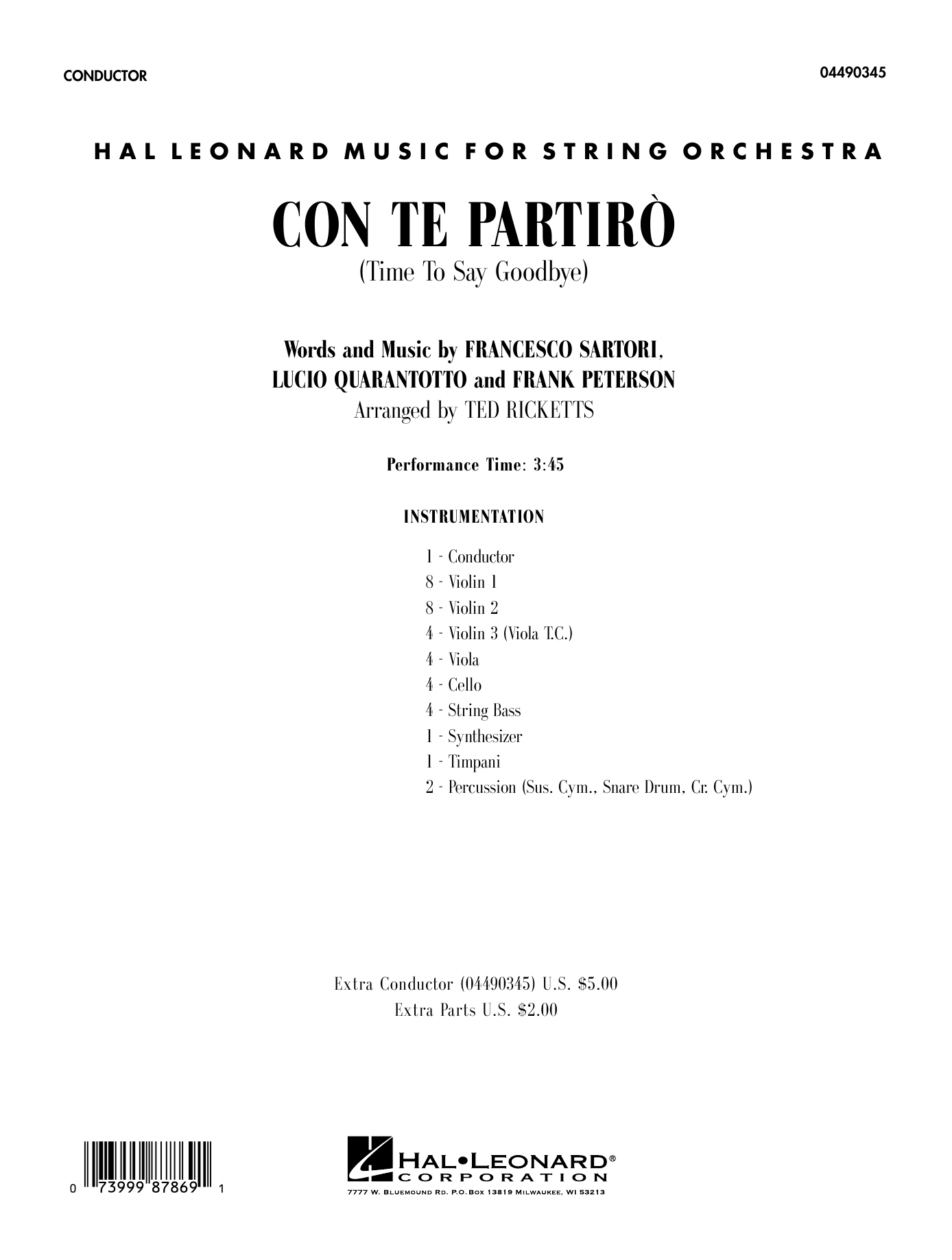

Con Te Partiro (arr. Ted Ricketts): String Orchestra Conductor Score & Parts
As performed by Andrea Bocelli / Arranged by Ted Ricketts
Grade: 3
Item: 35-PK01411841
$45.00
Pickup currently not available
Buy Extra Parts (Digital PDF Download)
Parts Added to Cart!
Description
Andrea Bocelli's signature song has become an international hit and has great appeal with all audiences. Your string orchestra will enjoy Ted Ricketts' arrangement that captures the emotion and musical sensitivity of this memorable song.


Con Te Partiro (arr. Ted Ricketts): String Orchestra Conductor Score & Parts isn't in MakeMusic Cloud just yet...but it could be. Let us know you'd like to see it, and you'll help shape what comes next. In the meantime, start a free trial and dive into thousands of interactive titles your students can play along with today.
Request This Title
Tell us you want it.
Start Your Free Trial
Explore everything that's ready to play right now.
Sample Audio
No sample audio found.
Sample Video
No sample videos found.
Additional Details
Publisher:
Hal Leonard
SKU:
35-PK01411841
More about this title
About the Artist: Andrea Bocelli
Andrea Bocelli is an Italian tenor whose career has bridged classical training and popular music with remarkable success. His distinctive voice and ability to connect emotionally with audiences across genres have made him one of the most commercially successful classical artists of the modern era, performing for billions through Olympic ceremonies, papal events, and global broadcasts.
Why we love this
Ted Ricketts' arrangement respects the song's emotional core while making it genuinely playable for Grade 3 ensembles. Your students will experience what it means to serve a melody with sensitivity rather than technical flash, and audiences will recognize and connect with every phrase instantly.
What to expect
Tender and yearning. The piece carries a quiet intensity that builds through heartfelt melodic lines and lush harmonies. There's an intimacy here that invites the ensemble to play with restraint and emotional generosity rather than volume.
Who it's for
String orchestras at the intermediate level who want to program something their audiences will love and their players will find genuinely musical to perform. This works equally well for concert settings, community performances, or pops programs.
How to get the most out of it
- Shape the melodic line as a vocalist would; the sustained notes need breath and direction even though they're played by instruments.
- Let the lower strings support the harmony without overwhelming the primary melody. Balance this piece toward transparency rather than thickness.
- Work the tempo so it feels unhurried without dragging. The emotional weight comes from phrasing, not from rushing through the passage work.
How to use it
Pair this with other orchestral arrangements of popular standards for a pops concert, or nest it among classical works to show how melody transcends genre. It also serves as a beautiful closer for a spring concert or as a standalone feature piece that lets your musicians explore interpretive playing.
Skills your students will build
- Sustaining tone with consistent vibrato and intonation over longer phrases
- Balancing melody against harmonic accompaniment
- Shaping musical lines with attention to phrasing and dynamic contour
- Reading and playing with emotional intention rather than mechanical accuracy