
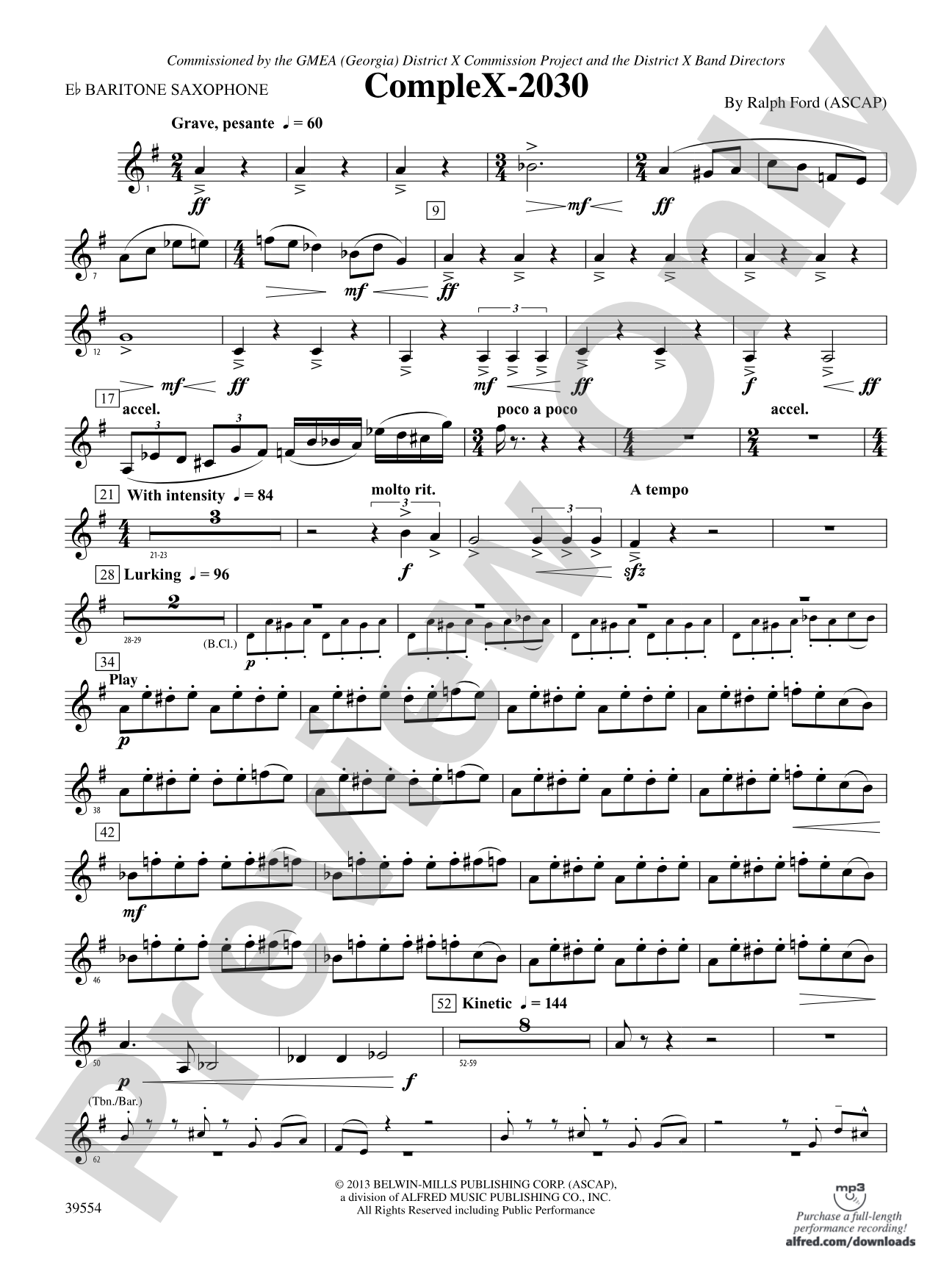

CompleX-2030: E-flat Baritone Saxophone
By Ralph Ford
Grade: 4 (Medium)
Item: 00-PC-0016226_BTX
$3.00
Pickup currently not available
Description
The title CompleX-2030 was inspired by the title given to plan created in 2000 by the National Nuclear Security Administration (NNSA) to modernize nuclear weaponry. Premiered by the Georgia Music Educators Association District X honor band in February of 2012 by the composer, the work is a mental 'soundtrack' he generated while reading a book detailing this initiative. With a variety of innovative techniques and bold sweeping musical statements, the work will clearly be well received. (5:45) This title is available in MakeMusic Cloud.


Don't just read it, hear it, play along with it, and watch your students grow with it. In MakeMusic Cloud, CompleX-2030: E-flat Baritone Saxophone comes alive with professional accompaniment, adjustable tempo, and built-in practice tools that turn solo practice into real progress.
Open in the Player
Jump straight in and assign it today.
Start Your Free Trial
Open this title and explore the full library in minutes.
Sample Audio
1
Audio File
--:--
0:00
0:00
Sample Video
No sample videos found.
Additional Details
Series:
Belwin Symphonic Band
Publisher:
Alfred Music
Page Count:
288
SKU:
00-PC-0016226_BTX
More about this title
About the Composer: Ralph Ford
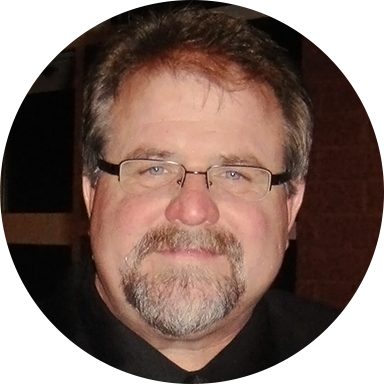
Ralph Ford (b. 1963) combines a prolific career in educational music with extensive work across media and broadcast production. His thirty years teaching at the university level run parallel to his role as exclusive composer and arranger for the Belwin division of Alfred Music, where over 250 of his works appear in catalogs for concert band, orchestra, jazz ensemble, and marching band.
Beyond the concert hall, Ford has built a substantial career in advertising, animation, and television production, earning international recognition for his commercial work. His arrangement experience began at fifteen in Panama City, Florida, and deepened during his undergraduate years at Troy State University, where he directed the Jazz Ensemble while still a student and later served as staff arranger for the university band program. He earned his Master of Science degree in 1988 and has maintained an active schedule as a commissioned composer whose works are performed by university, military, professional, and school ensembles worldwide.
Why we love this
Ford's score balances sophisticated compositional language with a narrative impulse that engages conductors and audiences alike. The work's conceptual foundation—born from Ford's reading about a real governmental initiative—translates into genuinely inventive orchestration and structural drama that rewards careful preparation without demanding extreme technical virtuosity from your ensemble.
What to expect
The score projects bold, sweeping statements punctuated by moments of intricate orchestration. Ford's writing balances structural weight with approachable voicing, creating a sophisticated soundworld that feels both modern and connected to the band tradition.
Who it's for
This Grade 4 work suits confident concert bands and honor ensembles ready to engage with contemporary compositional thinking. Directors seeking repertoire that challenges musicianship without overwhelming technical demands will find CompleX-2030 ideal for both festival programming and educational performances.
How to get the most out of it
- Study the conceptual arc before rehearsing passages in isolation. Understanding Ford's musical response to the source material will help your ensemble invest in the narrative sweep rather than simply executing notes.
- Attend to the balance between ensemble tutti sections and smaller textural moments. Ford's innovative techniques often rely on clear inner voicing, so ensure woodwind and brass doublings sit properly within the overall sonority.
- Mark the major structural transitions in your score and rehearse them deliberately. With a running time of nearly six minutes, these pivots will help your band maintain architectural clarity for both players and listeners.
How to use it
CompleX-2030 works effectively as a centerpiece for a contemporary music concert or as the opening statement for a program built around mid-20th century and newer works. Its five-minute-plus length and conceptual substance make it suitable for festival competition while also serving educational contexts where you want to explore how composers draw inspiration from non-musical sources.
Skills your students will build
- Balancing multiple instrumental lines in innovative orchestration
- Interpreting contemporary compositional techniques and extended techniques
- Shaping long-form musical narratives across five-plus minutes
- Reading complex score layouts and conductor cues
- Responding to conceptual and programmatic direction in rehearsal