Compared to What: E-flat Baritone Saxophone Sheet Music Preview

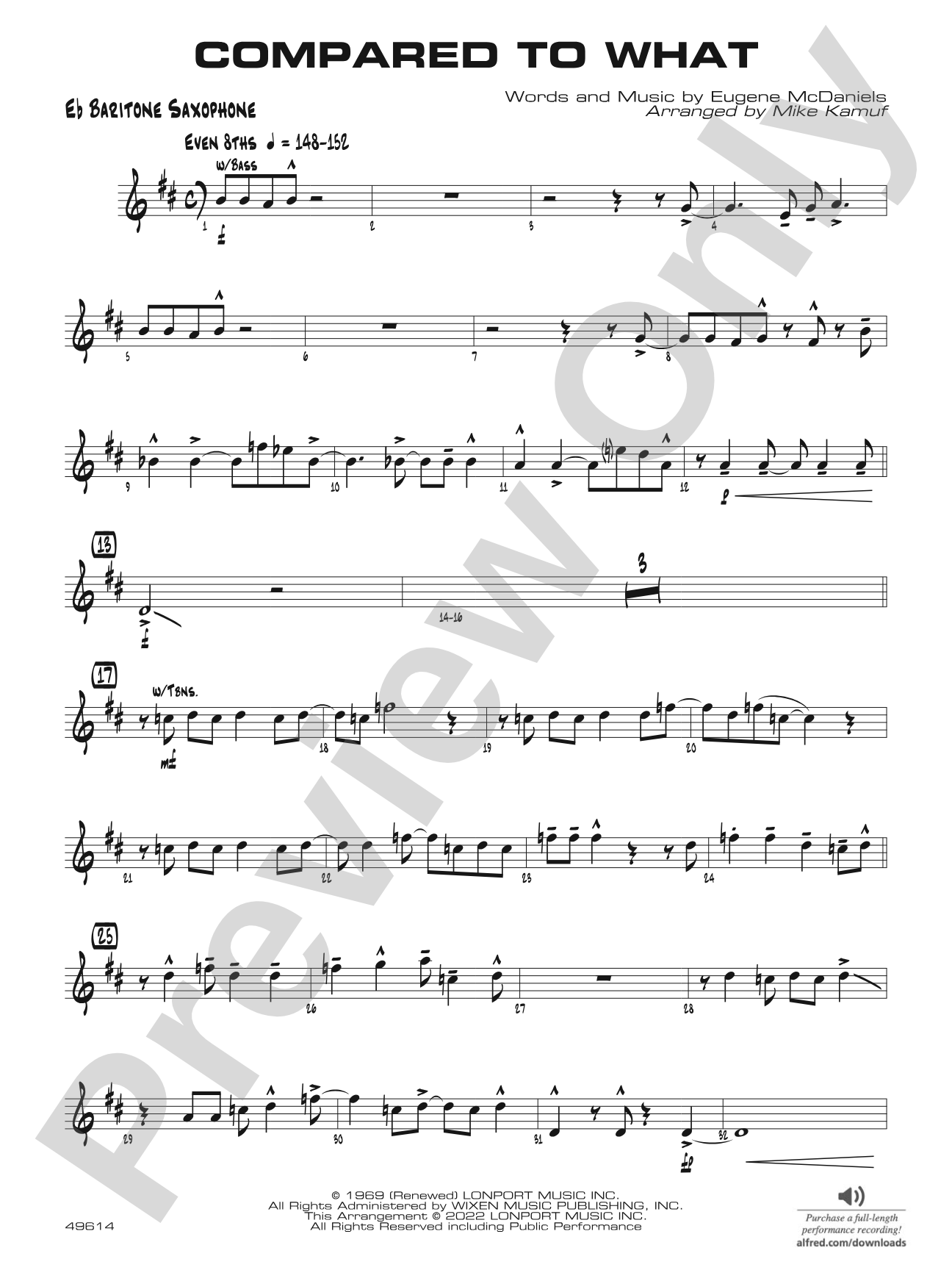
Compared to What: E-flat Baritone Saxophone

Words and music by Eugene McDaniels / arr. Mike Kamuf

Grade: 2.5

Item: 00-PC-0018842_BTX

Digital Download
$3.00
Description
Compared to What arranged by Mike Kamuf has a straight-eighth groove played around 148 BPM with a distinctive Les McCann flavor. Written solos provided for tenor 1 and trumpet 2, unison sax lead lines, some written drum fills, and a sweet shout chorus together make a fine chart. Optional vibes too! (4:01) This title is available in MakeMusic Cloud.

Don't just read it, hear it, play along with it, and watch your students grow with it. In MakeMusic Cloud, Compared to What: E-flat Baritone Saxophone comes alive with professional accompaniment, adjustable tempo, and built-in practice tools that turn solo practice into real progress.

Sample Audio
0:00
0:00
Sample Video
Additional Details
Series: Young Jazz Ensemble
Publisher: Alfred Music
SKU: 00-PC-0018842_BTX

More about this title

About the Composer: Eugene McDaniels

Eugene McDaniels was a soul and funk singer, songwriter, and activist whose work in the 1960s and 1970s bridged soul music with social consciousness. "Compared to What," recorded by Les McCann in 1969, became an anthem of the era, blending jazz, funk, and spoken word into a powerful statement. McDaniels' songwriting gifts made him essential to the sound of soul-jazz fusion during one of popular music's most creatively daring periods.

Why we love this

Kamuf's arrangement captures the groovy essence of the original without requiring a high-level ensemble, making this accessible and exciting for Grade 2.5 groups. The written tenor and trumpet solos, unison sax lines, and shout chorus give students real jazz vocabulary to perform, not just play through changes. A chart this soulful at this level rarely lands with so much authenticity.

What to expect

Soulful and grounded. The straight-eighths and deliberate tempo create space rather than rush, letting each section breathe. There's a vintage funk warmth here that students recognize from modern music while learning genuine jazz history.

Who it's for

Jazz ensembles at the Grade 2 to 2.5 level who are ready for real funk and soul-jazz repertoire with contemporary edge. This works for programs wanting accessible yet authentic material that holds its own in a setlist alongside concert pieces.

How to get the most out of it

  • Nail the straight-eighth groove at 148 BPM; the pocket here is everything. Lock the rhythm section first, then layer horns once that foundation is solid.
  • Balance the unison sax lead lines so the melody cuts through without the section sounding shrill. Encourage breath management across the phrase.
  • Let the written solos breathe. The tenor 1 and trumpet 2 parts are vehicles for style, not speed, so work dynamics and phrasing before worrying about tempo.
  • Use the written drum fills as learning moments. Have your drummer study them measure by measure, then talk through the jazz vocabulary they represent.

How to use it

Program this alongside other soul-jazz standards to build a thematic set, or use it as a festival or contest submission that showcases musicality over technical flash. It also pairs well earlier in a concert as an audience engagement piece before moving into more challenging charts.

Skills your students will build

  • Playing straight-eighth funk grooves with precise rhythm section coordination
  • Interpreting jazz melody and phrasing in unison sax lines
  • Understanding blues and soul-jazz harmonic language
  • Reading and executing written jazz solos with stylistic intent
  • Ensemble balance and blend in small-group jazz settings

You May Also Like