Companions on the Journey: 2nd Percussion Sheet Music Preview

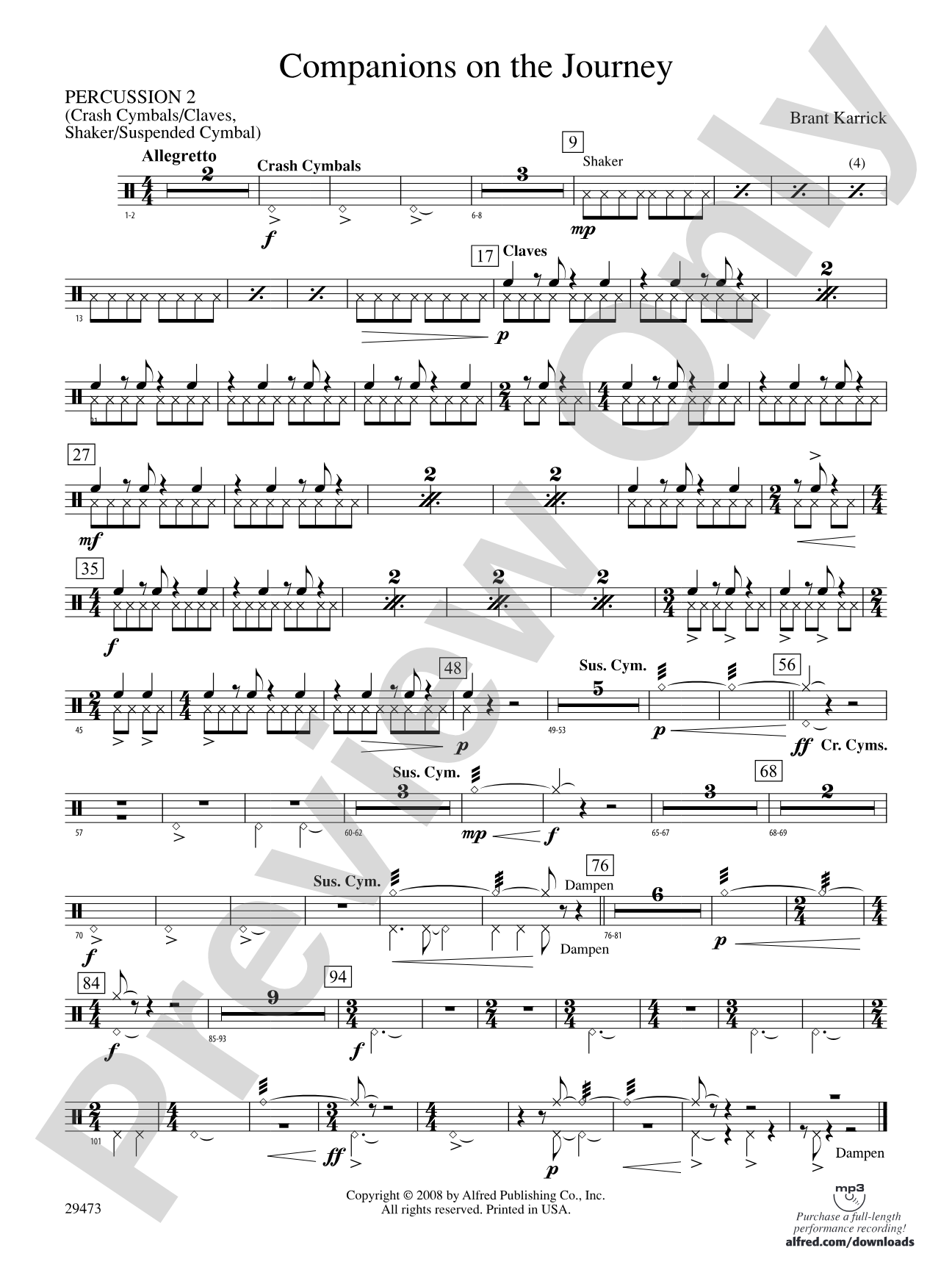
Companions on the Journey: 2nd Percussion

By Brant Karrick

Grade: 2.5 (Medium Easy)

Item: 00-PC-0001429_PC2

Digital Download
$3.00
Description
Imagine the exciting sensation and thrill of traveling with friends to a foreign country in another hemisphere for the first time! Companions on the Journey is a song of joy, camaraderie and celebration. It was composed for the Xavier College Wind Ensemble from Melbourne, Australia, in conjunction with the group's 2006 tour of the United States. (3:20)

Don't just read it, hear it, play along with it, and watch your students grow with it. In MakeMusic Cloud, Companions on the Journey: 2nd Percussion comes alive with professional accompaniment, adjustable tempo, and built-in practice tools that turn solo practice into real progress.

Sample Audio
0:00
0:00
Sample Video
Additional Details
Series: Young Symphonic
Publisher: Alfred Music
Page Count: 276
SKU: 00-PC-0001429_PC2

More about this title

About the Composer: Brant Karrick

Brant Karrick

Brant Karrick joined Northern Kentucky University's faculty in 2003 as Director of Bands, where he oversees the entire band program and teaches conducting, instrumental methods, and orchestration. His teaching background spans nine years at the University of Toledo and seven years in Kentucky public schools, alongside active work as a guest conductor, clinician, and adjudicator. He earned his Ph.D. in music education from Louisiana State University in 1994, his Master's from Western Kentucky University in 1984, and his Bachelor of Music Education from the University of Louisville in 1982.

Karrick's compositions and arrangements have been performed across the United States, Canada, Europe, South Africa, South America, Japan, and Australia. His primary composition teachers were David Livingston, Steve Beck, and Cecil Karrick, while his conducting studies came under Frank Wickes. He holds memberships in NAFME, ASCAP, the College Band Directors National Association, and other professional organizations.

Why we love this

Karrick captures genuine camaraderie and celebration in a score that sits perfectly at the 2.5 grade level, making it accessible without sacrificing musical substance. The contextual backstory of a college ensemble's first international tour gives conductors a ready-made emotional hook for students, transforming what could be a generic concert piece into a shared story. At just over three minutes, it delivers full impact without overextending a concert program or rehearsal time.

What to expect

Companions on the Journey radiates warmth and optimism, evoking the rush of shared adventure and the bonds formed through travel with friends. The writing balances accessible harmonies with genuine musical substance, creating a piece that feels celebratory without becoming trivial or saccharine.

Who it's for

Concert bands at the high school or early college level seeking repertoire that builds ensemble musicality without overwhelming developing players. Directors want a piece that engages students emotionally while remaining technically manageable will find the grade 2.5 difficulty appropriate for mixed-ability sections.

How to get the most out of it

  • Establish the character of celebration from the first downbeat; this piece thrives on energy and forward momentum rather than introspection
  • Balance the melodic voices against the harmonic foundation to keep the writing transparent at the 2.5 grade level
  • Encourage players to listen for the joy and camaraderie in the articulation choices; rhythmic precision alone won't convey the emotional content

How to use it

Program this as a concert opener or second piece to establish a positive mood and set the ensemble at ease before tackling more demanding repertoire. It works particularly well in a spring concert context or any program celebrating ensemble accomplishment, group travel, or community connections.

Skills your students will build

  • Balance between melody and accompaniment voices
  • Maintaining ensemble pulse and articulation clarity in moderate tempos
  • Musical expression through dynamic contrast rather than technical complexity
  • Listening for and executing stylistic energy in light concert music

You May Also Like