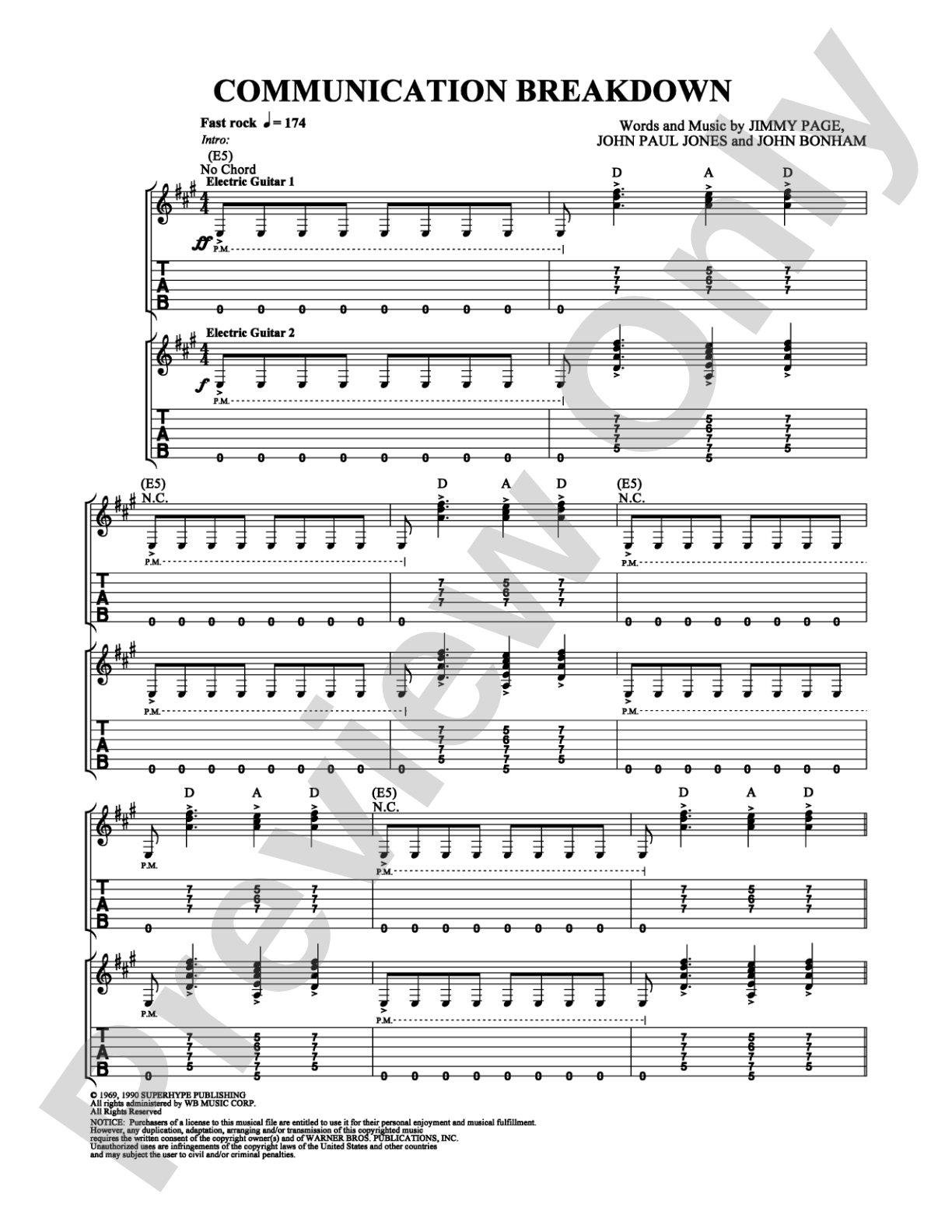
Communication Breakdown: Guitar TAB Digital Sheet Music

Communication Breakdown: Guitar TAB Digital Sheet Music

Led Zeppelin, Jimmy Page, John Paul Jones, John Bonham

Item: 00-PS-0002276

Digital Download
$2.99
Description

Communication Breakdown: Guitar TAB Digital Sheet Music isn't in MakeMusic Cloud just yet...but it could be. Let us know you'd like to see it, and you'll help shape what comes next. In the meantime, start a free trial and dive into thousands of interactive titles your students can play along with today.

Sample Audio
No sample audio found.
Sample Video
Additional Details
SKU: 00-PS-0002276

More about this title

About the Artist: Led Zeppelin

Led Zeppelin redefined rock and metal in the 1970s by fusing blues structures with Eastern influences, mystical lyrics, and relentless sonic intensity. The band's approach to arrangement and dynamics, particularly guitarist Jimmy Page's innovative layering and production choices, became a blueprint for generations of rock musicians and remains foundational to how guitarists think about texture and power.

Why we love this

This track captures the essential DNA of early metal guitar work: a thick, memorable riff that sits solidly in the lower register and rewards students for nailing tone and timing. The TAB format makes it accessible to players who are still building sight-reading skills, so advanced intermediate players can get straight to learning the actual music without decoding standard notation getting in the way.

What to expect

Heavyweight and hypnotic. The riff settles into a groove that feels almost mechanical in its precision yet unmistakably human in its swagger. There's a satisfaction in locking into that pocket, a feeling of power and control that comes from nailing something built on repetition and tone.

Who it's for

Intermediate to advanced guitarists drawn to classic rock and metal repertoire who want to master a foundational riff without the friction of standard notation. This TAB is ideal for players building their rock vocabulary or preparing material for live performance or school ensemble contexts.

How to get the most out of it

  • Anchor the riff in your hand position early and practice it slowly without distortion first; once the muscle memory is solid, the effect will sit naturally on top of clean execution.
  • Match the recorded tone by experimenting with gain and sustain settings rather than compensating with finger pressure; a lighter touch at higher volume often sounds better than gripping hard through a clean amp.
  • Lock into the rhythm by feeling the pulse in your body, not just your fingers; this riff demands a confident, slightly behind-the-beat pocket that separates competent playing from commanding it.
  • Work the dynamics of the intro and main sections separately; the opening builds tension through repetition, so resist the urge to add variation until the arrangement actually calls for it.

How to use it

Feature this as a solo spotlight in a rock or popular music showcase, where a skilled guitarist can own the stage with a single, well-executed idea. It also works well in ensemble contexts when layered with bass and drums, teaching students how iconic riffs anchor a full band sound.

Skills your students will build

  • Reading guitar TAB notation
  • Sustain and distortion tone shaping
  • Locked-in rhythmic pocket and groove
  • Lower register riff development and precision
  • Dynamic control and emphasis within repetitive figures

You May Also Like