
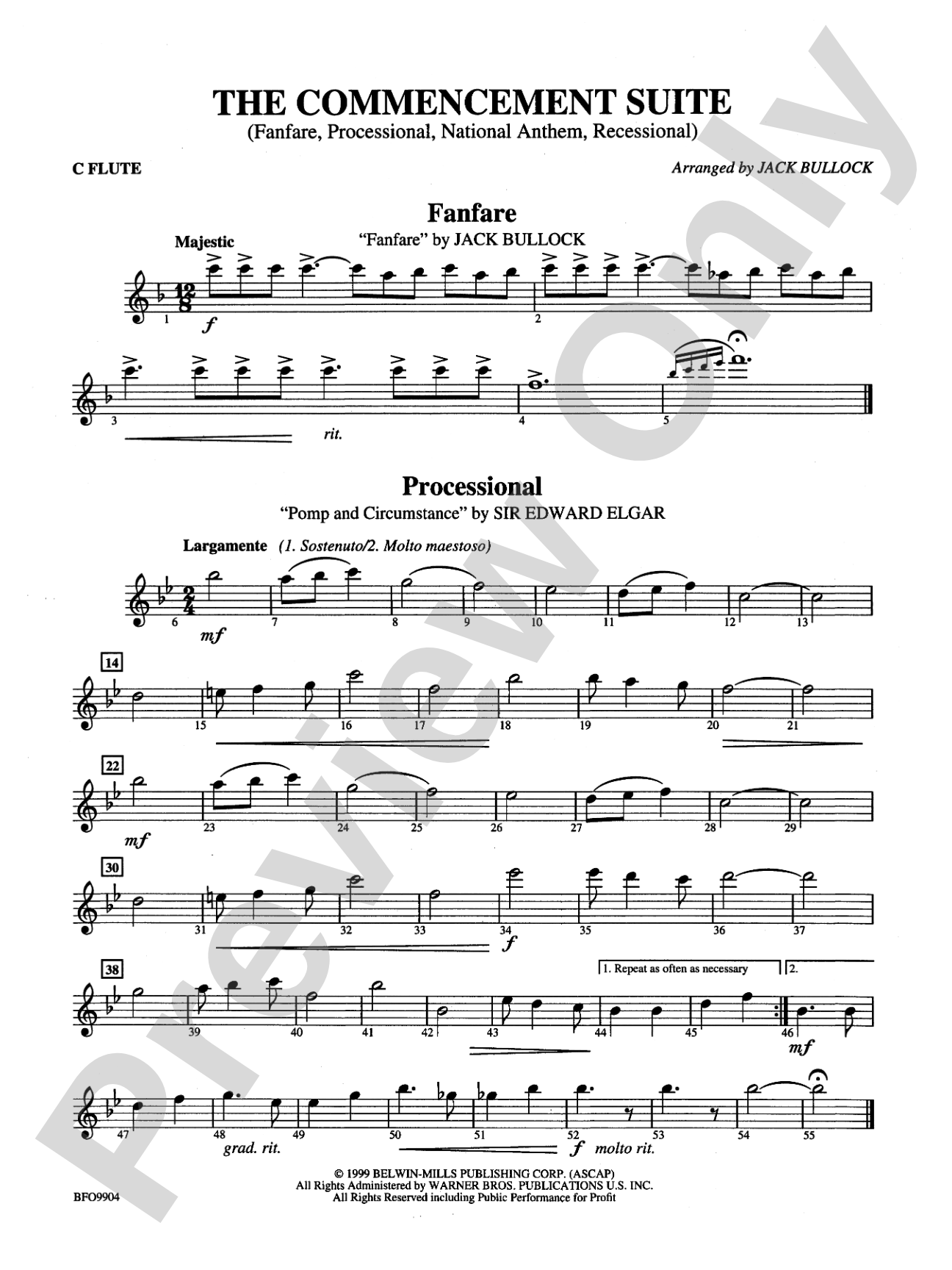

Commencement Suite: Flute
Arr. Jack Bullock
Grade: 2.5
Item: 00-PC-0002216_F1
$3.00
Pickup currently not available
Description
To solve all of your musical concerns at the time of graduation, Jack Bullock has scored this complete package containing a fanfare, processional, "The National Anthem," and a recessional. The arrangement is complete when played only with string orchestra and can be further enhanced by adding any winds and percussion up to and including full orchestra. (5:09)


Don't just read it, hear it, play along with it, and watch your students grow with it. In MakeMusic Cloud, Commencement Suite: Flute comes alive with professional accompaniment, adjustable tempo, and built-in practice tools that turn solo practice into real progress.
Open in the Player
Jump straight in and assign it today.
Start Your Free Trial
Open this title and explore the full library in minutes.
Sample Audio
1
Audio File
--:--
0:00
0:00
Sample Video
No sample videos found.
Additional Details
Series:
Belwin Intermediate String/Full Orchestra
Publisher:
Alfred Music
Page Count:
234
SKU:
00-PC-0002216_F1
More about this title
About the Arranger: Jack Bullock

Jack Bullock brings decades of professional experience to his arranging work, combining a background as a trumpet performer with the Miami Philharmonic Orchestra and Miami Opera Company with deep expertise in music education. He earned three degrees in Music Education and spent 20 years teaching instrumental music in the classroom, including seven years as an assistant band director at Ithaca College's School of Music, where he also served as chair of the Music Education Department.
As a prolific arranger and composer, Bullock has created over 600 publications across concert band, orchestra, jazz ensemble, and marching band contexts. He co-authored the Belwin 21st Century Band Method and contributed arrangements for Alfred Music's Music Expressions curriculum. His work has earned recognition from ASCAP (member since 1980) and listings in Marquis Who's Who publications. He has conducted clinics and workshops throughout the United States, Canada, and England.
Why we love this
Bullock has designed this suite specifically for the ceremonial reality of graduation: a complete musical package that works with what you have on hand. Whether your program features a small string orchestra or a full complement of winds and percussion, the arrangement adapts without losing its dignity or impact. The flexibility to build from string fundamentals outward makes this genuinely practical for schools with varying instrumentation levels.
What to expect
The suite unfolds with the formal grandeur expected of ceremonial music: a bright fanfare signals the occasion, a processional establishes stately forward momentum, the National Anthem grounds the moment in shared tradition, and a spirited recessional sends graduates forward with optimism. The writing feels confident without demanding virtuosity, allowing young musicians to play with genuine musical purpose rather than struggle against the material.
Who it's for
Music directors conducting graduation ceremonies at schools where instrumentation may range from strings-only to full orchestra. This suite serves ensembles at Grade 2.5 level that need repertoire balanced between accessibility and ceremonial significance. The scalable orchestration makes it ideal for programs transitioning between different ensemble sizes or combining multiple student groups for a single event.
How to get the most out of it
- Shape the fanfare with clear articulation in the brass and string attacks to establish ceremonial authority from the opening moment.
- Balance the National Anthem so that any added wind voices blend with rather than overpower the string foundation; this arrangement prioritizes accessibility, not virtuosity.
- Use the processional's moderate tempo as an opportunity to lock the ensemble's rhythmic cohesion; graduation ceremonies demand precision and confidence.
- Bring out the recessional's festive character by maintaining buoyant articulation in the string parts while allowing winds and percussion to add celebratory brightness.
How to use it
Program this as the complete ceremonial frame for your graduation event, using the fanfare and processional to open the proceedings and the recessional to conclude. The suite's flexibility allows you to enhance each movement based on your ensemble's makeup on the day of the event. The inclusion of the National Anthem means you have thoughtful, musically interesting voicing for that essential element rather than relying on a standalone arrangement.
Skills your students will build
- Conducting and maintaining ensemble balance across movements with different instrumentation
- Reading full orchestral scores with multiple instrument families and optional parts
- Adjusting articulation and phrasing to match ceremonial contexts
- Managing tempo consistency across transitions between distinct musical sections
- Adapting ensemble texture by adding or removing instrumental sections without losing musical continuity