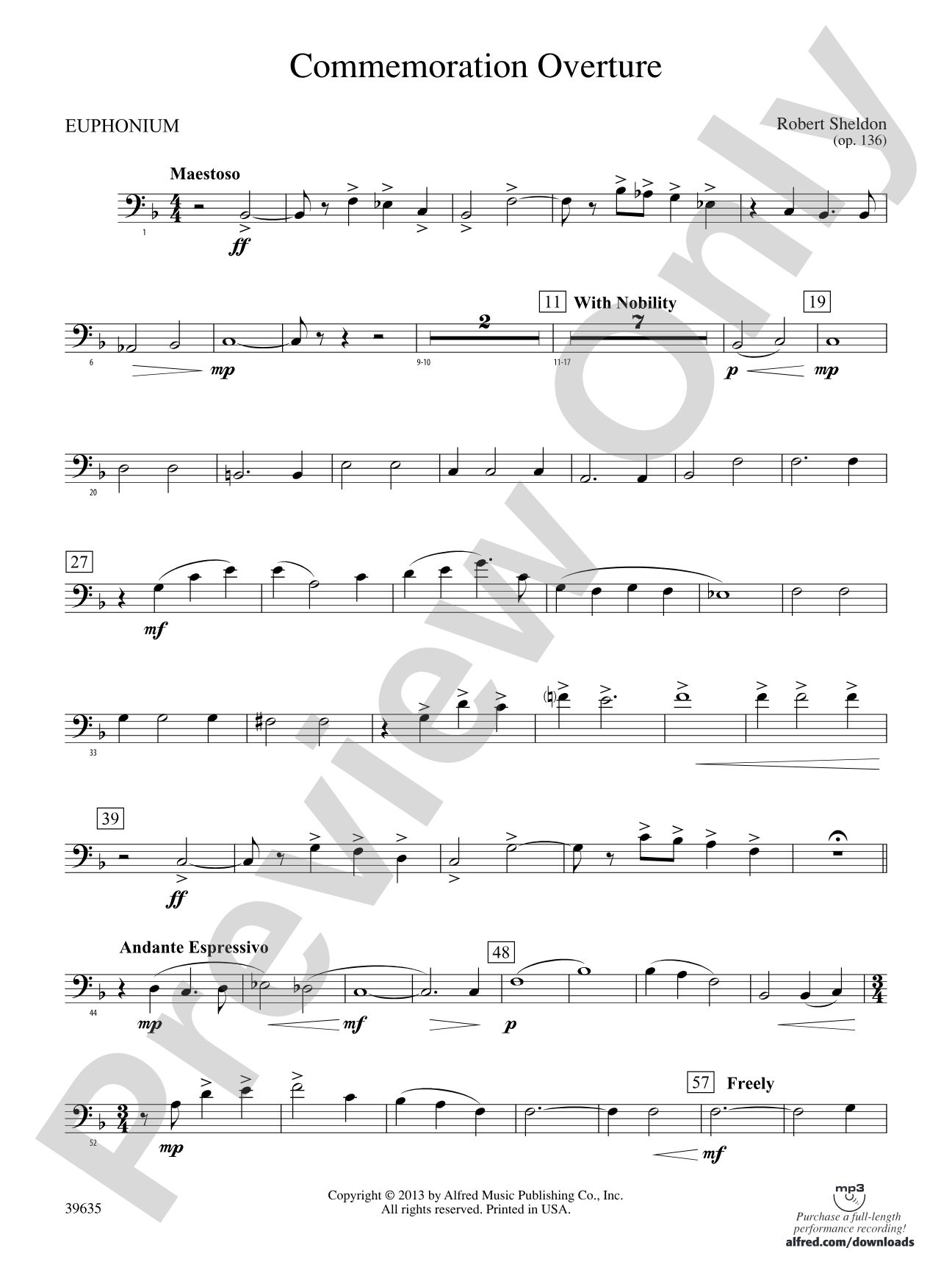
Commemoration Overture: Baritone B.C. Sheet Music Preview

Commemoration Overture: Baritone B.C.

By Robert Sheldon

Grade: 3 (Medium)

Item: 00-PC-0015909_BBC1

Digital Download
$3.00
Description
Fanfares and majestic themes provide a noble character to this commemorative piece, while soaring lines and heartfelt harmonies lend moments of lyricism. (5:25) This title is available in MakeMusic Cloud.

Don't just read it, hear it, play along with it, and watch your students grow with it. In MakeMusic Cloud, Commemoration Overture: Baritone B.C. comes alive with professional accompaniment, adjustable tempo, and built-in practice tools that turn solo practice into real progress.

Sample Audio
0:00
0:00
Sample Video
Additional Details
Series: Alfred Concert Band
Publisher: Alfred Music
Page Count: 264
SKU: 00-PC-0015909_BBC1

More about this title

About the Composer: Robert Sheldon

Robert Sheldon

Robert Sheldon's compositions have become standard repertoire in concert bands across North America and internationally. His work has earned recognition from the American School Band Director's Association, Phi Beta Mu, and ASCAP, and his pieces appear regularly on state and national contest lists. Beyond composing, Sheldon co-authored Sound Innovations for Concert Band and maintains an active schedule as a guest conductor for honor bands and clinician at universities and state music conferences.

Sheldon's music has been performed at Carnegie Hall, Symphony Hall Boston, Orchestra Hall Chicago, the Sydney Opera House, and the Kennedy Center. He has conducted and taught throughout the United States and abroad in Japan, Canada, Italy, Germany, Australia, and China. VanderCook College of Music awarded him an honorary doctorate in 2020 in recognition of his contributions to wind band music.

Why we love this

Sheldon writes commemorative music that feels genuinely noble without sacrificing accessibility. The balance of fanfare and lyricism gives your band moments of real gravitas while the Grade 3 scoring ensures that most sections can handle the musical demands. This is concert-ready material that programs with dignity and doesn't require championship-level musicianship to sound dignified.

What to expect

Commemoration Overture opens with purposeful fanfares that establish dignity and ceremony, then unfolds into passages where heartfelt harmonies create genuine warmth. The soaring melodic lines feel spacious and contemplative, giving the piece an elegance that feels earned rather than overwrought.

Who it's for

This score and parts set serves concert bands at the Grade 3 level who need repertoire that combines ceremonial impact with musical substance. Directors programming festival or concert performances will find this especially valuable when seeking a centerpiece that speaks to ensemble and audience alike without extreme technical demands.

How to get the most out of it

  • Shape the fanfare sections with clear articulation and precise attacks; these opening gestures set the commemorative tone and need crisp definition from the full ensemble.
  • Let the soaring melodic lines breathe in the lyrical passages. Resist the urge to rush these moments, and encourage players to listen for phrase continuity across the ensemble.
  • Balance the brass and woodwind writing so that thematic material remains audible whether it's in the upper or lower voices. Test seating and dynamic balance early in rehearsal.
  • Use the recorded accompaniment to lock tempo and phrasing, especially during the transitions between majestic and tender sections where ensemble unity matters most.

How to use it

Program this as an opening concert selection to set a reflective or ceremonial tone for your program, or use it to commemorate a specific occasion (dedication, anniversary, memorial). Its 5 minute 25 second duration makes it a strong opener or interlude that won't dominate rehearsal time relative to its impact on the audience.

Skills your students will build

  • Ensemble balance between brass fanfares and woodwind accompaniment
  • Phrasing across longer lyrical melodic lines
  • Sectional coordination during rhythmically complex transitions
  • Dynamic control and contrast between majestic and tender passages
  • Reading full concert band voicing and texture

You May Also Like