
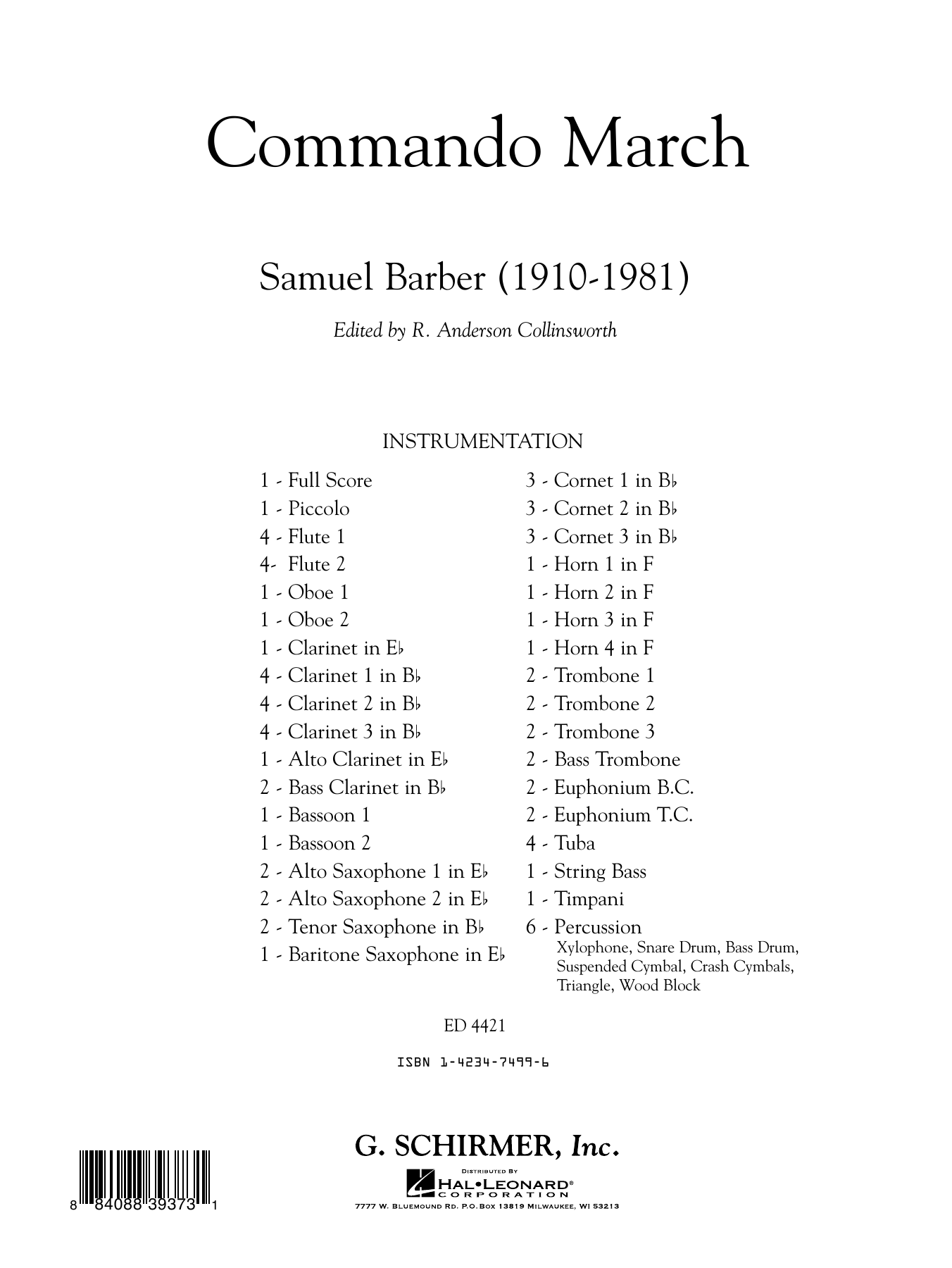

Commando March: Concert Band Conductor Score & Parts
By Samuel Barber / Edited by R. Anderson Collinsworth
Grade: 4
Item: 35-PK01202995
$80.00
Pickup currently not available
Buy Extra Parts (Digital PDF Download)
Parts Added to Cart!
Description
Composed in 1943, "Commando March" was Samuel Barber's first work scored exclusively for band. This stirring work has since become a staple in the repertoire. This new critical edition now includes a full score, plus historical notes and corrections from the original publication. A true classic! Dur: 3:00 (Grade 4)


Commando March: Concert Band Conductor Score & Parts isn't in MakeMusic Cloud just yet...but it could be. Let us know you'd like to see it, and you'll help shape what comes next. In the meantime, start a free trial and dive into thousands of interactive titles your students can play along with today.
Request This Title
Tell us you want it.
Start Your Free Trial
Explore everything that's ready to play right now.
Sample Audio
No sample audio found.
Sample Video
No sample videos found.
Additional Details
Publisher:
Hal Leonard
SKU:
35-PK01202995
More about this title
About the Composer: Samuel Barber
Samuel Barber (1910–1981) stands among America's most performed composers, known for his gift for direct emotional expression and singable melodies. His orchestral and vocal works have defined American classical music, yet his contributions to the band repertoire remain equally significant. Commando March represents a pivotal moment in Barber's output: his first and only work written expressly for concert band, composed during World War II when he was deeply invested in supporting the American war effort through his art.
Why we love this
Barber's march offers something rare at Grade 4: genuine sophistication without inflated difficulty. The writing is clean and transparent, allowing young players to sound mature and confident while wrestling with real musical ideas. This critical edition corrects inconsistencies from the original publication, making rehearsals more efficient and the score more reliable for conductors seeking historically informed performance.
What to expect
Commando March radiates purposeful energy without bombast. The opening establishes a firm, march-like stride, but Barber's lyrical sensibility softens the edges; this is a work of resolve rather than aggression. Listening to it, you hear the voice of a deeply American composer channeling wartime determination through a deeply human melody.
Who it's for
This work reaches conductors building a Grade 4 band that can handle longer forms and subtler musical textures. It's equally valuable for experienced ensembles seeking a touchstone piece that students should know, and for programs seeking authentic American repertoire that doesn't talk down to young musicians.
How to get the most out of it
- Shape the main theme with a singing line that connects across the full three minutes; resist the urge to break it into fragments, even when it passes between sections.
- Balance the harmonic padding in the middle voices so that inner melodic lines emerge without drowning the primary tune.
- Maintain steady forward momentum through tempo transitions; Barber's march language assumes continuous propulsion rather than dramatic shifts.
- Use the historical notes included in this edition to frame rehearsal discussions about how American composers wrote for band during the 1940s.
How to use it
Program this as an opener or closer on a concert that also includes contemporary American works, where it can anchor the program with historical weight. It also serves beautifully as a single, substantial work on a program of shorter pieces, giving bands a moment to demonstrate their command of extended form at an accessible level.
Skills your students will build
- Sustaining lyrical phrasing across a full three-minute work
- Balancing melody against supporting harmonic figures
- Reading and executing period-style articulation and dynamics
- Ensemble precision in transitions between contrasting sections
- Understanding historical context and American classical music of the 1940s