
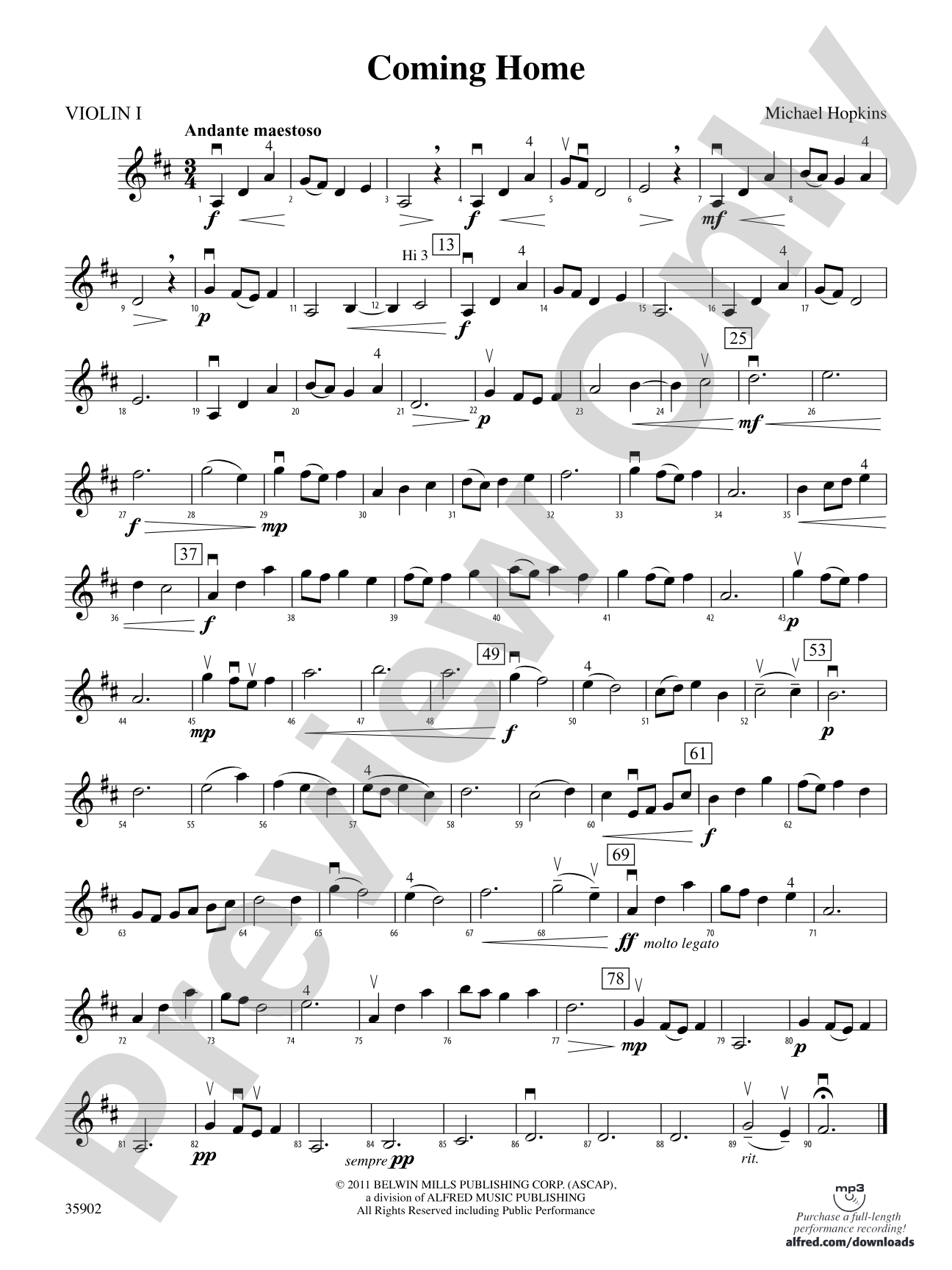

Coming Home: 1st Violin
By Michael Hopkins
Grade: 2
Item: 00-PC-0014986_VN1
$5.99
Pickup currently not available
Description
Truly a beautiful and majestic work! This is a great piece for teaching slurs, bow distribution, bowing variation, using 4th finger on violin and viola, hemiola, dynamic contrasts, ritardando, and legato style. All parts have interesting melodic material and are playable in first position with some shifting for basses.
"Students will delight in preparing this majestic work for performance."
-The Instrumentalist


"Students will delight in preparing this majestic work for performance."
-The Instrumentalist
Don't just read it, hear it, play along with it, and watch your students grow with it. In MakeMusic Cloud, Coming Home: 1st Violin comes alive with professional accompaniment, adjustable tempo, and built-in practice tools that turn solo practice into real progress.
Open in the Player
Jump straight in and assign it today.
Start Your Free Trial
Open this title and explore the full library in minutes.
Sample Audio
1
Audio File
--:--
0:00
0:00
Sample Video
No sample videos found.
Additional Details
Series:
Belwin Beginning String Orchestra
Publisher:
Alfred Music
Page Count:
72
SKU:
00-PC-0014986_VN1
Instrumentation:
strings w/ vln 3
More about this title
About the Composer: Michael Hopkins

Michael Hopkins has led string programs at the middle and high school levels across Colorado, Michigan, and Vermont before establishing himself as a pedagogue and researcher in higher education. He founded the Burlington Chamber Orchestra and served as conductor of the University of Vermont Symphony Orchestra, bringing classroom experience to his work as Professor and Chair of Music Education at the University of Michigan, where he teaches string techniques, orchestra methods, and music psychology.
Hopkins has shaped string education through both composition and scholarship. His catalog includes over 70 published orchestral works and arrangements, while his articles appear regularly in peer-reviewed journals including the Journal of Research in Music Education and American String Teacher. He authored The Art of String Teaching, a comprehensive pedagogy text published by GIA Publications, and continues to present at national and state music education conferences on string education and music technology.
Why we love this
Hopkins writes with deep understanding of what young string players can handle musically and technically. Coming Home delivers on genuine teaching value: the scoring gives every section memorable material to own, the bowing challenges build real control without frustration, and the majestic tone makes students eager to prepare it for concert. This is the kind of piece that proves Grade 2 doesn't mean simple.
What to expect
Coming Home unfolds with genuine majesty without grandstanding. The writing creates space for each section to breathe while maintaining forward momentum, and the harmonic language feels grounded and accessible. Young players experience the satisfaction of producing something that sounds polished and genuinely beautiful.
Who it's for
String orchestra directors teaching Grade 2 ensembles who want repertoire with substance. This piece suits programs preparing for concert performance or festival competition, and works equally well for student orchestras building technical foundation through engaging literature.
How to get the most out of it
- Shape the slurs with intention rather than smooth them into uniformity. Each slur pattern serves a specific musical purpose, so highlight the contour within each phrase before blending them together.
- Establish clear bowing patterns early in rehearsal so students can focus on dynamic shaping and legato quality. Consistency in bow direction frees mental energy for listening to balance across sections.
- Address the hemiola sections by conducting them clearly and having students count through the metric shift. Mark these moments in parts so no one gets caught off guard.
- Reserve full tempo and dynamics for the final week of rehearsal. Spend earlier sessions on intonation, articulation, and part security at a comfortable tempo.
How to use it
Program this as a centerpiece for a winter or spring concert where it can anchor a mixed repertoire of lighter and more challenging works. It also serves as an excellent choice for a single festival appearance, providing both performance polish and a teaching vehicle for fundamental bow control and voice leading.
Skills your students will build
- Slur execution and bow distribution across string crossings
- Bowing variation and articulation control
- Fourth finger extension on violin and viola
- Hemiola recognition and rhythmic independence
- Dynamic contrast and gradual tempo adjustment (ritardando)
- Legato style and phrase shaping across sections
- Melodic responsibility in supporting parts