Come, Ye Thankful People, Come Sheet Music Preview

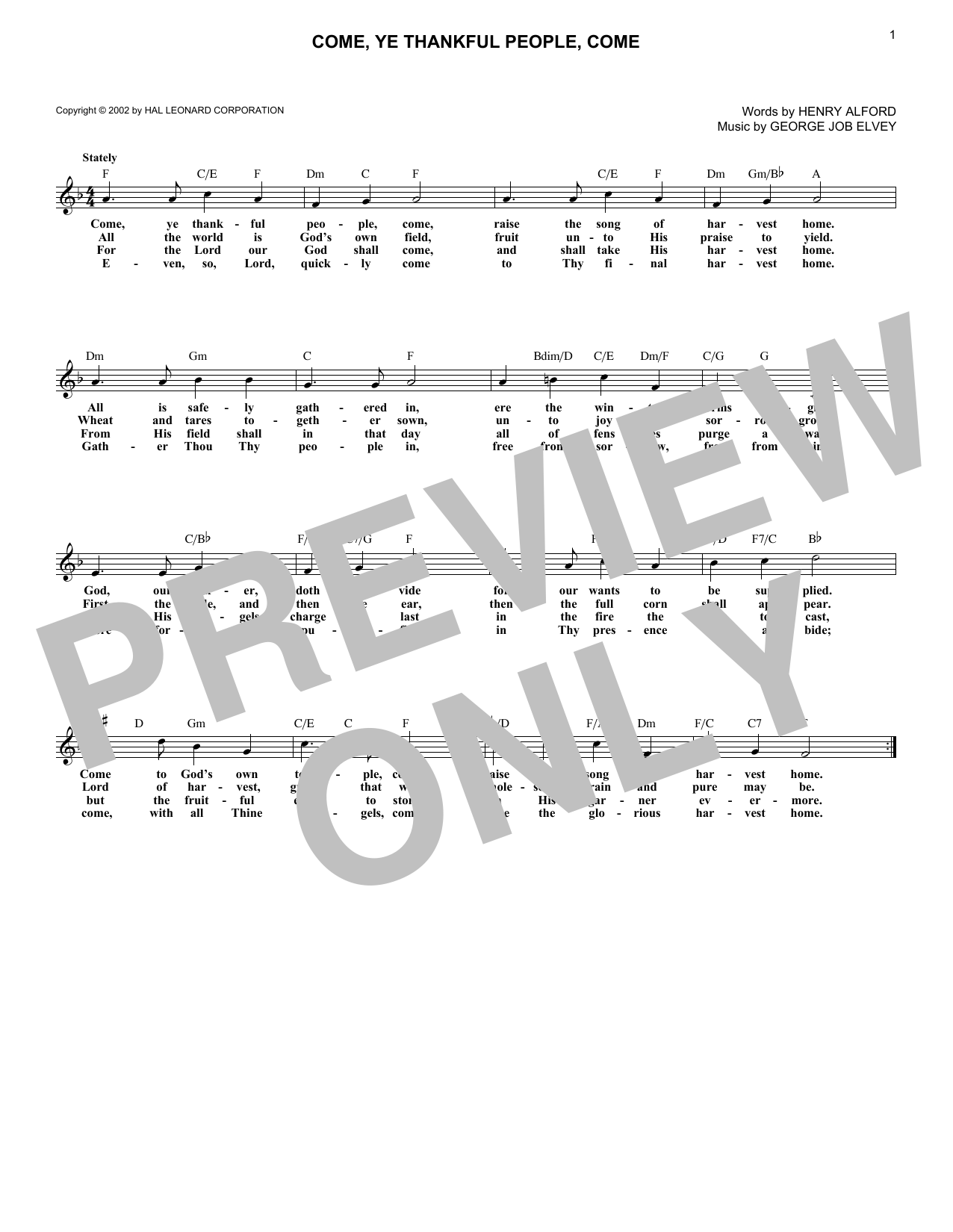
Come, Ye Thankful People, Come: Lead Sheet / Fake Book

As performed by Henry Alford and George Job Elvey

Item: 35-DS00470696

Digital Download
$3.99
Description

Come, Ye Thankful People, Come: Lead Sheet / Fake Book isn't in MakeMusic Cloud just yet...but it could be. Let us know you'd like to see it, and you'll help shape what comes next. In the meantime, start a free trial and dive into thousands of interactive titles your students can play along with today.

Sample Audio
No sample audio found.
Sample Video
Additional Details
Publisher: Hal Leonard
Page Count: 1
SKU: 35-DS00470696

More about this title

About the Artist: Henry Alford and George Job Elvey

Henry Alford (1810–1871) was an English clergyman and hymn writer whose texts shaped Victorian sacred music. He wrote the lyrics to "Come, Ye Thankful People, Come" in 1844, creating a harvest thanksgiving hymn that has endured as a cornerstone of the church calendar. His gift lay in crafting accessible yet theologically rich verse that congregations could embrace.

George Job Elvey (1816–1893) composed the melody that carries Alford's text. As organist at St. George's Chapel, Windsor, Elvey produced music of genuine harmonic sophistication and melodic clarity. His tune "St. George's Windsor" became inseparable from Alford's words, and together they represent a high point of 19th-century English hymn writing.

Why we love this

This lead sheet captures one of the most recognizable hymn melodies in the repertoire, offering organists and pianists the flexibility to accompany singers with their own interpretation. The tune's strength lies in its singability and harmonic foundation, making it ideal for accompanists who want to support congregational singing or develop their own arrangements.

What to expect

Sturdy and affirmative. Elvey's melody moves with quiet confidence, neither rushing nor dragging, while the harmonic language feels warm and grounded in traditional practice. There is gratitude in the tune's shape, a sense of gathering and collective voice rather than virtuosity or drama.

Who it's for

Organists and pianists who regularly accompany congregational singing, choir directors preparing familiar hymns for performance, and accompanists seeking a clean lead sheet to build personal arrangements from. Voice students and singers developing hymn literature also benefit from having the melody and chord structure in one compact format.

How to get the most out of it

  • Support the melody's phrase shapes by breathing with singers; the tune divides naturally into four-bar gestures that deserve rhythmic independence
  • Keep the harmonic movement understated in your accompaniment so the text clarity remains primary, especially during the opening phrases
  • Consider the season and context: fuller textures work for harvest festivals while sparer voicings suit general thanksgiving services

How to use it

Essential repertoire for Thanksgiving services, autumn church concerts, and harvest celebrations. Pair it with other seasonal hymns or sacred songs to build a coherent thematic program, or use it as the anchoring piece in a mixed choral and congregational service where your ensembles support community singing.

Skills your students will build

  • Reading chord symbols and lead sheet notation
  • Accompanying vocal melody while managing harmonic rhythm
  • Phrase-based accompaniment that supports rather than dominates the singer
  • Adapting harmonic voicings to match congregational energy and acoustic space

You May Also Like