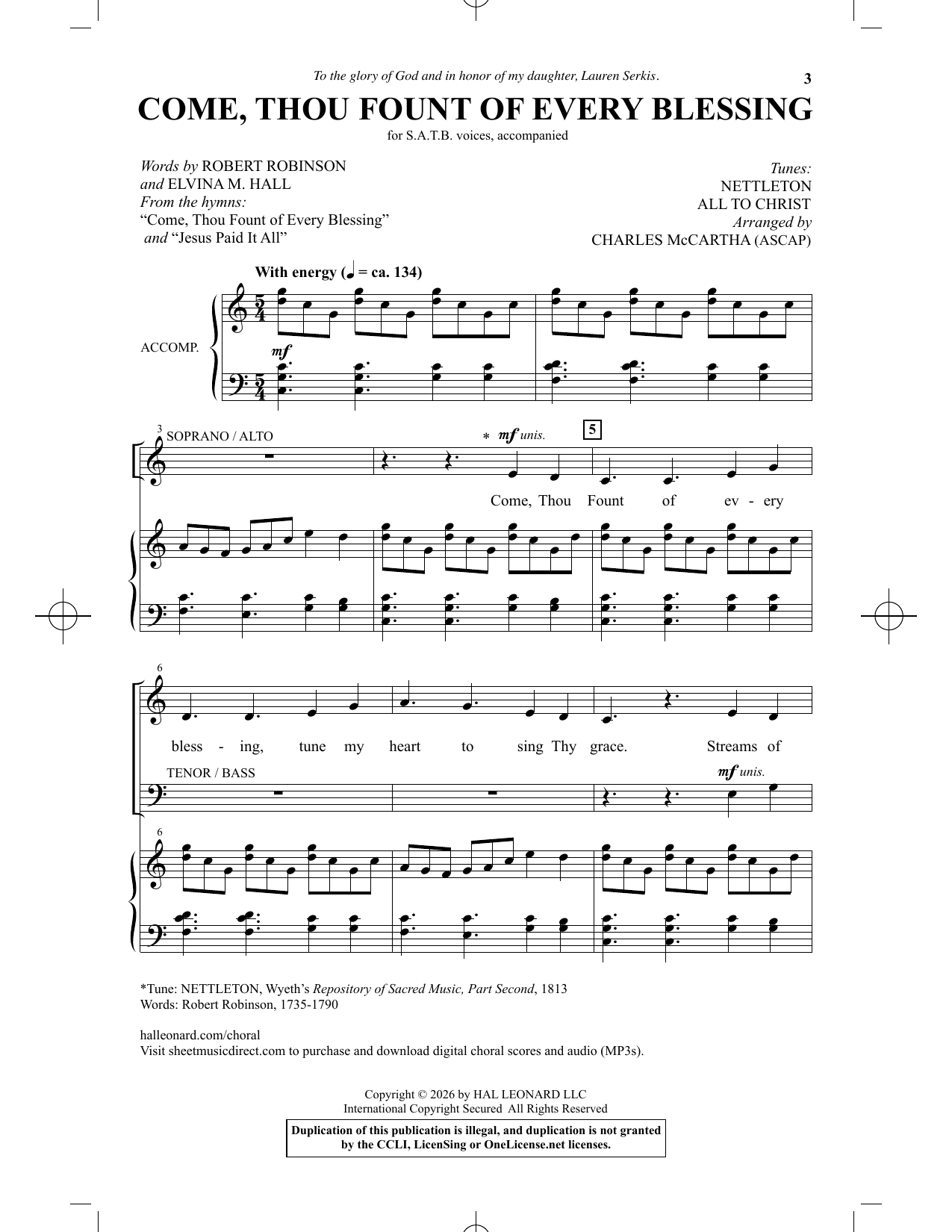
Come, Thou Fount Of Every Blessing (arr. Charles McCartha): SATB Choral Octavo
As performed by Elvina M. Hall / Arranged by Charles McCartha
Item: 35-DS01954223
Digital Download
$2.50
Minimum order quantity: 10 copies
Please note: Under U.S. copyright law, you must purchase the exact number of copies needed for your ensemble. Printing, duplicating or sharing additional copies is strictly prohibited.
Pickup currently not available
Description
Discover MakeMusic Cloud: thousands of interactive titles your students can play along with today.
Elvina M. Hall wrote "Come, Thou Fount of Every Blessing" in 1858, creating one of the most enduring hymn texts in American sacred music. Her lyrics capture a profound gratitude for divine grace while maintaining accessibility for congregational singing, a balance that has kept this hymn relevant across generations and denominations.
Hall's work exemplifies 19th-century American hymn writing at its finest. Her emphasis on singable melodies paired with theologically rich language makes her compositions valuable resources for choirs seeking repertoire that connects with both singers and audiences on an emotional level.
Why we love this
Charles McCartha's arrangement respects the hymn's architectural strength while giving SATB choirs interpretive space. The nine-page score suggests substantial musical development rather than a straightforward harmonization, making this compelling for choirs ready to explore the text with nuance and independence across voice parts.
What to expect
Gratitude rendered in four-part harmony. The piece carries the weight of its text's theological depth while remaining singable and emotionally direct. There's warmth in the arrangement and a sense of voices in conversation rather than unison declaration.
Who it's for
Sacred music directors planning services, special liturgical moments, or concerts that blend traditional hymnody with contemporary choral arrangements. This works equally well for college, community, and church choirs with some rehearsal time available and voices secure enough to navigate part independence.
How to get the most out of it
Balance the alto and tenor lines; McCartha likely gives these voices important harmonic or melodic material that defines the arrangement's character. Don't let sopranos carry the full weight of the tune.
Pay attention to text underlay and phrase breathing. Hymn texts often reveal their meaning through how words land on harmonic moments, so mark breath points collaboratively with your singers rather than imposing them.
Test the piece in several tempos during rehearsal. The emotional arc of gratitude in Hall's text can shift dramatically between a sturdy, grounded tempo and something more ethereal.
Listen for moments where parts move independently. These create texture and interest; they're not accidents but intentional choices that separate this from a basic four-part arrangement.
How to use it
Pair this with another arrangement of the same hymn to explore textual interpretation, or program it alongside other Hall settings if your repertoire library includes them. Its length and substance make it suitable as a standalone anthem or as part of a service devoted to gratitude and thanksgiving themes. Early autumn or Thanksgiving season programming fits naturally, though the text's universality supports use throughout the year.
Skills your students will build
Singing sustained harmonic progressions with precise intonation
Balancing independent voice lines while maintaining textual clarity
Interpreting romantic-era hymn arrangements with expressive control
Connecting theological language to musical phrasing decisions
You May Also Like
Scan to Complete Your Purchase
Use your phone's camera to scan the code below
You'll log in on your phone and the order will be added to your account