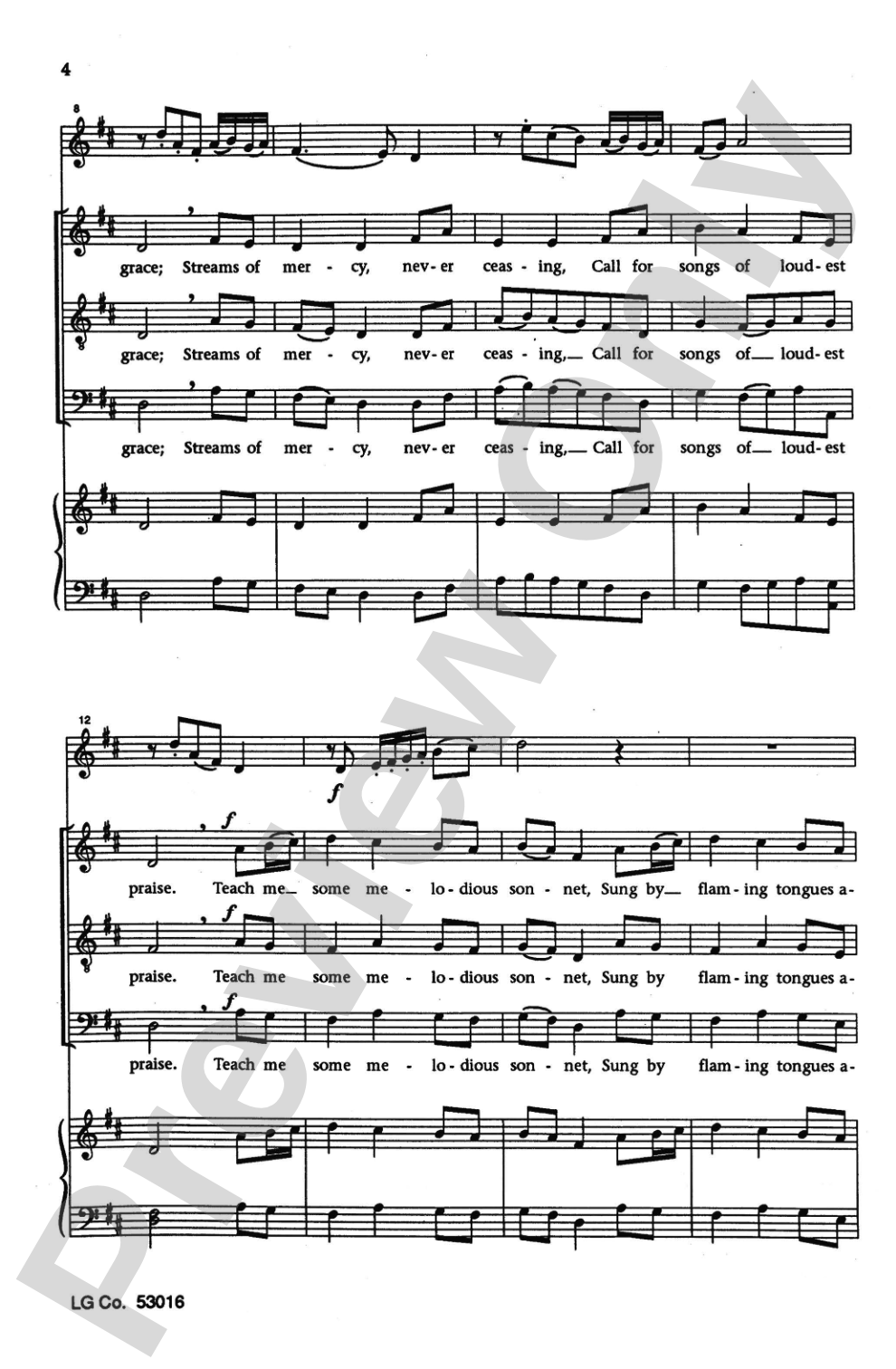
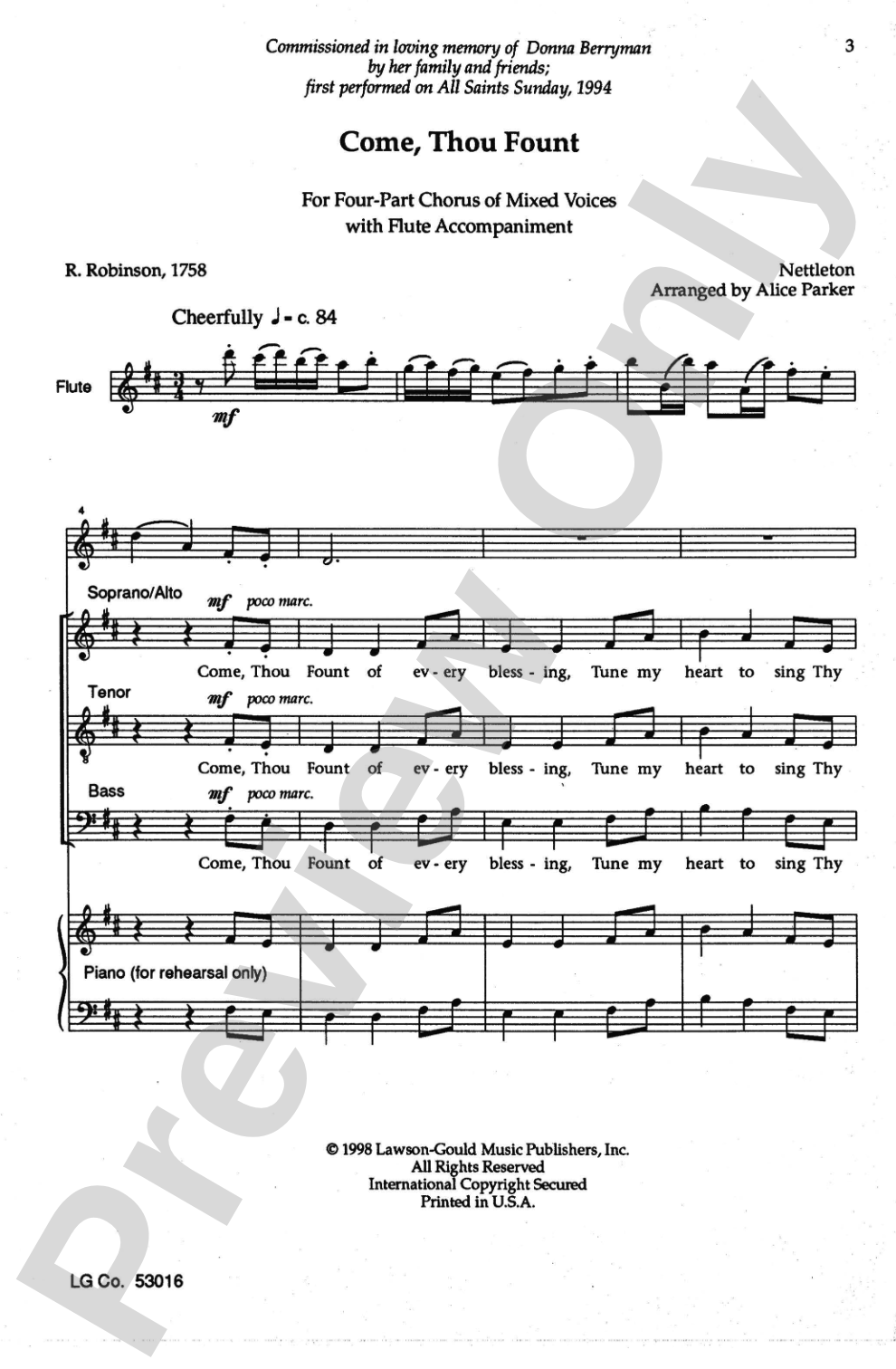
Come, Thou Fount Sheet Music Preview

Come, Thou Fount: SATB Choral Octavo

Arr. Alice Parker

Item: 00-PO-0005105

Digital Download
$2.25

Minimum order quantity: 20 copies

Description

Come, Thou Fount: SATB Choral Octavo isn't in MakeMusic Cloud just yet...but it could be. Let us know you'd like to see it, and you'll help shape what comes next. In the meantime, start a free trial and dive into thousands of interactive titles your students can play along with today.

Sample Audio
0:00
0:00
Sample Video
Additional Details
Series: Alfred Archive Edition: Alice Parker Choral Series
Publisher: Alfred Music
Page Count: 12
SKU: 00-PO-0005105

More about this title

About the Arranger: Alice Parker

Alice Parker

Alice Parker's compositional voice emerged from her dual training at Smith College and Juilliard, where her partnership with Robert Shaw began. Together they shaped American choral music through hundreds of settings of folk hymns, spirituals, and traditional songs that remain central to choral repertoires everywhere. Her creative output spans five hundred published works across operas, cantatas, song cycles, and individual anthems, each grounded in her deep study of melody and vocal style.

Parker founded MELODIOUS ACCORD, INC. in 1985 to center her work on the essential role of melody in singing. She authored influential books on melodic styles, choral improvisation, and congregational music practice, including the widely consulted "Melodious Accord: Good Singing in Church." Her contributions to American choral culture earned her the Robert Shaw Award from the American Choral Directors Association, the Harvard Glee Club Foundation Medal, and six honorary doctorates, along with recognition as Distinguished Composer of the Year 2000 by the American Guild of Organists.

Why we love this

Parker's arrangement honors the hymn's timeless melody while giving it textural variety and harmonic warmth that engages singers across all four voice parts. The 12-page setting strikes an ideal balance for liturgical and concert use, offering enough musical substance to feel rewarding without overwhelming a mixed chorus of varying ability levels. Her signature attention to singability and phrase architecture means the voices move naturally, making this a piece that sounds better the more you rehearse it.

What to expect

There is an unhurried dignity to this setting, with harmonies that feel both grounded and gently expressive. The arrangement opens the familiar tune to fresh harmonic colors while maintaining the spiritual directness that made the hymn endure for generations.

Who it's for

This arrangement serves choirs comfortable with traditional four-part writing and looking for sacred repertoire that works in both Sunday services and concert settings. Directors seeking music that honors congregational hymn singing while offering thoughtful musical development will find this a natural fit for mixed ensembles of intermediate skill.

How to get the most out of it

  • Shape the opening phrases to land gently on their downbeats; Parker's harmonic support asks for breath control and a sense of architectural phrasing rather than rhythmic drive.
  • Balance the inner voices in the full four-part sections so the soprano line remains audible without forcing; this arrangement values textural clarity over power.
  • Let the melody breathe in moments where it carries the primary musical thought, even if other voices have accompanying figures; Parker's craft depends on listeners hearing the tune clearly.

How to use it

Program this as an anchor for a sacred choral concert or worship service, where its 12-page length allows you to build musical weight without excessive rehearsal demand. It pairs naturally with other hymn-based settings in a liturgical context or stands alone as a reflective centerpiece in a mixed repertoire program.

Skills your students will build

  • Singing sustained, shaped phrases in four-part harmony
  • Balancing individual voice lines within ensemble texture
  • Interpreting hymn-based writing with musical expression beyond note accuracy
  • Maintaining intonation across a range of harmonic movement

You May Also Like