
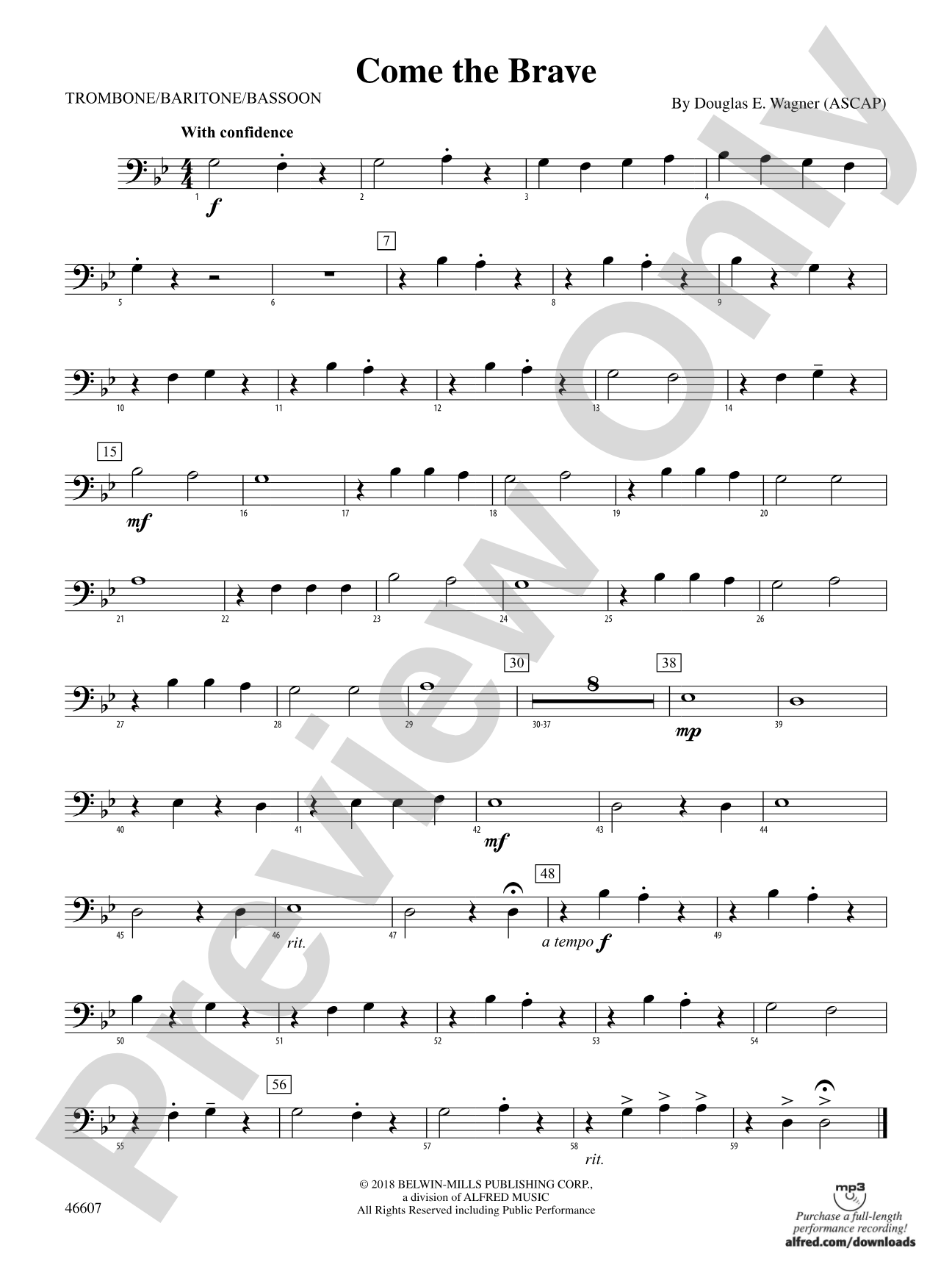

Come the Brave: 1st Trombone
By Douglas E. Wagner
Grade: 0.5 (Very Easy)
Item: 00-PC-0018041_TN1
$3.00
Pickup currently not available
Description
Inspired by demonstrated courage, this original work is intended as a confidence-building piece for a young ensemble's first Spring concert. It serves as a perfect gateway into articulation and varying dynamics: the three most commonly occurring articulation marks (staccato, accent, and tenuto) have been included, as have the middle three dynamic markings (mezzo piano, mezzo forte, and forte) building and declining in intensity. These musical concepts can be experienced individually and within the ensemble. A bold musical statement!


Don't just read it, hear it, play along with it, and watch your students grow with it. In MakeMusic Cloud, Come the Brave: 1st Trombone comes alive with professional accompaniment, adjustable tempo, and built-in practice tools that turn solo practice into real progress.
Open in the Player
Jump straight in and assign it today.
Start Your Free Trial
Open this title and explore the full library in minutes.
Sample Audio
1
Audio File
--:--
0:00
0:00
Sample Video
Additional Details
Series:
Belwin Very Beginning Band
Publisher:
Alfred Music
Page Count:
130
SKU:
00-PC-0018041_TN1
More about this title
About the Composer: Douglas E. Wagner

Douglas E. Wagner began his career as a high school music educator and administrator, spending three decades in the classroom before transitioning to full-time composition. A Butler University graduate with degrees in music, Wagner has established himself as one of the most prolific composers in American music education, with over 3,500 published works spanning concert band, choir, orchestra, handbell ensemble, organ, piano, and voice.
Since 1973, more than seventeen million copies of Wagner's music have found their way into rehearsal rooms, concert halls, and broadcast studios across the United States and internationally. His work continues to appear on concert programs and radio broadcasts worldwide. Wagner resides in Indianapolis, Indiana.
Why we love this
Wagner understands what young ensembles need to hear and play at their very first concert: music that sounds confident and musical without overwhelming developing musicians. Come the Brave accomplishes this by intentionally limiting itself to three articulation types and three dynamic markings, giving students something concrete to master rather than a bewildering palette of possibilities. The piece delivers genuine musical satisfaction in performance while teaching the fundamentals that every band director wants students to own.
What to expect
Brave and affirmative. The piece carries genuine musical weight despite its accessibility, offering young players the chance to make a bold statement together. There's clarity in every note and transparency in every marking, creating a sense of accomplishment the moment the final note rings out.
Who it's for
This piece is designed for young concert bands taking the stage for their first Spring performance. The very easy difficulty level and focused musical concepts make it ideal for ensembles in their opening weeks of study, yet it remains musically engaging enough to build genuine confidence rather than simply filling a program slot.
How to get the most out of it
- Isolate each articulation type in sectional rehearsals before bringing the full band together. Have students speak the difference between staccato, accent, and tenuto while fingering their instruments to build kinesthetic awareness.
- Map the dynamic arc clearly on the score so students can see how intensity builds and recedes. Use hand gestures consistently to show the relationship between mezzo piano, mezzo forte, and forte throughout rehearsal.
- Balance the band so the dynamic markings register clearly in the hall. With young players, middle dynamics often disappear, so reinforce that mezzo piano and mezzo forte are distinct statements, not approximations.
How to use it
Open your Spring concert with this piece to set a confident tone and showcase how far your ensemble has come in just a few weeks. Its pedagogical focus on articulation and dynamics makes it a natural centerpiece for a program that might also include more advanced pieces, demonstrating the foundational work that enables everything else.
Skills your students will build
- Distinguishing and executing three fundamental articulation marks (staccato, accent, tenuto)
- Reading and responding to middle-range dynamic markings (mezzo piano, mezzo forte, forte)
- Following a conductor's dynamic gestures and shaping phrase intensity as an ensemble
- Maintaining tone quality across varying dynamic levels