

Come, See the Baby: SATB, a cappella Choral Octavo
Music by Jay Althouse
Item: 00-PO-0003983
$2.25
Minimum order quantity: 20 copies
Pickup currently not available
Related Items
Come, See the Baby: SATB, a cappella Choral Octavo |
$2.25
|
View |
Description
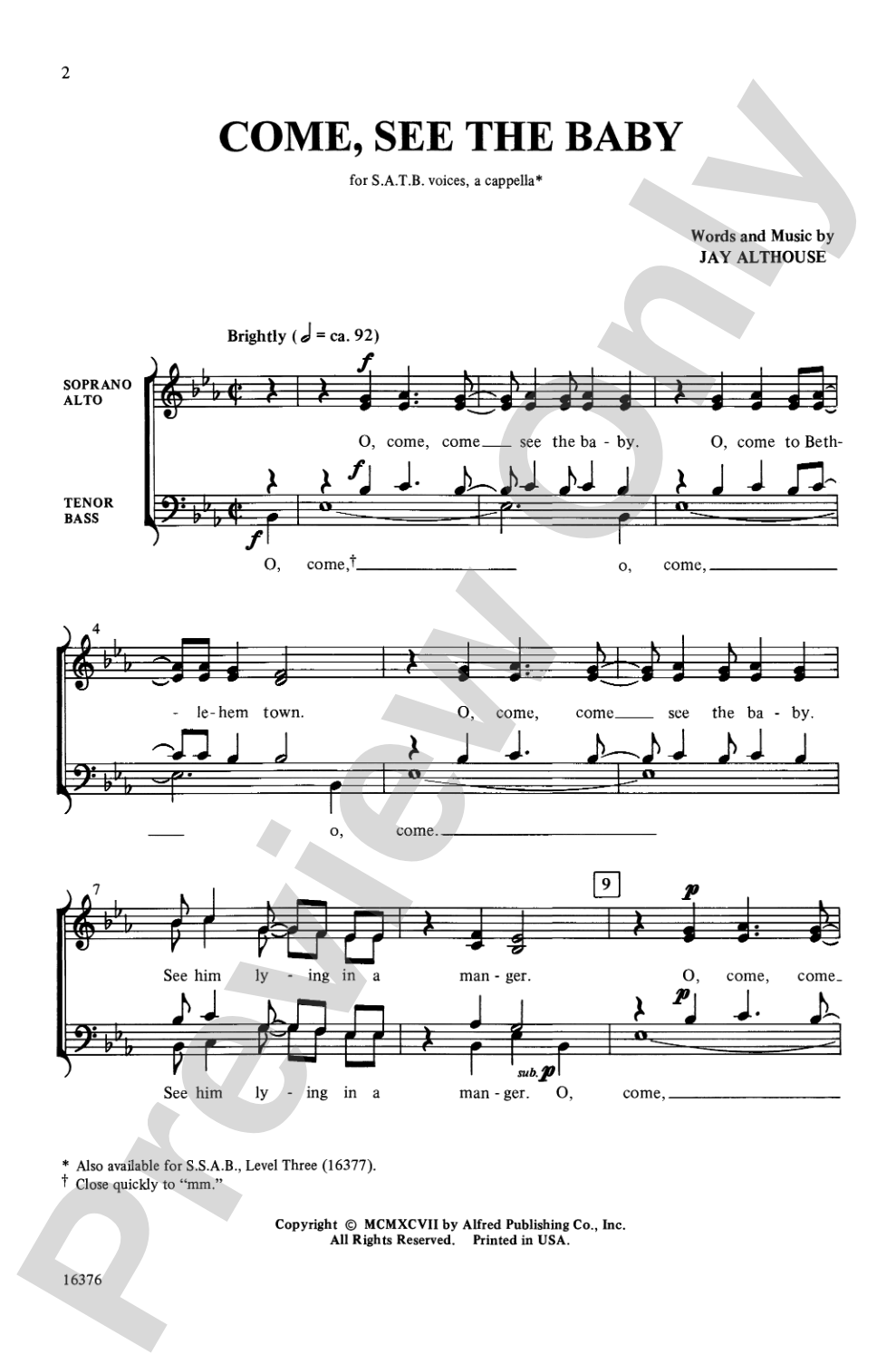
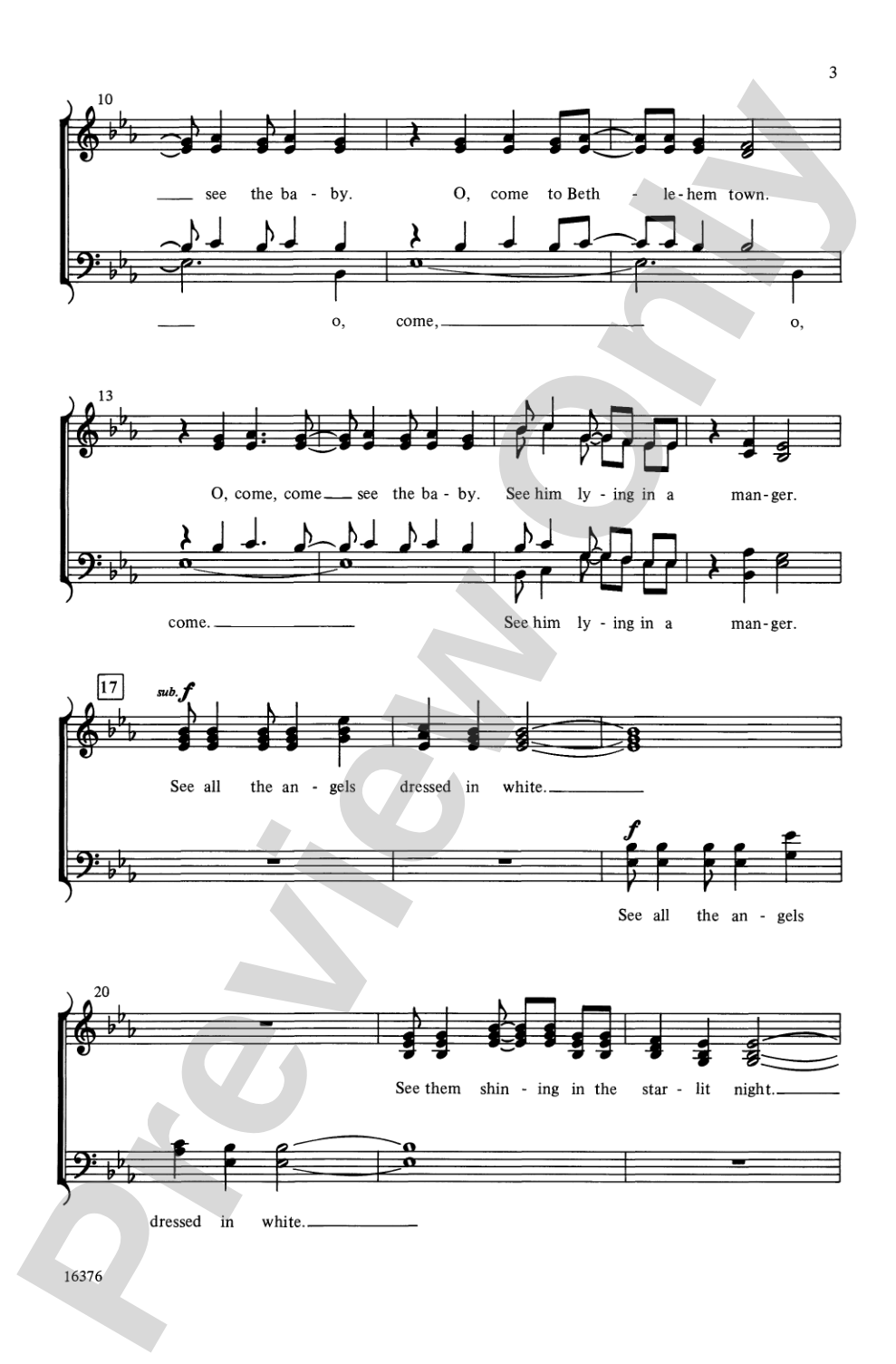
A new, original Christmas spiritual by Jay Althouse in the traditionof his top-selling Whisper!, Whisper!, I saw a Star, and Star of Glory. This full-sounding work features much three-part singing over a solid, traditional bass part, as well as an echo section between the women and the men. Sudden dynamic changes are powerful and effective (and simple to sing).


Come, See the Baby: SATB, a cappella Choral Octavo isn't in MakeMusic Cloud just yet...but it could be. Let us know you'd like to see it, and you'll help shape what comes next. In the meantime, start a free trial and dive into thousands of interactive titles your students can play along with today.
Request This Title
Tell us you want it.
Start Your Free Trial
Explore everything that's ready to play right now.
Sample Audio
No sample audio found.
Sample Video
No sample videos found.
Additional Details
Series:
Alfred Archive Edition: Alfred Choral Designs
Publisher:
Alfred Music
Page Count:
8
SKU:
00-PO-0003983
More about this title
About the Composer: Jay Althouse

Jay Althouse studied music education and music at Indiana University of Pennsylvania, where he later received the Distinguished Alumni award. His career spans both publishing and composition; he spent eight years managing rights and licenses for a major educational music publisher and served on the Executive Board of the Music Publishers Association of America. He is a writer member of ASCAP and a regular recipient of the ASCAP Special Award.
Althouse has composed over 800 choral works performed internationally across all choir levels. Beyond composition, he has compiled respected vocal solo collections, co-written children's musicals with his wife Sally K. Albrecht, and authored instructional resources for music classrooms including The Complete Choral Warm-up Book and Accent on Composers. His choral work "I Hear America Singing" (co-written with Albrecht) was performed by the San Francisco Girls and Boys Choirs at President Barack Obama's 2009 Inauguration. He serves on the National Advisory Board of the Folk Art Society of America and resides in Wake Forest, North Carolina.
Why we love this
Althouse delivers the accessible warmth of a traditional spiritual without requiring complex ensemble work or exhausting rehearsal time. The three-part singing over a steady bass creates genuine fullness in sound, while the echo section between women and men gives your singers a clear structural anchor and a moment of musical dialogue that feels both textually appropriate and dramatically satisfying. Dynamic shifts arrive with impact precisely because they're set against restraint elsewhere in the piece.
What to expect
The piece captures the reverent intimacy of a spiritual without sentimentality. Three-part singing creates a warm, almost conversational texture, and the back-and-forth between women's and men's voices builds a sense of community reflection. Sudden dynamic shifts break the quieter passages with moments of quiet conviction.
Who it's for
This octavo works for choirs of moderate ability and mixed age. The traditional spiritual idiom and straightforward harmonic language make it approachable for less experienced singers, while the structural sophistication (layered voicing, dynamic contrast, call-and-response) keeps mature choirs engaged.
How to get the most out of it
- Balance the three-part women's writing over the bass line by having tenors support the soprano and alto blend in rehearsal; this prevents the traditional bass from sounding isolated and strengthens the overall harmonic foundation.
- Shape the echo section with intentional space between the women's phrase and the men's response; silence is as much part of the effect as the singing itself.
- Mark sudden dynamic changes in pencil before the first rehearsal and drill those transitions as isolated moments; singers absorb sudden shifts better when they see and practice them as distinct events rather than trying to execute them in context.
How to use it
This works as a centerpiece in a Christmas concert program featuring spirituals and traditional sacred music, or as a compelling contrast to more ornate holiday arrangements. Consider pairing it with instrumental or solo-driven pieces to showcase the a cappella setting fully, and program it where its dialogue structure can breathe between ensemble-heavy works.
Skills your students will build
- Singing in thirds and sixths over a sustained bass part
- Executing sudden dynamic contrasts with ensemble cohesion
- Echo singing and call-and-response technique
- Blending three-part harmony while maintaining independent melodic lines
- Breath control and phrasing in a cappella contexts