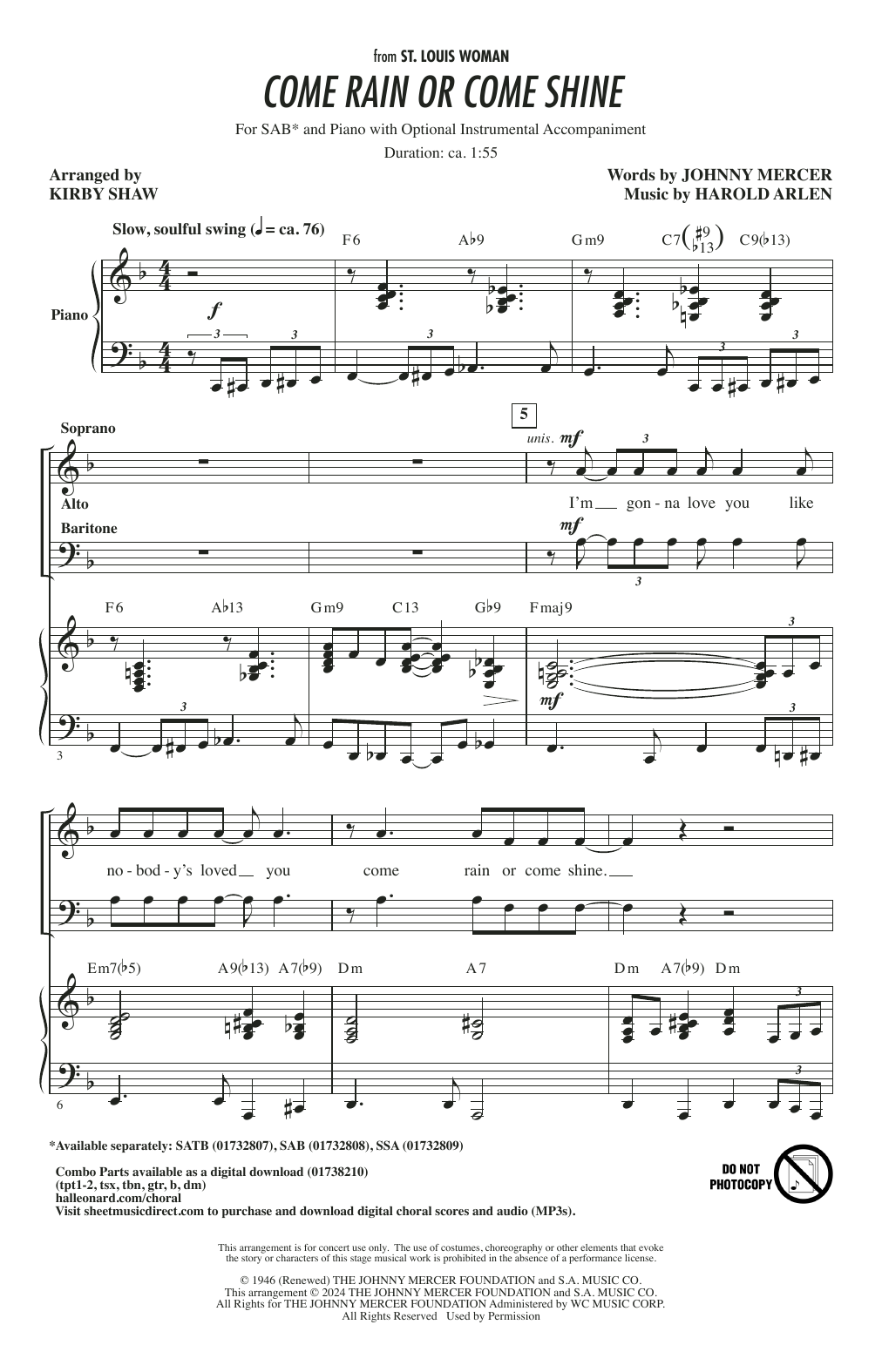
Come Rain Or Come Shine (arr. Kirby Shaw) Sheet Music Preview

Come Rain Or Come Shine (arr. Kirby Shaw): SAB Choral Octavo

Arranged by Kirby Shaw

Item: 35-DS01569093

Digital Download
$2.50

One moment…

Description

Come Rain Or Come Shine (arr. Kirby Shaw): SAB Choral Octavo isn't in MakeMusic Cloud just yet...but it could be. Let us know you'd like to see it, and you'll help shape what comes next. In the meantime, start a free trial and dive into thousands of interactive titles your students can play along with today.

Sample Audio
No sample audio found.
Sample Video
Additional Details
Publisher: Hal Leonard
Page Count: 7
SKU: 35-DS01569093

More about this title

About the Arranger: Kirby Shaw

Kirby Shaw

Kirby Shaw's reputation in choral music stems from decades of hands-on teaching and an extraordinary output of over 2500 arrangements and compositions that have sold nearly 20 million copies worldwide. His education includes degrees in Music Education and Choral Composition from San Jose State University and a DMA in Choral Conducting from the University of Washington. He has conducted innovative vocal jazz ensembles at the College of the Siskiyous, Colorado State University, and the University of Missouri at Kansas City, and currently directs the Jefferson State Choral Coalition at Southern Oregon University.

Shaw's work has taken him across 45 states and to six countries on four continents, sharing his distinctive blend of musical rigor and infectious humor. His mentorship includes personal collaboration with Bobby McFerrin, Al Jarreau, Jon Hendricks, and other jazz luminaries. Beyond his prolific arrangement catalog and multiple ASCAP awards, Shaw co-created the original musical Scroogical with his wife Markita, and performs with Just 4 Kicks, a four-man jazz a cappella ensemble.

Why we love this

Shaw's arrangement captures the warmth and sophistication of this standard while keeping the voicing accessible for mixed ensembles still building their jazz vocabulary. The SAB texture allows directors to bring this sophisticated material into their programs without requiring advanced vocal jazz singers, and the orchestration of the melody across voices creates natural blend and balance points. His decades of experience arranging for singers of all levels shows in how cleanly the parts sit and how the harmony supports rather than overwhelms.

What to expect

Warm, slightly melancholic, and deeply human. The arrangement honors the emotional core of this standard, letting the lyric breathe while the supporting voices create that classic jazz harmonic richness. It feels like a professional recording you could actually achieve in rehearsal without months of intensive jazz training.

Who it's for

Intermediate mixed choirs looking to program Broadway and jazz standards without the complexity of full SATB voicing. Ensembles working on jazz phrasing and interpretation for singers who are confident readers but may be new to the style. Directors building a diverse repertoire that includes accessible big-band era material.

How to get the most out of it

  • Attend to the legit singing voice early in rehearsal; these ballad lines need sustained tone and genuine connection to the lyric before any jazz inflection lands authentically.
  • Work the rhythm section parts (or recorded accompaniment) before full ensemble runs so the harmonic foundation is secure and the singers have something solid to reference.
  • Shape the melody by listening for where the arrangement voices the lead; this isn't a melody-plus-chords setup, so encourage singers to hear how their individual lines contribute to the overall phrase architecture.
  • Mark any subtle tempo or dynamic shifts in pencil during first reads; jazz standards often shift slightly in their feel, and having visual cues prevents the performance from feeling metronomic.

How to use it

Pair this with other classic standards or American songbook selections for a concert celebrating the golden age of musical theater and jazz. It works particularly well as a feature after an energetic opener, giving your ensemble and audience a moment to settle into genuine storytelling. Consider it for winter concert programming or any showcase celebrating American vocal traditions.

Skills your students will build

  • Jazz phrasing and interpretation in a ballad context
  • Reading SAB voicing and tracking individual lines within vertical harmony
  • Sustaining legit singing tone while incorporating jazz articulation
  • Listening to and supporting a moving vocal line rather than doubling it
  • Interpreting a standard with stylistic authenticity

You May Also Like