Come, Let Us All The Day Sheet Music Preview

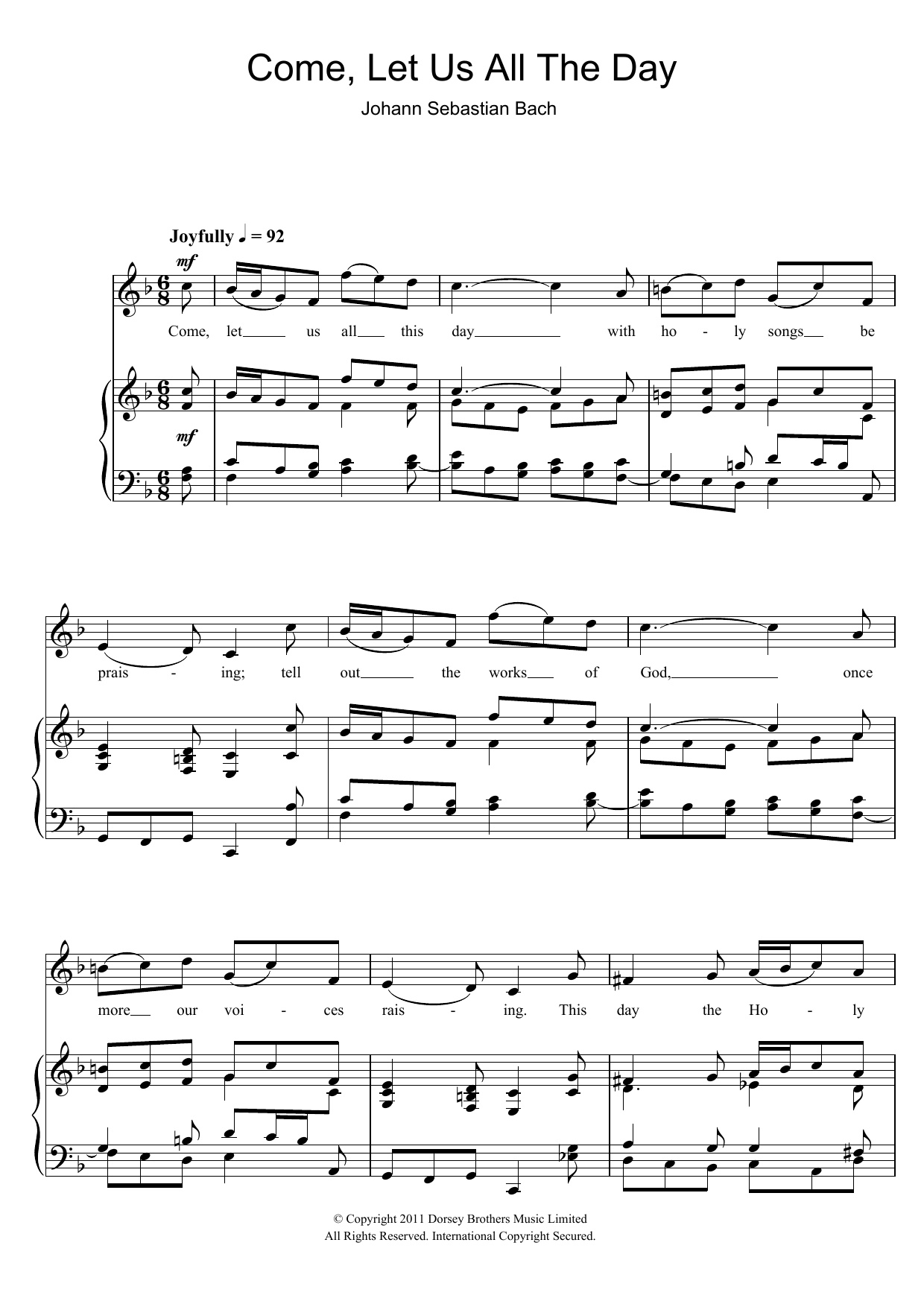
Come, Let Us All The Day: Piano Vocal

By Johann Sebastian Bach

Item: 35-DS00205515

Digital Download
$5.99
Description

Come, Let Us All The Day: Piano Vocal isn't in MakeMusic Cloud just yet...but it could be. Let us know you'd like to see it, and you'll help shape what comes next. In the meantime, start a free trial and dive into thousands of interactive titles your students can play along with today.

Sample Audio
No sample audio found.
Sample Video
Additional Details
Publisher: Hal Leonard
Page Count: 3
SKU: 35-DS00205515

More about this title

About the Composer: Johann Sebastian Bach

Johann Sebastian Bach (1685–1750) stands as perhaps the most systematic and comprehensive musical mind in Western classical tradition. His output spans every major genre except opera, and his harmonic language established foundational principles that composers still study today. For music students and educators, Bach's work offers unmatched rigor in counterpoint, voice leading, and structural design.

Bach spent much of his career in administrative and pedagogical roles, composing vast quantities of music for worship, court performance, and instruction. His keyboard works in particular were conceived as teaching tools that simultaneously function as profound artistic statements. This dual nature makes his music especially valuable in educational settings, where technical demands and musical depth reinforce one another.

Why we love this

This Bach chorale arrangement preserves the composer's elegant four-part voice leading in a format that allows singers to learn the melody while accompanying themselves or working with a pianist. The three-page length makes it accessible for rehearsal without overwhelming preparation, and the harmonic language demonstrates the kind of smooth, logical progressions that singers benefit from hearing and internalizing.

What to expect

Serene and grounded, with the dignity that comes from Bach's unhurried harmonic movement. The melody sits comfortably in the voice, supported by warm, familiar harmonies that feel inevitable rather than surprising. There is clarity and light throughout, never overwrought or sentimental.

Who it's for

Singers working on art song repertoire, intermediate vocalists building comfort with classical texts, and pianists seeking accessible vocal accompaniment material that teaches harmonic foundation. It suits ensemble or solo contexts equally well.

How to get the most out of it

  • Shape each phrase according to the text's natural speech rhythm rather than treating every measure identically. Bach's harmonies often suggest subtle dynamic contours that enhance emotional clarity.
  • Attend to the inner voices on the piano part. If a student is singing, their awareness of how their line relates to those surrounding harmonies deepens both intonation and musicianship.
  • Balance legato singing with the clarity that Bach's harmonic rhythm requires. The listener should hear both the vocal line and the functional progression beneath it.

How to use it

Include this on a recital exploring sacred vocal repertoire from different eras, or pair it with other Bach chorales to create a focused program segment. It also works well as a concert opener, setting a reflective tone before moving to contrasting material.

Skills your students will build

  • Singing through Bach's harmonic language with accurate intonation
  • Interpreting baroque phrasing and text declamation
  • Understanding four-part voice leading as a singer rather than purely as theory
  • Coordinating with a pianist on period-appropriate tempos and interpretive choices
  • Maintaining legato vocal production while honoring harmonic rhythm

You May Also Like