Come, Join in Singing Sheet Music Preview

Come, Join in Singing: 3-Part Mixed, a cappella Choral Octavo

By Jacob Arcadelt / ed. Patrick M. Liebergen

Level: Moderately Easy

Item: 00-PO-0003063

Digital Download
$2.25

Minimum order quantity: 20 copies

Description
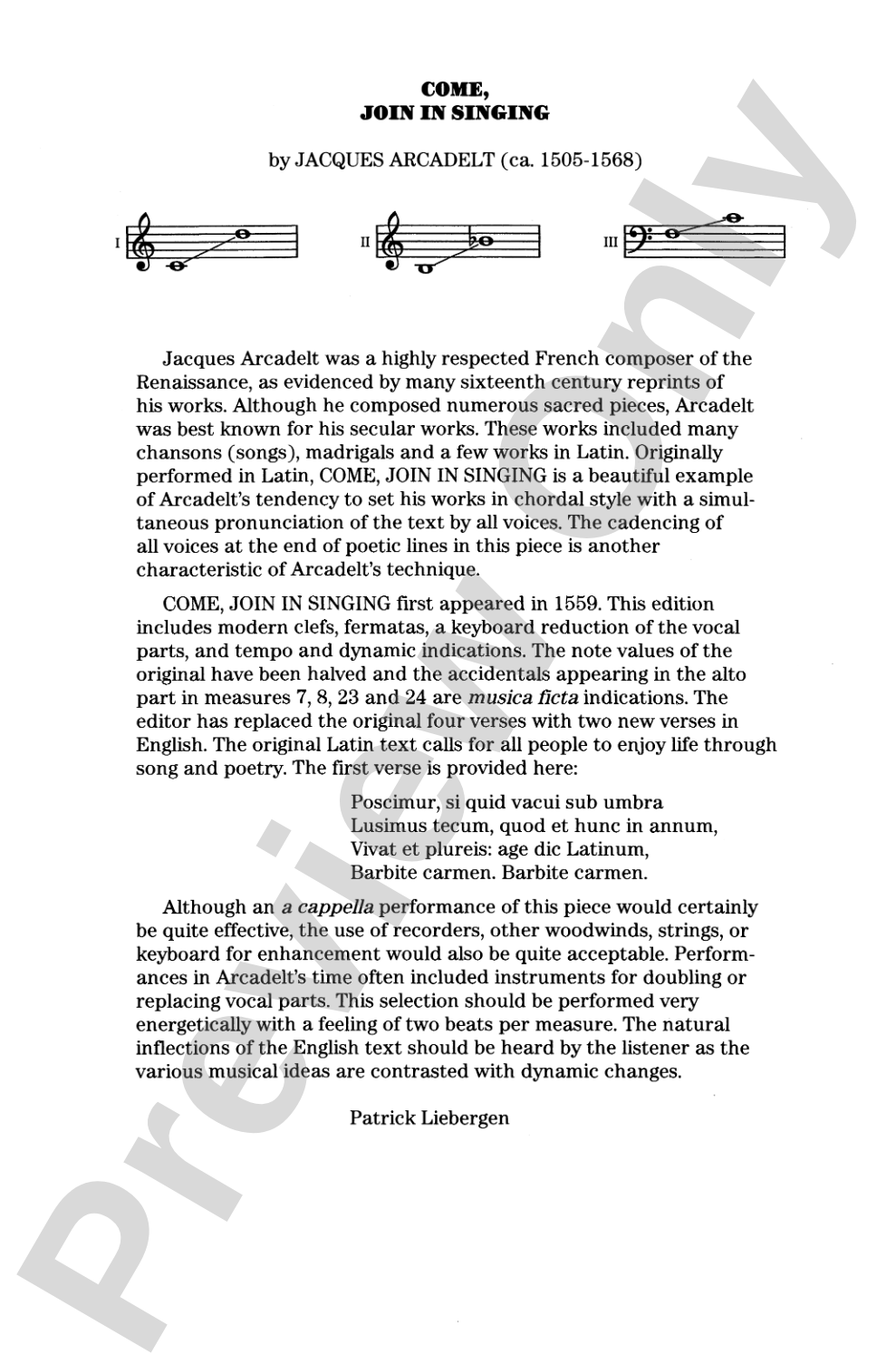
Arcadelt is known for his homophonic, tuneful settings. Provided with a new English text by the editor, this late Renaissance work is perfect for the emerging mixed ensemble. The boys' range is limited to five notes. Performed a cappella, with keyboard or with instruments, this work is ideal for concert, contest or festival.

Come, Join in Singing: 3-Part Mixed, a cappella Choral Octavo isn't in MakeMusic Cloud just yet...but it could be. Let us know you'd like to see it, and you'll help shape what comes next. In the meantime, start a free trial and dive into thousands of interactive titles your students can play along with today.

Sample Audio
No sample audio found.
Sample Video
Additional Details
Series: Alfred Archive Edition: Belwin Festival Series
Publisher: Alfred Music
Page Count: 8
SKU: 00-PO-0003063

More about this title

About the Composer: Jacob Arcadelt

Jacob Arcadelt (c. 1507-1568) was a Franco-Flemish composer whose career spanned from the early Renaissance through the mid-sixteenth century. He served in papal choirs and held positions across Europe, composing sacred works alongside a substantial catalog of secular songs and madrigals that made him one of the most widely published musicians of his era.

Arcadelt's gift for melody and clarity of texture established him as a master of the homophonic style. His secular works, in particular, demonstrate an intuitive understanding of how singable lines and straightforward harmonic progressions can convey both elegance and emotional directness—qualities that made his music enduringly popular with both professional and amateur singers of the sixteenth century.

Why we love this

Arcadelt's melodic clarity and lean texture translate beautifully to emerging ensembles, and the deliberately limited range in the lower part means singers without extensive experience can participate fully and confidently. This new English text opens Renaissance repertoire to younger or community choirs without the historical-music expertise often required for pieces in their original languages.

What to expect

A Renaissance song of elegant simplicity, with a melody that feels both fresh and timeless. The homophonic texture creates an intimate, almost song-like warmth that lets the text breathe naturally without contrapuntal complexity.

Who it's for

This octavo suits emerging mixed choirs, particularly those in their first or second year of ensemble singing. It also works well for community or adult choirs seeking approachable Renaissance repertoire that doesn't demand specialized vocal technique or historical-music training.

How to get the most out of it

  • Shape the melodic line with gentle emphasis on strong beats rather than mechanical accentuation; Renaissance phrasing favors natural speech rhythm over metrical regularity.
  • Support the ensemble sound with keyboard accompaniment if the a cappella version feels thin; even a soft organ or harpsichord continuo can anchor pitch and confidence without overwhelming the voices.
  • Balance the three parts so that the soprano line emerges naturally as the primary melody; the inner and lower parts should blend rather than compete.
  • Use this piece to introduce ensemble intonation across a wider range of voices; the straightforward harmony highlights tuning issues and rewards precision in each singer.

How to use it

Include this as an opener or interlude in a concert featuring lighter works; its brevity and accessibility make it an ideal palette-cleanser between more demanding pieces. It also pairs well with other Renaissance or Renaissance-inspired secular repertoire, or stand alone as a festival or contest piece that builds ensemble confidence.

Skills your students will build

  • Reading SAB voicing and managing part independence in a three-part texture
  • Sustaining intonation across changing harmonic motion in simple but transparent harmony
  • Interpreting Renaissance phrase shapes and text expression without modern dynamic extremes
  • Building ensemble blend when one part carries the primary melody

You May Also Like