
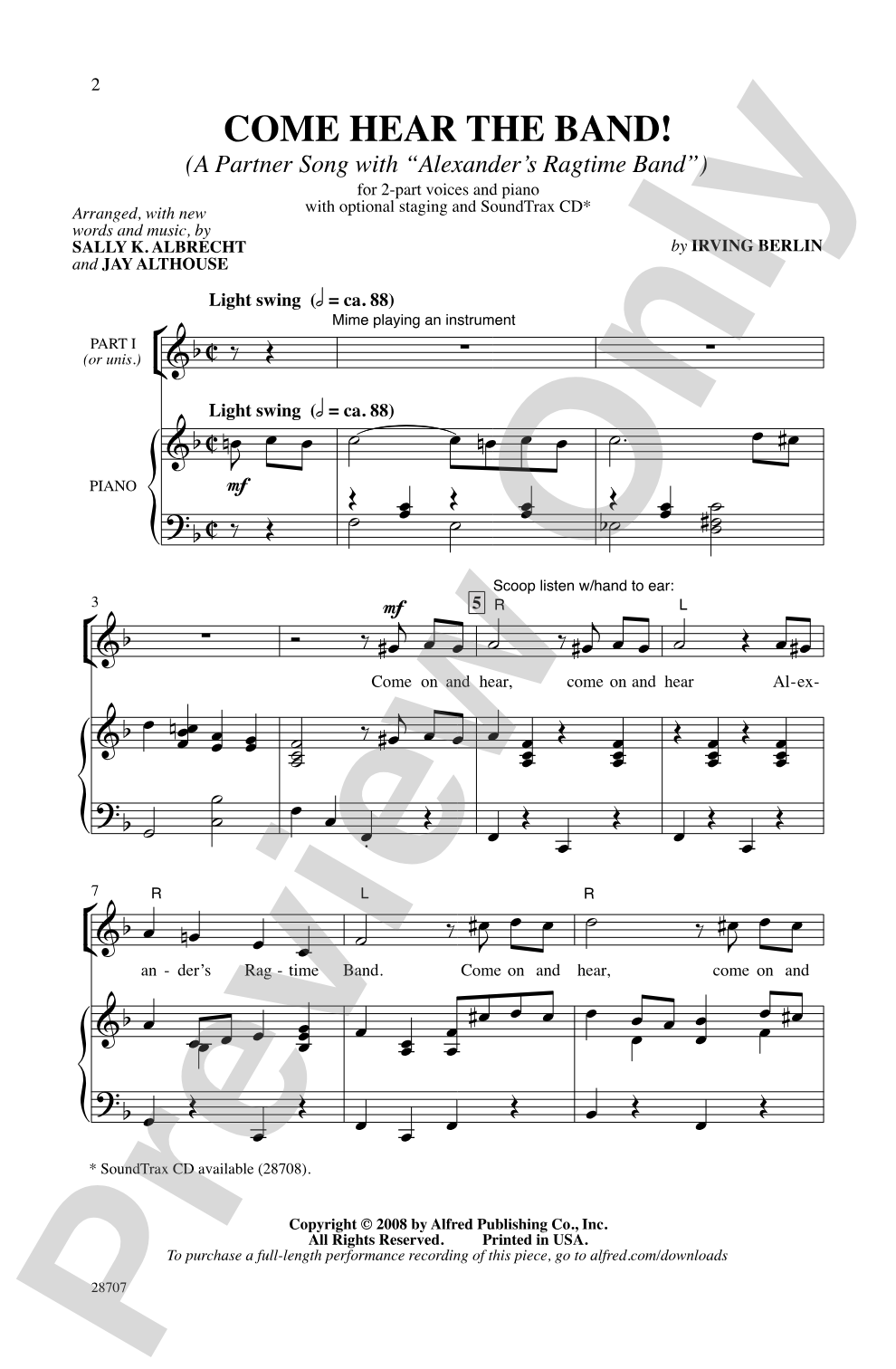

Come Hear the Band!: 2-Part Choral Octavo
A Partner Song with Irving Berlin's "Alexander's Ragtime Band"
Arr., with new words and music, by Sally K. Albrecht and Jay Althouse
Item: 00-PO-0000542
$1.75
Minimum order quantity: 20 copies
Pickup currently not available
Description
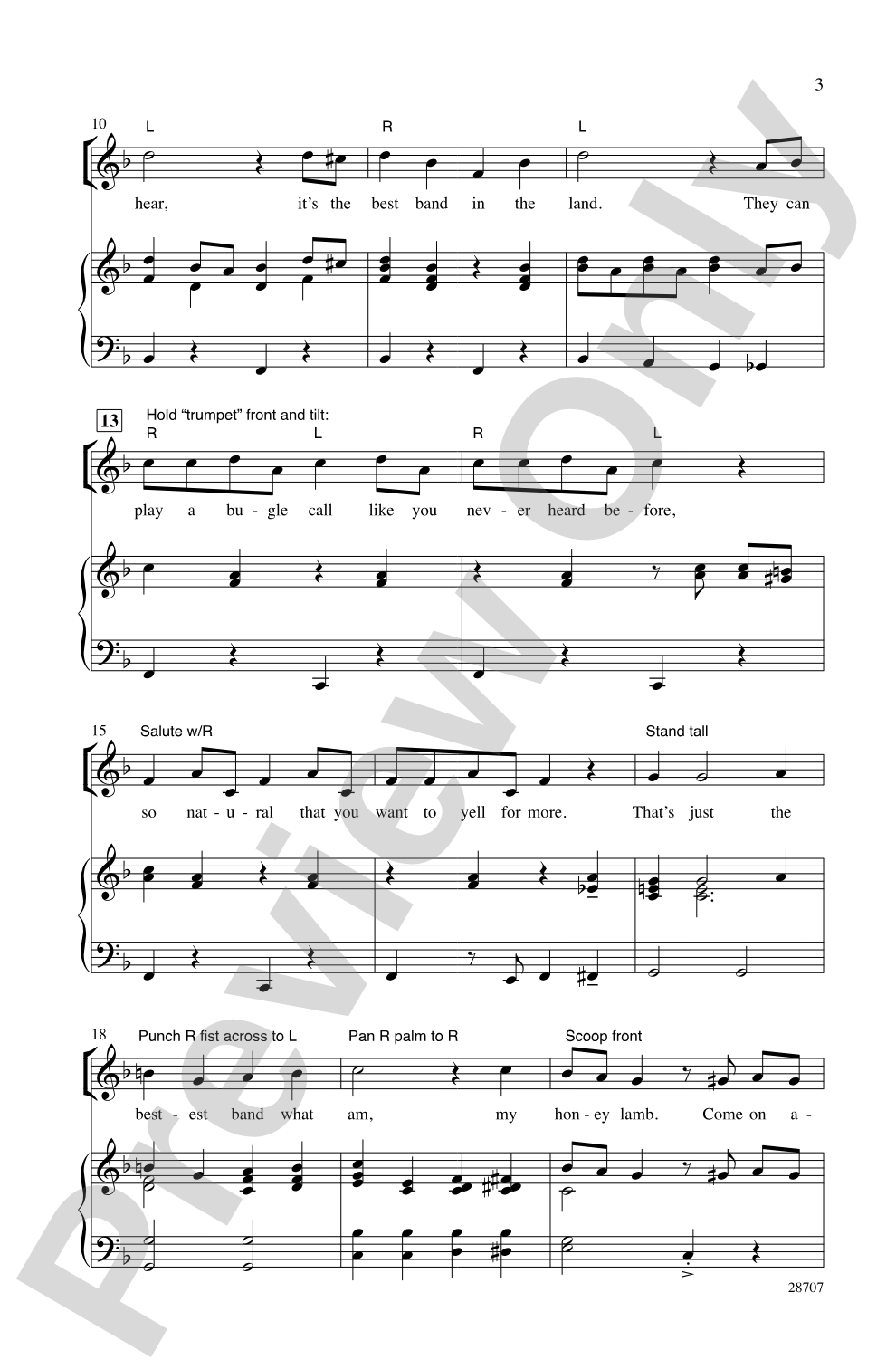
This effective arrangement partners the familiar Irving Berlin "Alexander's Ragtime Band" with a clever countermelody, imitating a tuba, clarinet, trombone, and flute. Staging included in the publication and featured on the "Hooray for Hollywood!" movement DVD #28868.


Come Hear the Band!: 2-Part Choral Octavo isn't in MakeMusic Cloud just yet...but it could be. Let us know you'd like to see it, and you'll help shape what comes next. In the meantime, start a free trial and dive into thousands of interactive titles your students can play along with today.
Request This Title
Tell us you want it.
Start Your Free Trial
Explore everything that's ready to play right now.
Sample Audio
1
Audio File
--:--
0:00
0:00
Sample Video
No sample videos found.
Additional Details
Series:
Alfred Choral Designs
Publisher:
Alfred Music
Page Count:
12
SKU:
00-PO-0000542
More about this title
About the Composer: Irving Berlin
Irving Berlin (1888-1989) was one of America's most prolific songwriters, composing over 1,000 songs across musical theater, film, and popular music. His melodies are built on deceptive simplicity: they lodge in the ear immediately yet reveal harmonic sophistication upon closer study. Berlin's "Alexander's Ragtime Band," published in 1911, became one of the defining songs of the ragtime era and remains a standard in both popular and educational contexts.
Why we love this
This arrangement transforms a recognizable favorite into genuine theater. The countermelodies imitating distinct band instruments give singers character work beyond vocal line, and the included staging makes it a complete package for concert or classroom performance. Young singers get to inhabit the sounds of jazz-age instrumentation while learning the joy of harmonizing with attitude.
What to expect
Playful and energetic, with the infectious bounce of early 20th-century ragtime. The interlocking instrumental imitations create a sense of ensemble joy, like a small jazz combo has walked into your rehearsal room. There's room for expression and personality without sacrificing musical coherence.
Who it's for
Middle school and high school choirs seeking repertoire that engages younger singers with humor, character, and clear musical storytelling. This arrangement works equally well for festival performance, school concerts, or classroom units on American popular song and jazz history.
How to get the most out of it
- Assign singers to specific instrument voices (tuba, clarinet, trombone, flute) and have them listen to recordings of those instruments before rehearsal; this gives each part melodic ownership and clarifies the textural intention.
- Nail the rhythmic swing of ragtime by working the syncopation separately from the melody; Berlin's ragtime idiom demands precision but should never feel stiff.
- Layer the staging gradually during rehearsals, beginning with the 2-part vocal work, then adding movement once the singers are secure with intonation and blend.
- Use the recorded accompaniment to establish proper style and tempo, especially if your singers are unfamiliar with authentic ragtime feel.
How to use it
Program this as an opening number to energize an audience, or pair it with other Americana and jazz standards to anchor a thematic concert. The movement and staging also make it suitable as an entertainment piece within a larger show or as a teaching tool in music history units on the ragtime era.
Skills your students will build
- Singing syncopated rhythms accurately in ragtime idiom
- Blending harmonic countermelodies while maintaining individual part identity
- Interpreting stage movement and choreography integrated with vocal performance
- Listening to and imitating instrumental timbres vocally