
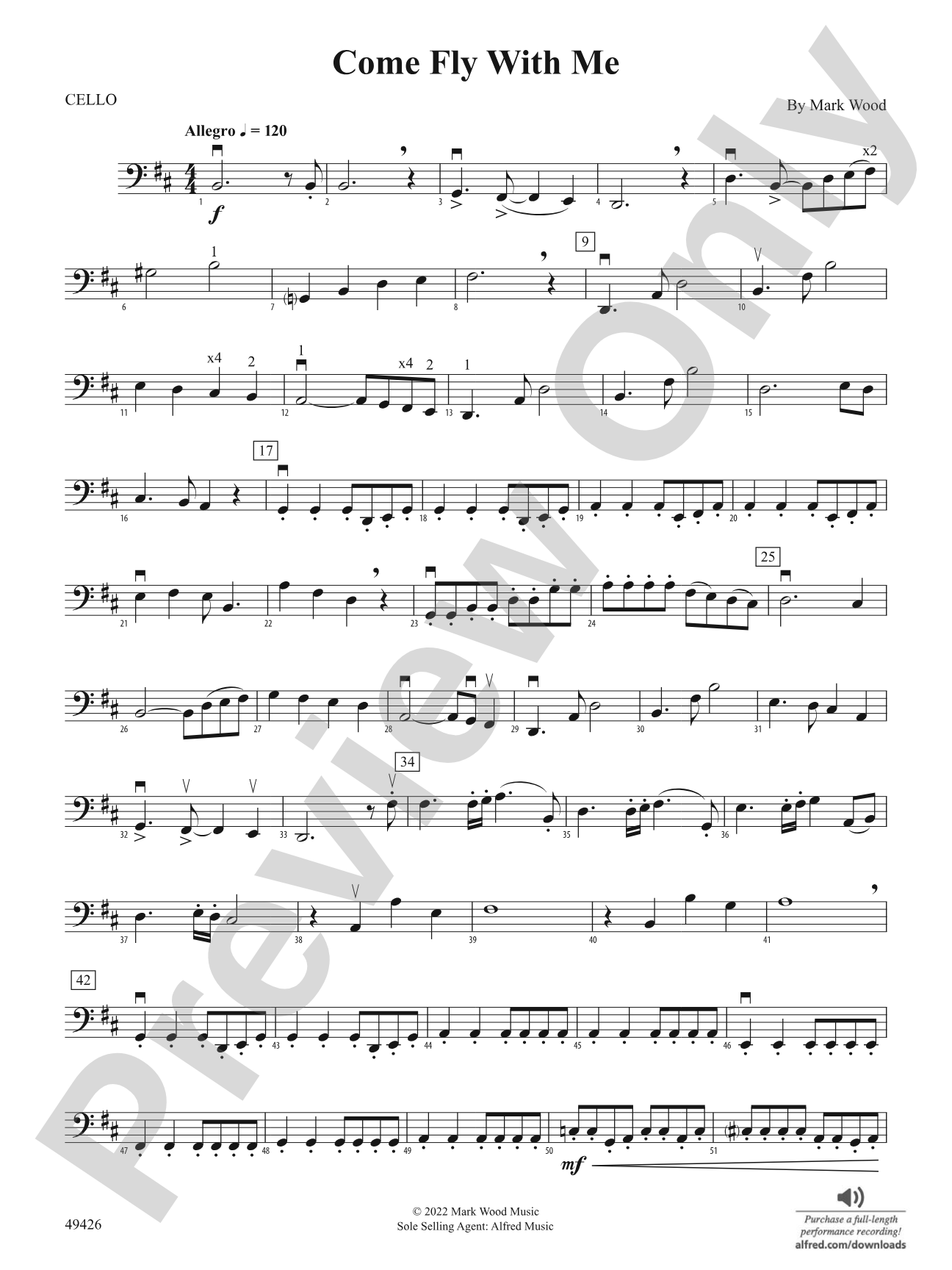

Come Fly with Me: Cello
By Mark Wood
Grade: 3
Item: 00-PC-0019156_VC1
$3.00
Pickup currently not available
Description
The composer, Mark Wood, writes: Come Fly with Me comes from my personal visualization of flying while improvising music. In writing a work which combines classical and American rock styles, I have created a vehicle for musicians to spread their wings and truly learn the beautiful art of composing their own music on the spot in the improvisation section. (4:00)


Come Fly with Me: Cello isn't in MakeMusic Cloud just yet...but it could be. Let us know you'd like to see it, and you'll help shape what comes next. In the meantime, start a free trial and dive into thousands of interactive titles your students can play along with today.
Request This Title
Tell us you want it.
Start Your Free Trial
Explore everything that's ready to play right now.
Sample Audio
1
Come Fly with Me (Play-Along)
--:--
2
Come Fly with Me
--:--
Come Fly with Me (Play-Along)
0:00
0:00
Sample Video
Additional Details
Series:
Mark Wood Series
Publisher:
Alfred Music
SKU:
00-PC-0019156_VC1
More about this title
About the Composer: Mark Wood

Mark Wood is an electric violinist and composer who has spent four decades reshaping what strings can do in contemporary music. Rising to international prominence as founding member and string master of Trans Siberian Orchestra, which sold over 10 million records, Wood earned the distinction of PBS calling him "The Eddie Van Halen and Jimi Hendrix of The Violin World" for his pioneering work in electric violin. His versatility spans solo albums, film and television scoring (including an Emmy for Olympic broadcast music), collaborations with artists like Celine Dion, Billy Joel, and Paul McCartney, and performances on stages including Carnegie Hall and Lincoln Center.
Beyond his recording and performance career, Wood is deeply committed to music education. His original compositions for student ensembles bridge classical and contemporary idioms, creating opportunities for young musicians to engage with rock and pop styles while developing serious orchestral skills. His work reflects a conviction that strings belong in every musical conversation.
Why we love this
This piece uses the string orchestra's full color palette to inhabit a world that feels contemporary and energized without losing orchestral sophistication. The built-in improvisation section gives your students genuine compositional agency rather than asking them to merely execute what's written, transforming rehearsal into creative discovery.
What to expect
Soaring and liberated, with the energy of flight and the exhilaration of spontaneous music-making. The piece balances structured orchestral writing with moments of genuine freedom, creating a sense that anything could happen within the frame of a steady groove.
Who it's for
Conductors leading Grade 3 and 3½ orchestras who want to introduce improvisation and contemporary compositional thinking without leaving classical training behind. String students ready to take ownership of their own musical ideas and comfortable playing in rock and pop idioms.
How to get the most out of it
- Establish a steady pulse in rehearsal before introducing the improvisation section; students need rhythmic confidence before they can explore melodic invention.
- Balance the rock groove in the accompanying parts so it supports rather than overwhelms the improvising section.
- Let the string soloists in the improvisation hear the recorded or rehearsal accompaniment multiple times before their first run-through.
- Shape the transitions between the composed passages and the improvisation as intentional moments, not accidents of stopping and starting.
How to use it
Program this as a concert centerpiece that showcases your orchestra's versatility and introduces audiences to string-driven contemporary music. It pairs well on a mixed repertoire concert alongside traditional classical selections, offering audiences a vivid contrast while demonstrating orchestral relevance beyond the nineteenth century.
Skills your students will build
- Improvisation within a rhythmic and harmonic framework
- Ensemble cohesion while supporting individual soloists
- Rock and pop stylistic conventions for strings
- Listening and response to ongoing musical material
- Confidence in spontaneous musical decision-making