
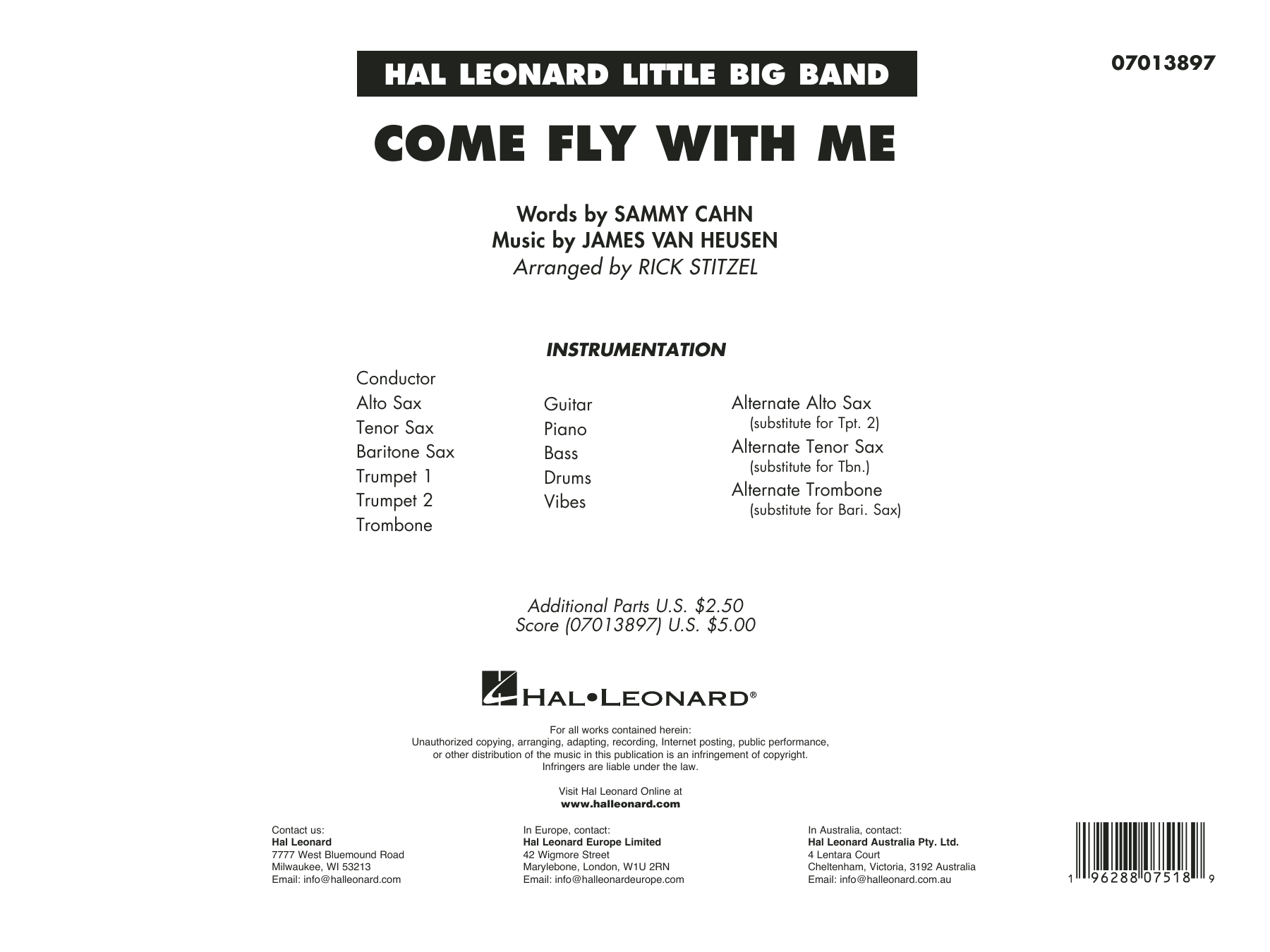

Come Fly With Me (arr. Rick Stitzel): Jazz Ensemble Conductor Score & Parts
By Sammy Cahn / As performed by Frank Sinatra / Arranged by Rick Stitzel
Grade: 2
Item: 35-PK01112185
$45.00
Pickup currently not available
Buy Extra Parts (Digital PDF Download)
Parts Added to Cart!
Description
Arranged in a comfortable medium swing style and featuring easy rhythms and ranges, this popular standard fits nicely in the easy level of the Little Big Band Series. Nice scoring for the entire ensemble, and no solos are required.


Come Fly With Me (arr. Rick Stitzel): Jazz Ensemble Conductor Score & Parts isn't in MakeMusic Cloud just yet...but it could be. Let us know you'd like to see it, and you'll help shape what comes next. In the meantime, start a free trial and dive into thousands of interactive titles your students can play along with today.
Request This Title
Tell us you want it.
Start Your Free Trial
Explore everything that's ready to play right now.
Sample Audio
No sample audio found.
Sample Video
No sample videos found.
Additional Details
Publisher:
Hal Leonard
SKU:
35-PK01112185
More about this title
About the Composer: Sammy Cahn
Sammy Cahn (1913-1993) was one of America's most prolific lyricists, crafting words for some of the 20th century's most enduring melodies. His partnership with composer Jule Styne produced standards that defined the Great American Songbook, and his ability to marry sophisticated rhyme schemes with conversational ease made him a favorite of vocalists from Frank Sinatra to Barbra Streisand.
For music educators, Cahn's catalog represents a goldmine of accessible yet genuinely well-crafted material. His lyrics reward careful phrasing and interpretation without requiring advanced vocal technique, making his songs ideal teaching vehicles for understanding how melody, rhythm, and language work together in jazz.
Why we love this
Rick Stitzel's arrangement strips away none of the song's charm while keeping it genuinely playable for young jazz ensembles. The medium swing groove sits perfectly for groups still building their rhythmic vocabulary, and the full-ensemble voicing means every player contributes meaningfully rather than sitting out sections waiting for a solo.
What to expect
Buoyant and breezy. The melody rises and falls with the lightness of someone truly ready for adventure, and Stitzel's arrangement captures that optimism through straightforward harmonies and a groove that lets the tune breathe. There's joy in the simplicity without any sense of condescension.
Who it's for
Grade 2 jazz ensembles ready to tackle a recognizable standard without the complexity of soloists or dense harmonic reharmonization. This works for bands meeting a few times weekly and for students encountering swing style for the first time, since the rhythmic demands are straightforward and the part-writing is clear.
How to get the most out of it
- Lock the time feel first. Spend a full rehearsal establishing a relaxed, floating swing that sits just behind the beat rather than rushing ahead; once the rhythm section settles, soloists and melodic voices will find their pocket naturally.
- Balance the saxes and brass when they're stating the melody together. The sax section should mirror the brass tone and energy rather than compete, which keeps the arrangement sounding cohesive and prevents the high woodwinds from overpowering the ensemble.
- Articulate all quarter notes and shorter rhythms with the same attack and weight across sections. Inconsistent tonguing between trumpet and saxophone lines, or between first and second trumpet, will muddy the groove even if the time feel is solid.
- Treat dynamic markings as part of the arrangement's storytelling. Pulling back during ensemble hits or swells, then popping back in for the melody, gives the piece shape and keeps your players engaged through repeated sections.
How to use it
Pair this with another early Sinatra standard or a different era of swing tune to build a mini unit on the Great American Songbook. It also sits well on a jazz concert as a palate cleanser between busier arrangements, since audiences recognize it immediately and young players gain the confidence of playing something genuinely familiar.
Skills your students will build
- Swing eighth-note feel and time placement
- Ensemble balance and blend in scored passages
- Articulation consistency across sections
- Reading and interpreting jazz notation (slash notation, swing markings)
- Phrasing and dynamic shape within a song form