
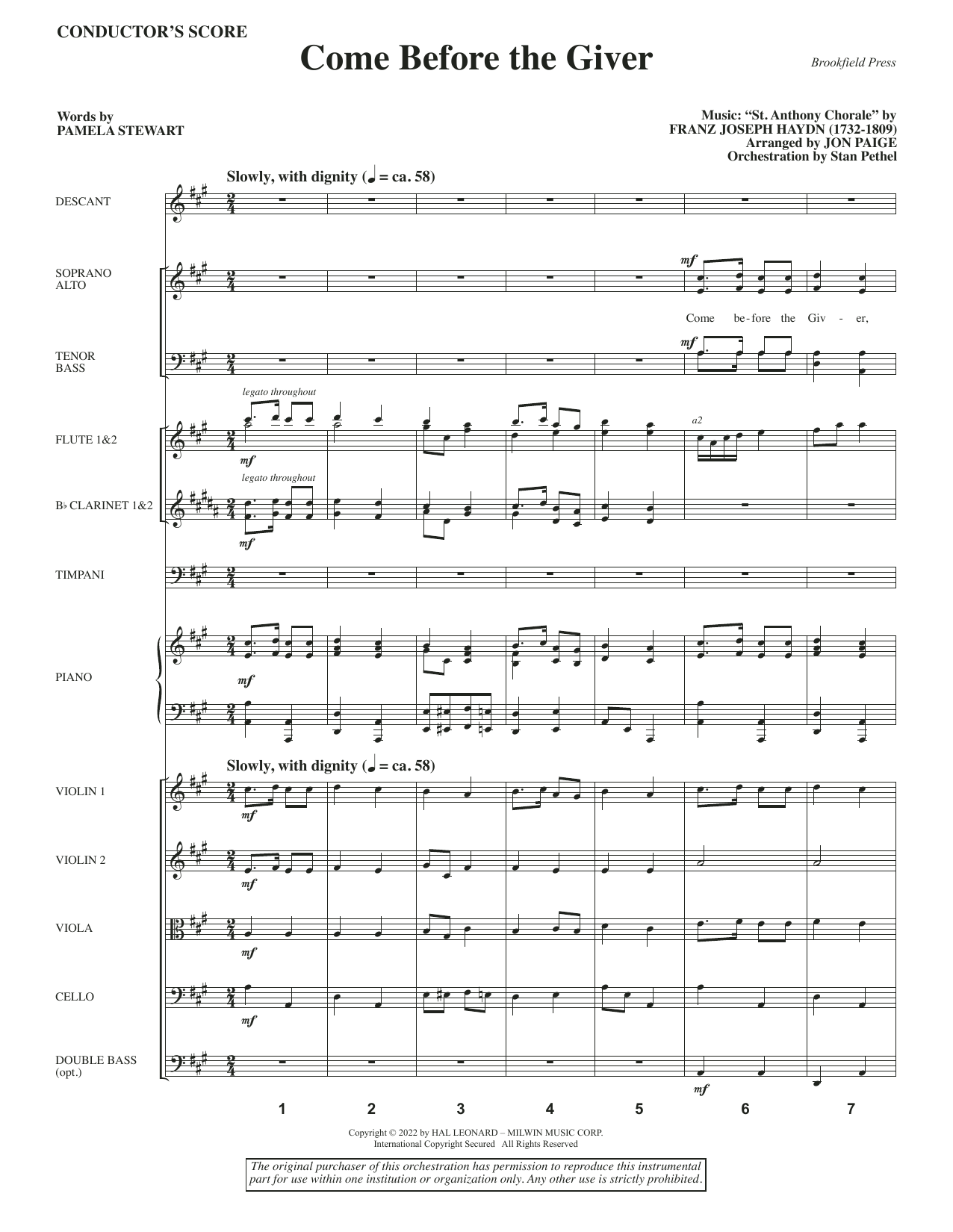

Come Before the Giver (arr. Jon Paige): Choral Instrumental Pak
By Franz Joseph Haydn / Arranged by Jon Paige
Item: 35-PK01048018
$63.00
Pickup currently not available
Buy Extra Parts (Digital PDF Download)
Parts Added to Cart!
Description
A re-imagining of a classical evergreen, this hymn of gratitude has the feeling of a processional. Reliable part-writing gives the anthem a traditional flair and maximizes the choral richness of any group. Appropriate anytime but especially useful at Thanksgiving. Score and Parts (fl 1-2, cl 1-2, timp, vn 1-2, va, vc, opt. db) available as a digital download.


Come Before the Giver (arr. Jon Paige): Choral Instrumental Pak isn't in MakeMusic Cloud just yet...but it could be. Let us know you'd like to see it, and you'll help shape what comes next. In the meantime, start a free trial and dive into thousands of interactive titles your students can play along with today.
Request This Title
Tell us you want it.
Start Your Free Trial
Explore everything that's ready to play right now.
Sample Audio
No sample audio found.
Sample Video
No sample videos found.
Additional Details
Publisher:
Hal Leonard
SKU:
35-PK01048018
More about this title
About the Composer: Franz Joseph Haydn
Franz Joseph Haydn (1732-1809) spent most of his career as Kapellmeister for the Esterházy family, a position that demanded constant output across every musical genre. His prolific work with both instrumental and vocal music shaped the Classical style itself; his symphonies, string quartets, and choral works became models for composers who followed. Haydn's gift for memorable melody and structural clarity made his music accessible without sacrificing sophistication, a balance that keeps his works essential in the choral repertoire today.
As a church musician and court composer, Haydn wrote numerous sacred works that blend personal devotion with technical mastery. His hymns and anthems combine tuneful vocal writing with rich harmonic language, creating pieces that sound equally at home in a concert hall or a liturgical setting. For directors seeking music that honors tradition while maintaining musical substance, Haydn remains an invaluable resource.
Why we love this
Jon Paige's arrangement honors Haydn's original while adding orchestral color that deepens the hymn's sense of ceremony. The string and wind writing feels naturally supportive rather than decorative, allowing the choir to shine while the ensemble adds texture and weight. Choirs at any level benefit from part-writing this clean; there's nowhere to hide, but nothing stands in the way either.
What to expect
There's a quiet dignity here, the kind of measured reverence that feels both timeless and immediate. The processional quality creates forward momentum without hurry, while the orchestration adds warmth and ceremonial weight to the gratitude expressed in the text.
Who it's for
This works for concert and sacred programs at the middle school level and above. Directors programming Thanksgiving services, holiday celebrations, or general concerts benefit from music that feels substantial without requiring advanced vocal technique.
How to get the most out of it
- Bring out the processional character by maintaining a steady, dignified tempo; let the ensemble lead the harmonic motion and the choir follow with confidence.
- Balance the flute and clarinet parts carefully in exposed passages so they enhance rather than overpower the vocal melody.
- Shape the timpani entries to support structural moments without rushing; subtle dynamic control here makes the difference between stately and plodding.
- Work for uniformity of vowel sound across the choir, especially in longer held notes where the string section will highlight any inconsistency.
How to use it
Pair this with other Haydn or classical sacred works to build a program focused on the hymn tradition, or use it as a centerpiece for a Thanksgiving service where you want instrumental support but not full orchestral weight. It also anchors a concert of arranged hymns or devotional music, offering a well-crafted model of how classical masterworks can be modernized with fresh orchestration.
Skills your students will build
- Blend and balance with a small instrumental ensemble
- Sustaining legato tone across phrase lengths
- Interpreting Classical period harmonic language
- Coordinate with non-vocal musicians in real time