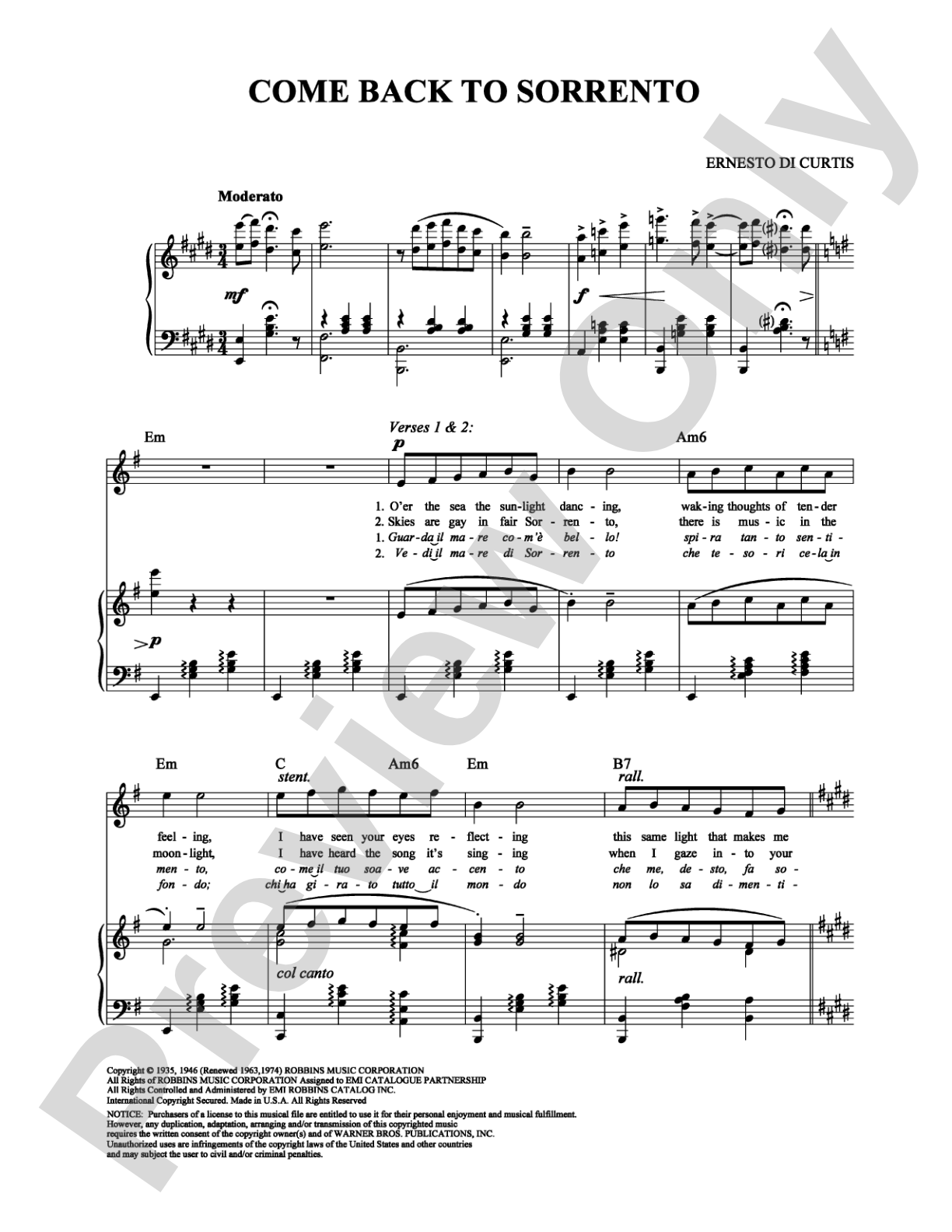
Come Back To Sorrento: Piano/Vocal/Chords Digital Sheet Music

Come Back To Sorrento: Piano/Vocal/Chords Digital Sheet Music

Ernesto Di Curtis

Item: 00-PS-0010092

Digital Download
$3.99
Description

Come Back To Sorrento: Piano/Vocal/Chords Digital Sheet Music isn't in MakeMusic Cloud just yet...but it could be. Let us know you'd like to see it, and you'll help shape what comes next. In the meantime, start a free trial and dive into thousands of interactive titles your students can play along with today.

Sample Audio
No sample audio found.
Sample Video
Additional Details
SKU: 00-PS-0010092

More about this title

About the Creator

"Come Back to Sorrento" emerged from the Italian songwriting tradition of the early 20th century, capturing a deeply romantic longing for a place and time that seems impossibly distant. The song's enduring appeal lies in its ability to transform personal nostalgia into something universal, making it a staple of both classical voice studios and popular music repertoire across generations.

Its simple yet sophisticated harmonic structure has made it a favorite for musicians exploring the intersection of art song and popular melody. The piece rewards both straightforward interpretation and imaginative reharmonization, which explains why it appears in so many different arrangements and why musicians keep returning to it.

Why we love this

This arrangement captures the romantic sweep of a beloved standard while remaining accessible to pianists and singers working across intermediate skill levels. The chord notations make it equally useful for jazz ensembles, piano bar performers, or classical recitals seeking a touch of vintage warmth.

What to expect

Wistful and deeply romantic, this arrangement carries the pull of memory and longing. The harmonic language unfolds with the grace of a song meant to linger in the listener's mind long after it ends.

Who it's for

Vocalists preparing recitals, crossover programs, or audition repertoire will find this arrangement straightforward enough to learn quickly yet nuanced enough to sustain artistic growth. Pianists seeking repertoire that develops accompanying skills, particularly the balance between harmonic sophistication and melodic support, will appreciate the chord-based framework. It's ideal for students exploring how popular standards sit at the intersection of classical technique and interpretive freedom.

How to get the most out of it

  • Shape the melody with long, singing phrases rather than punctuating every note; let the lyrical line breathe and carry the emotional weight of the text.
  • Explore the chord symbols beyond strict interpretation, try subtle reharmonizations that reflect the vocalist's interpretation without losing the song's essential character.
  • Balance the piano part so it supports rather than overwhelms the voice; the accompaniment should feel like a conversation, not a solo with background vocals.
  • Establish a warm, unhurried tempo that allows rubato to feel natural; this song asks for flexibility, not metronomic precision.

How to use it

Position this as a standalone vocal feature in a recital exploring themes of nostalgia and place, or pair it alongside other European standards and art songs to create a themed set. It works equally well as an encore or as part of a lighter program segment in a classical concert.

Skills your students will build

  • Interpreting jazz chord symbols and voicings in a traditional song context
  • Balancing vocal melody with piano accompaniment at varying dynamic levels
  • Shaping phrase contours through rubato and expressive timing
  • Reading and performing from lead sheet notation

You May Also Like