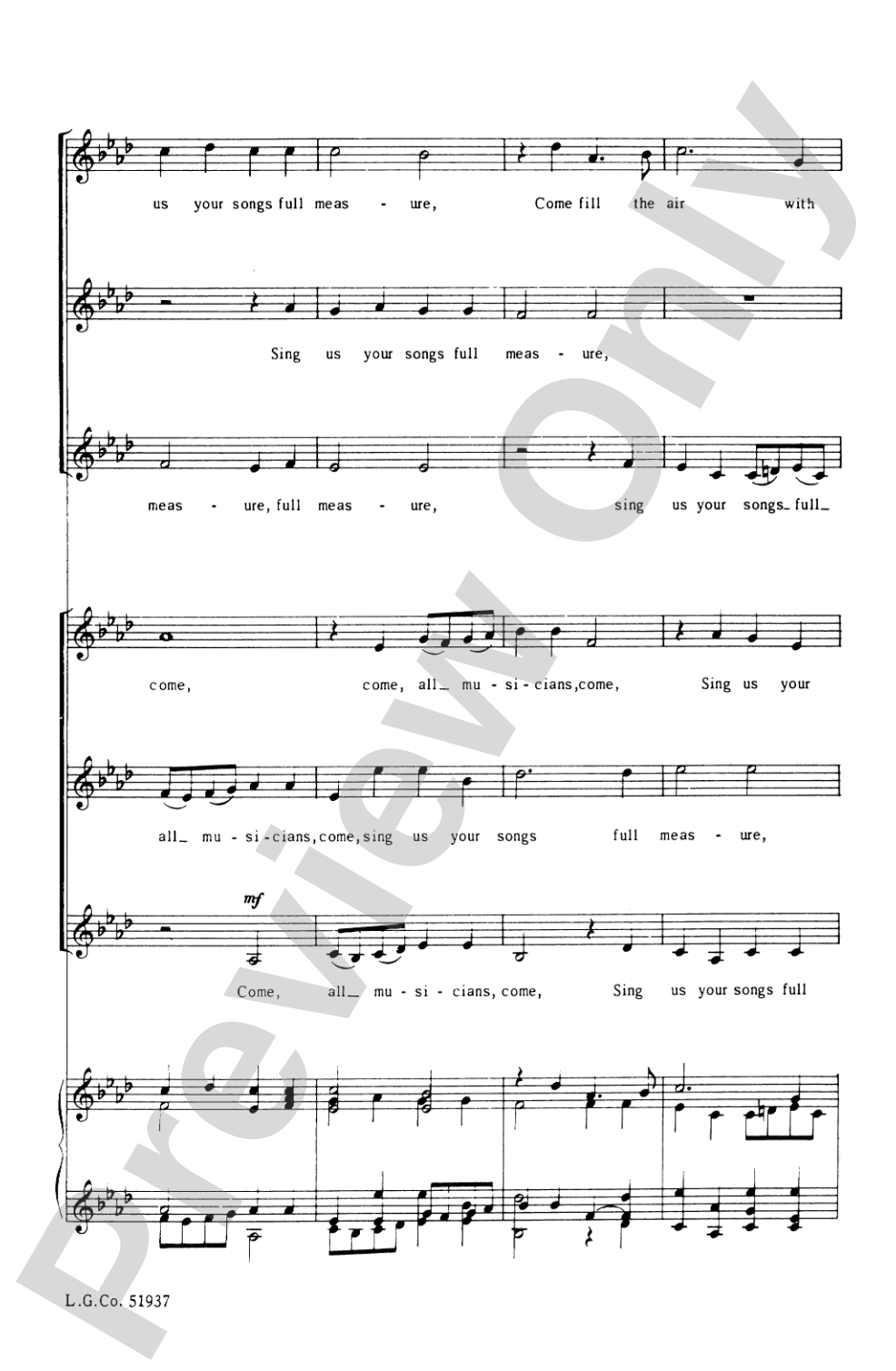
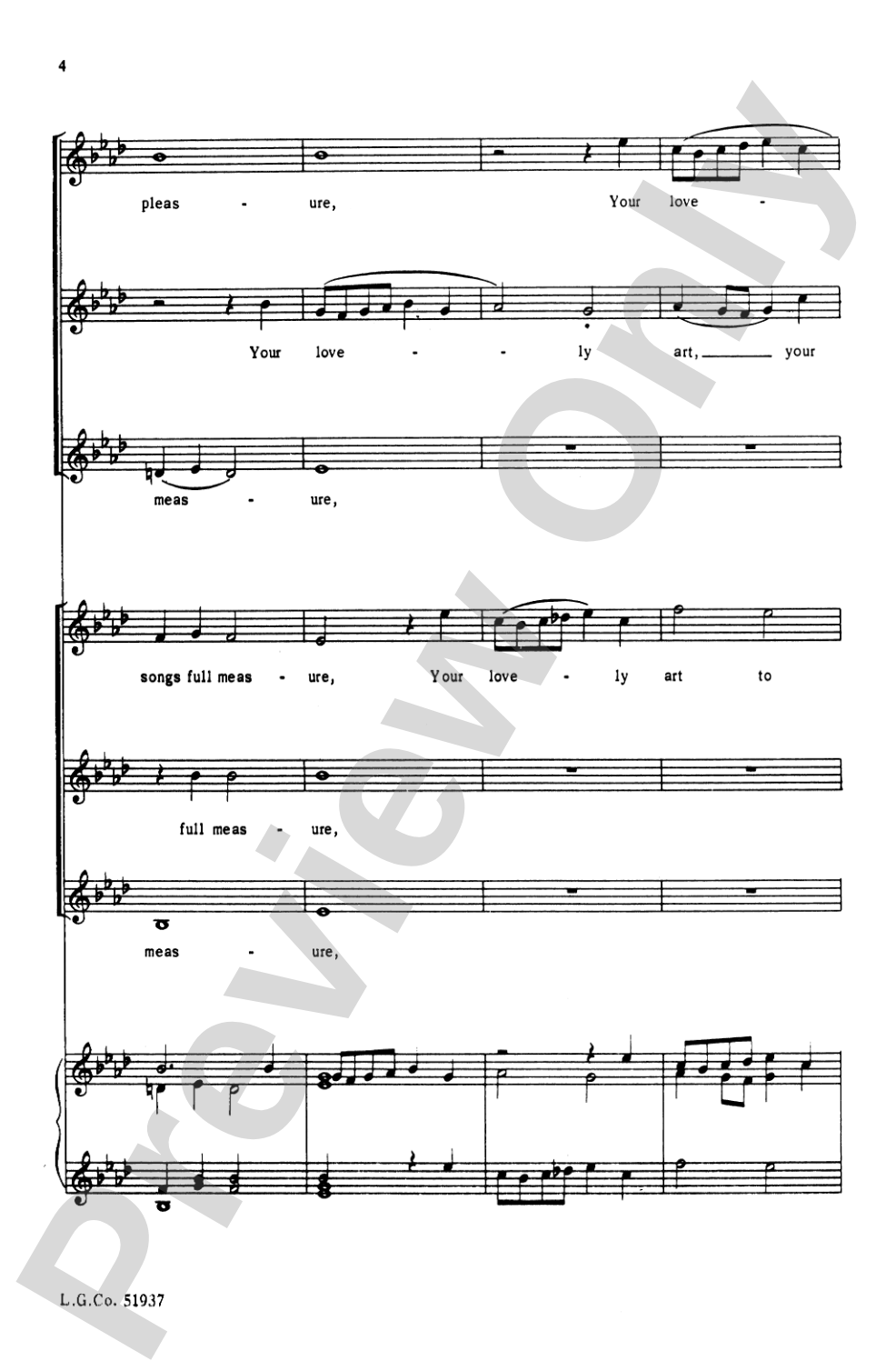
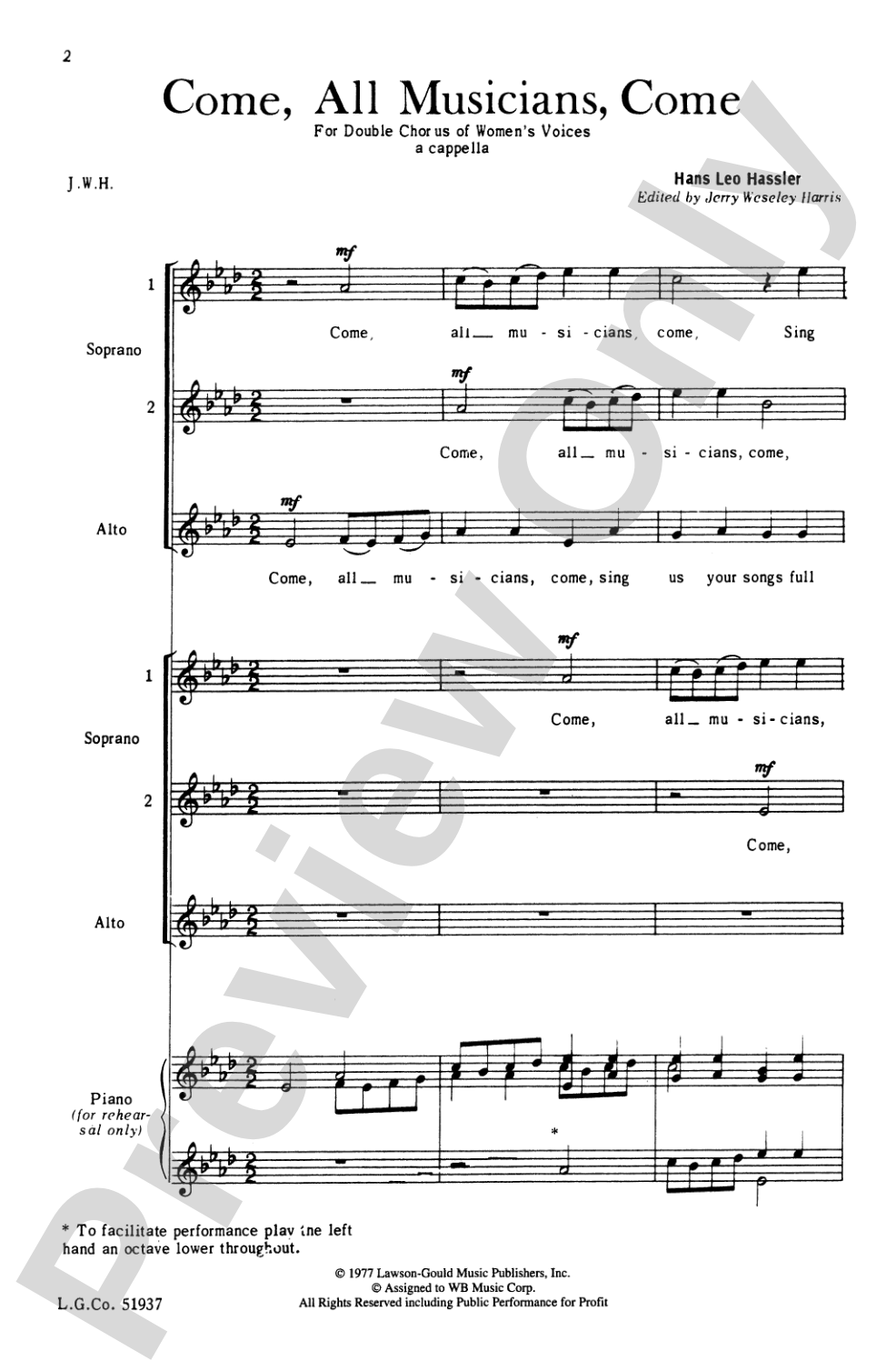
Come, All Musicians, Come Sheet Music Preview

Come, All Musicians, Come: SSA Choral Octavo

By Hans Leo Hassler / ed. Jerry Weseley Harris

Item: 00-PO-0003023

Digital Download
$2.95

Minimum order quantity: 20 copies

Description

Come, All Musicians, Come: SSA Choral Octavo isn't in MakeMusic Cloud just yet...but it could be. Let us know you'd like to see it, and you'll help shape what comes next. In the meantime, start a free trial and dive into thousands of interactive titles your students can play along with today.

Sample Audio
No sample audio found.
Sample Video
Additional Details
Series: Alfred Archive Edition: Lawson-Gould Music Publishers
Publisher: Alfred Music
Page Count: 16
SKU: 00-PO-0003023

More about this title

About the Composer: Hans Leo Hassler

Hans Leo Hassler (1564-1612) was among the most prolific composers of the late Renaissance, equally fluent in sacred and secular idioms. Born in Nuremberg and trained in Venice under Andrea Gabrieli, he absorbed both Italian and German musical traditions, a synthesis that made him one of the most influential composers north of the Alps.

Hassler's secular works, including motets and part-songs, reveal his gift for elegant counterpoint and singable melody. His music bridges the Renaissance and early Baroque, maintaining the clarity and balance of 16th-century polyphony while embracing the expressive possibilities of the emerging era. Many of his compositions remain standards in the choral repertoire.

Why we love this

Renaissance part-songs this well-crafted rarely appear in standard choral catalogs, yet they teach textural clarity and part independence with minimal rehearsal overhead. The piece sits comfortably for developing singers while maintaining the intellectual rigor that makes Renaissance music so rewarding to conduct. Its moderate length and SSA voicing make it genuinely usable in mixed-ability choirs and concert programming.

What to expect

Bright and conversational, like musicians genuinely inviting others to join them in song. The text and music move together with ease; there's no struggle, just clear lines interweaving and resolving in satisfying harmonic moments. It feels like Renaissance chamber music rendered intimate and human.

Who it's for

Choirs with solid sightreading skills and at least one season of Renaissance repertoire under their belt will find this piece accessible and rewarding. It works equally well in high school honor choirs, collegiate ensembles, or community groups with intermediate-to-advanced singers. The SSA voicing makes it a natural fit for treble or all-female ensembles.

How to get the most out of it

  • Balance the parts so each line remains audible; Renaissance polyphony depends on clarity rather than blend. This means resisting the urge to cover weaker sections with stronger ones.
  • Maintain steady pulse without modern rubato. Hassler's rhythmic language is direct; let the text and harmonic rhythm guide phrasing rather than tempo shifts.
  • Shape phrases by text accent and harmonic arrival, not by dynamic swells. The structural integrity of the counterpoint is your guide.

How to use it

Program this alongside other late Renaissance secular works to create a cohesive 15-minute Renaissance set, or use it as a tonal palette cleanser between a major choral work and something contemporary. Its modest performance demands and accessible charm make it ideal for pops concerts, educational outreach performances, or mid-season rehearsal repertoire that doesn't demand intensive preparation.

Skills your students will build

  • Reading Renaissance notation and text declamation in SSA voicing
  • Independent line singing and avoiding harmonic doubling tendency
  • Sustaining tone without vibrato while maintaining intonation in close harmony
  • Recognizing cadential patterns and harmonic function in Renaissance context

You May Also Like