
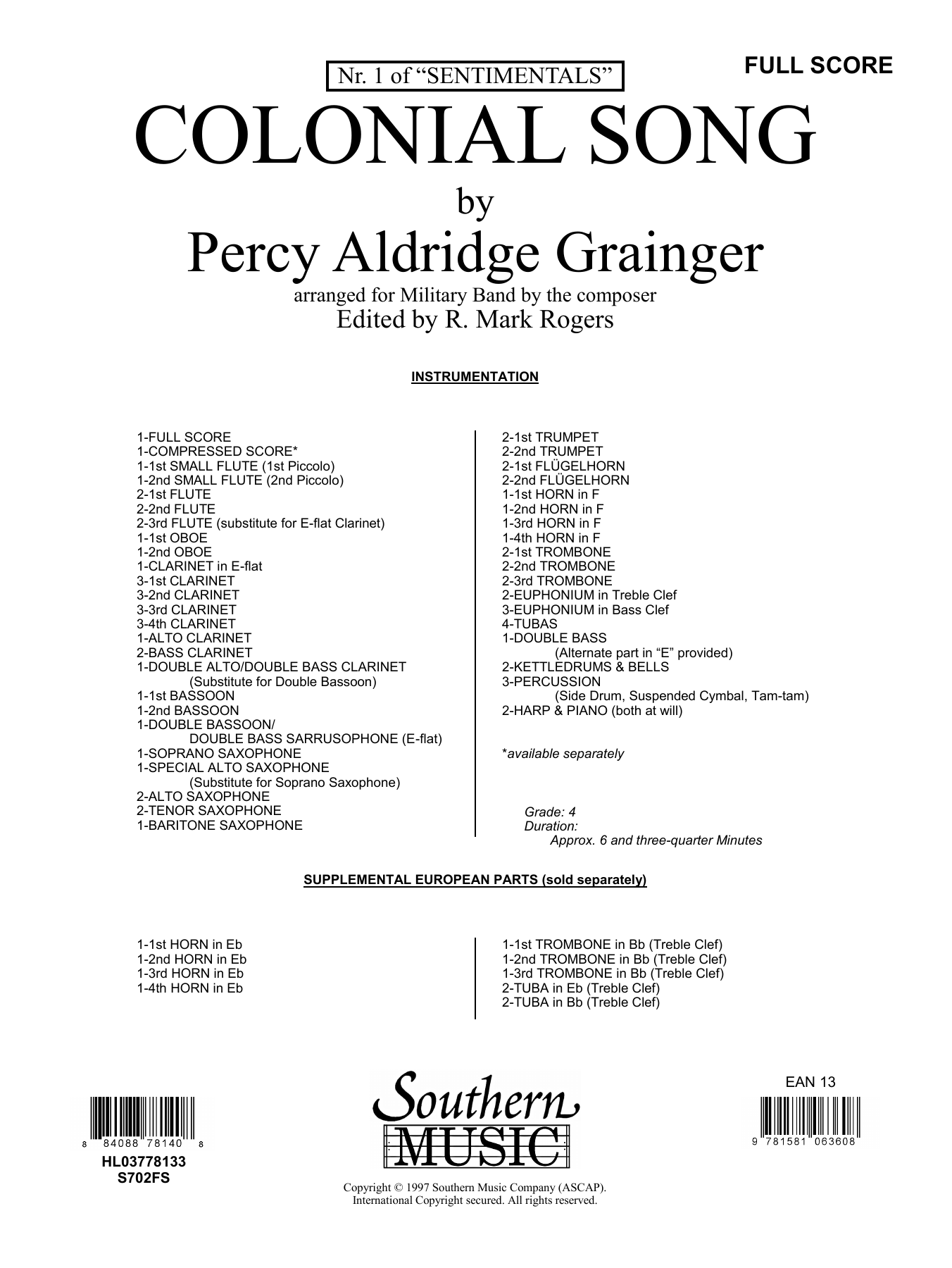

Colonial Song: Concert Band Conductor Score & Parts
By Percy Grainger / Arranged by R. Mark Rogers
Grade: 4
Item: 35-PK01469851
$95.00
Pickup currently not available
Buy Extra Parts (Digital PDF Download)
Parts Added to Cart!
Description
Grainger's art inextricably linked to folk music, this composition, which uses no traditional tunes but is meant to express feelings aroused by thoughts of the scenery and people of his native Australia, is perhaps the finest, and may well be the most well-crafted, of any of his original works. Intended to be the first of a set of pieces written in a sweetly romantic vein called "Sentimentals", the composer dedicated this composition to his mother, though it remains the only piece in the set following her death. This edition returned to the original arrangement for band produced by Grainger to create the most authentic version, true to the composer's intentions, with small adjustments in instrumentation made to accommodate the contemporary band.


Colonial Song: Concert Band Conductor Score & Parts isn't in MakeMusic Cloud just yet...but it could be. Let us know you'd like to see it, and you'll help shape what comes next. In the meantime, start a free trial and dive into thousands of interactive titles your students can play along with today.
Request This Title
Tell us you want it.
Start Your Free Trial
Explore everything that's ready to play right now.
Sample Audio
No sample audio found.
Sample Video
No sample videos found.
Additional Details
Publisher:
Hal Leonard
SKU:
35-PK01469851
More about this title
About the Composer: Percy Grainger
Percy Grainger (1882–1961) was an Australian composer and pianist whose career spanned concert halls, folk music archives, and innovative pedagogical work. His compositions reveal a musician equally at home with modernist techniques and genuine love for vernacular traditions; he collected folk songs obsessively and saw authentic cultural expression as the lifeblood of serious music. Grainger's original works for band became foundational repertoire for the ensemble, and his thoughtful approach to instrumentation influenced generations of arrangers and conductors.
Why we love this
Colonial Song occupies rare territory: it has the lyrical generosity of a Grainger band work without leaning on a folk tune, which means the craftsmanship is entirely visible. The piece breathes with genuine emotional weight, and directors appreciate how the romantic idiom sits comfortably within Grade 4 technical demands. This edition's fidelity to Grainger's original band arrangement gives students the authentic sound the composer envisioned.
What to expect
Colonial Song evokes introspection and nostalgia without sentimentality. The harmonic language is richer than the melody first suggests; underneath the lyrical surface, Grainger creates subtle color shifts that convey emotional depth. You hear both a landscape and the memory of a landscape, seen through the eyes of someone far from home.
Who it's for
Conductors building a thoughtful concert program who want to showcase original band writing from a major composer. The piece rewards both ensemble and audience; students gain exposure to genuine melodic craftsmanship in a piece that sits at the upper end of Grade 4 difficulty without excessive technical demands.
How to get the most out of it
- Shape the melodic line in your principal clarinet with subtle dynamic waves rather than rigid terracing; the sweetly romantic character emerges from continuous phrasing, not punctuation.
- Balance the woodwind and brass carefully in tutti sections so that thematic material remains audible even when the ensemble swells.
- Resist the urge to rush; Grainger's harmonic language rewards space and allows listeners to absorb the tender progressions.
- Let the lower voices (trombones, low reeds, euphonium) anchor the piece with steady support; this underpin gives the upper melodic material room to sing freely.
How to use it
Pair this with other Grade 4 works that invite contrast in color or energy; the piece works beautifully as a centerpiece in a concert devoted to art songs and chamber works arranged for band. It also serves well as a transition piece when you want the ensemble to settle into careful listening and expressive control before tackling more demanding repertoire.
Skills your students will build
- Sustaining long phrases with consistent air support and vibrato control
- Balancing independent melodic lines in a harmonically rich texture
- Responding to subtle dynamic and timbral nuance from the conductor
- Interpreting romantic-era harmonic language through ensemble sound
- Listening across the band to maintain homogeneous tone quality in sustained passages