Colliding Visions: F Horn Sheet Music Preview

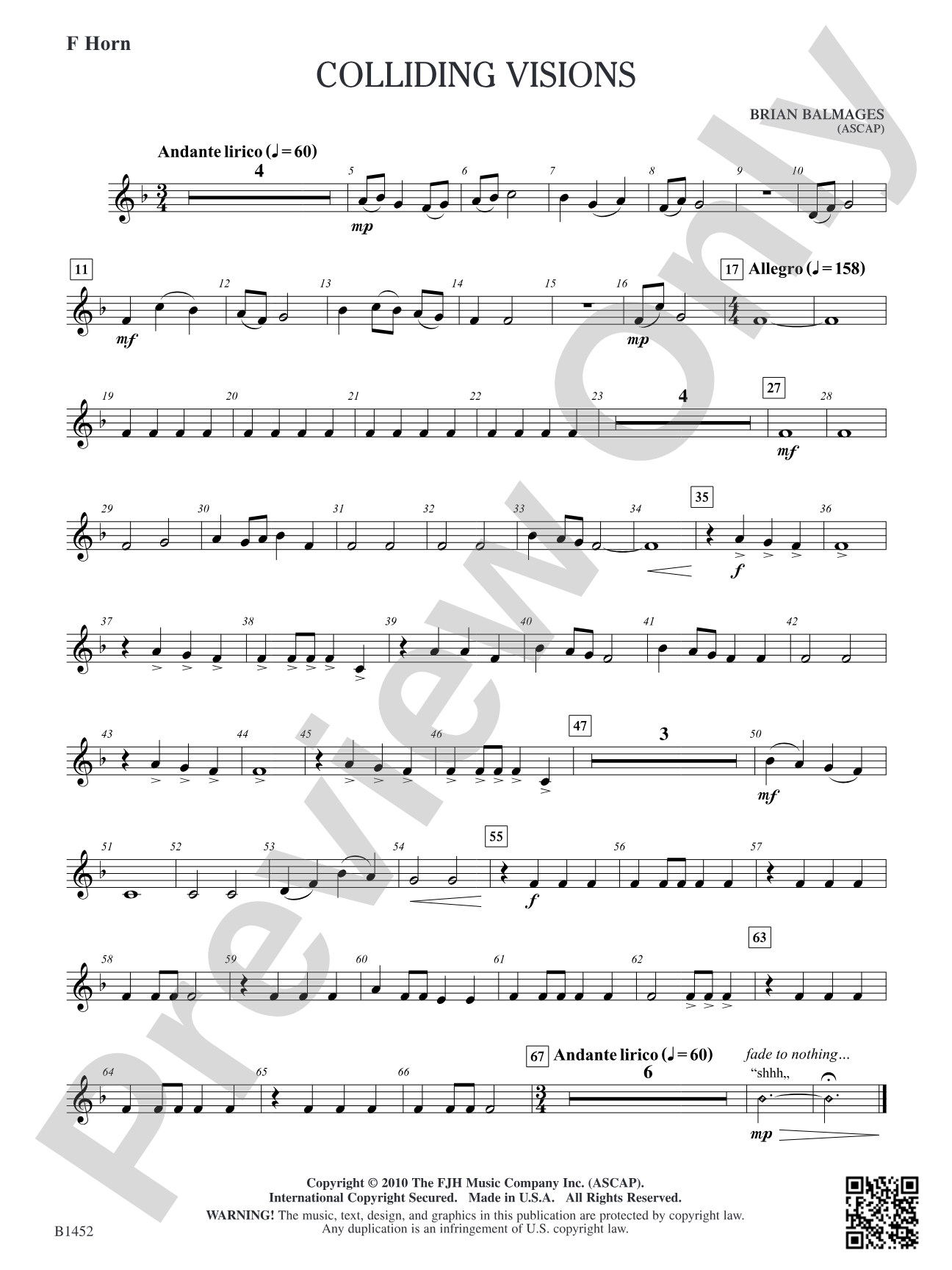
Colliding Visions: F Horn

By Brian Balmages

Grade: 1

Item: 98-PC-DB1452_H1

Digital Download
$7.00
Description
Lyrical melodies meet powerful fanfares in this emotionally charged work that tells the true story of a world premiere and a band program's final performance. Sweeping harmonies push the threshold of the typical young band sound before the music charges forward in spirit and excitement. A final section slowly moves toward silence, leaving the audience in wonderment as to what will lie in the future. Mature sounds for young bands! (2:30)

Don't just read it, hear it, play along with it, and watch your students grow with it. In MakeMusic Cloud, Colliding Visions: F Horn comes alive with professional accompaniment, adjustable tempo, and built-in practice tools that turn solo practice into real progress.

Sample Audio
0:00
0:00
Sample Video
Additional Details
Series: FJH Beginning Band
Publisher: The FJH Music Company, Inc.
SKU: 98-PC-DB1452_H1

More about this title

About the Composer: Brian Balmages

Brian Balmages

Brian Balmages has established himself as a composer and conductor working fluently across orchestral, band, and chamber repertoires. His works have been commissioned and performed globally in prestigious venues including Carnegie Hall, the Kennedy Center, and the Sydney Opera House, reaching audiences from professional orchestras down to elementary school ensembles.

Among his many honors, Balmages received the A. Austin Harding Award from the American School Band Directors Association and won the 2020 NBA William D. Revelli Composition Contest. He holds elected membership in the American Bandmasters Association and has been recognized with Distinguished Alumni Awards from both James Madison University and the University of Miami, where he was commissioned to compose for a presidential inauguration. As a guest conductor, he appears regularly at major conferences including the Midwest Clinic and College Band Directors Conference. He currently serves as Director of MakeMusic Publications and Digital Education for Alfred and MakeMusic.

Why we love this

This work strikes an unusual balance for Grade 1: it delivers genuine emotional depth and sophisticated harmonic writing without sacrificing accessibility. The programmatic arc (from lyricism through fanfare to contemplative closure) gives young musicians something meaningful to express, and the brevity means it fits naturally into contests, festivals, and concert programs without dominating rehearsal time.

What to expect

The music opens with tender, sweeping harmonies that gradually gain weight and brilliance as fanfares emerge. The middle pushes forward with spirited energy before the final pages dissolve into hushed reflection, leaving listeners suspended in uncertainty about what comes next.

Who it's for

Young concert bands at the Grade 1 level seeking repertoire that challenges them musically while remaining technically accessible. This is especially valuable for programs building confidence in programmatic interpretation and ensemble maturity.

How to get the most out of it

  • Shape the opening melodies with long phrase arcs; resist the urge to rush through the lyrical sections, as the contrast with the fanfare material depends on unhurried, singing lines.
  • Balance the powerful fanfare passages carefully across the full band so that younger players experience the thrill of ensemble strength without feeling lost in the texture.
  • Prepare the final section's gradual fade toward silence deliberately; discuss with students how the music's journey toward quietness creates anticipation rather than anticlimax.

How to use it

Program this as a centerpiece contest or festival entry where the emotional narrative will resonate with adjudicators. Its compact length and programmatic story also make it an excellent choice for a spring concert's opening or closing moment, offering closure to a band year while looking forward.

Skills your students will build

  • Sustaining long, singing phrase lines within a harmonic framework
  • Dynamic control across a wide range (ppp to ff)
  • Ensemble balance in thickly scored passages
  • Interpretation of programmatic intent through musical expression
  • Transitions between contrasting musical ideas (lyrical to dramatic to contemplative)

You May Also Like