Cole Porter Classics: 1st B-flat Clarinet Sheet Music Preview

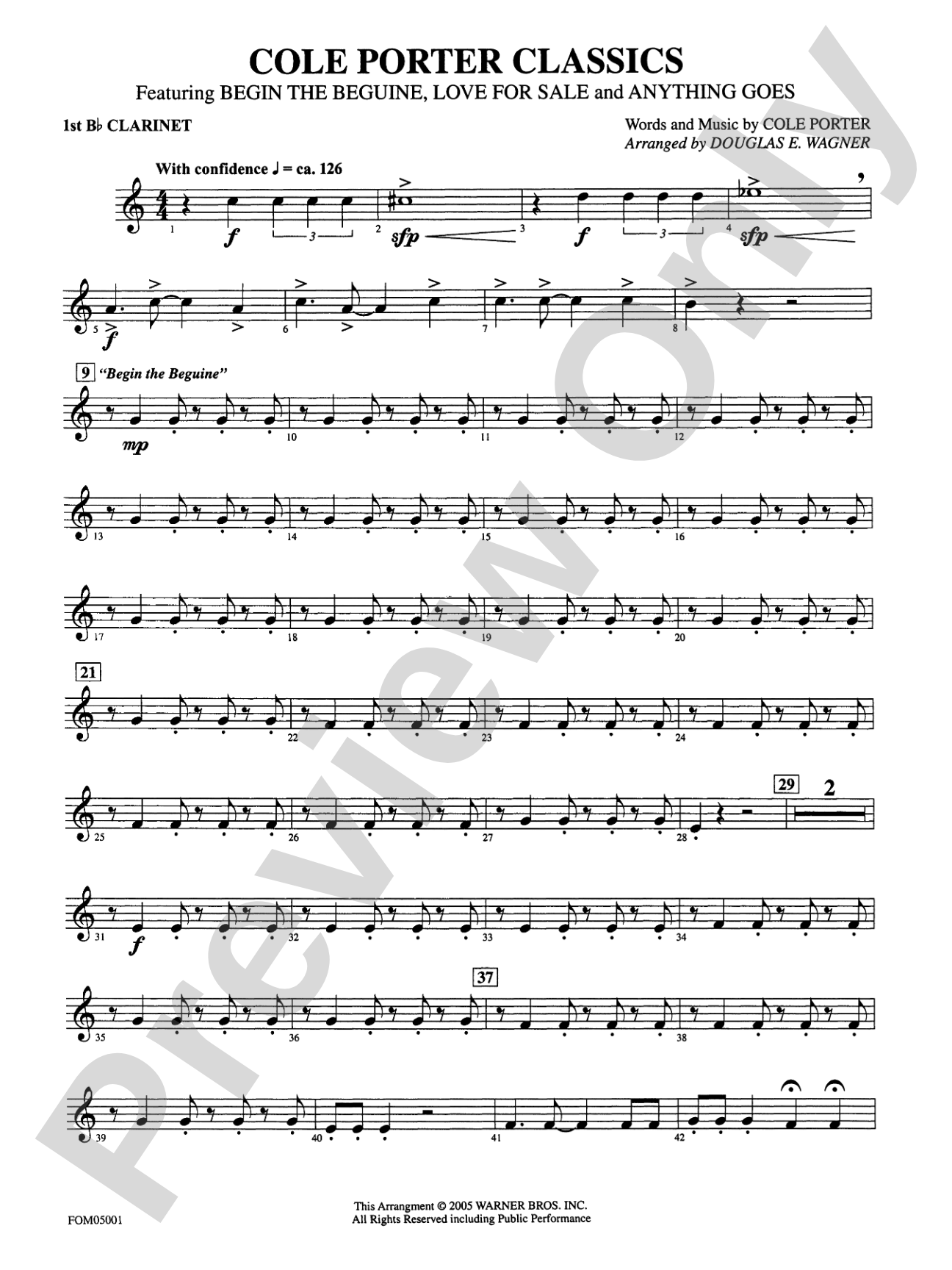
Cole Porter Classics: 1st B-flat Clarinet

Featuring: Begin the Beguine / Love for Sale / Anything Goes

Words and music by Cole Porter / arr. Douglas E. Wagner

Grade: 2.5

Item: 00-PC-0016622_C1

Digital Download
$3.00
Description
Walk down "Music History Lane" with these Cole Porter Classics. Scored for full orchestra or strings alone, the medley includes "Begin the Beguine," "Love for Sale," and "Anything Goes." This is a delightful tribute to the time-honored tunes of the immortal Cole Porter. (2:54)

Don't just read it, hear it, play along with it, and watch your students grow with it. In MakeMusic Cloud, Cole Porter Classics: 1st B-flat Clarinet comes alive with professional accompaniment, adjustable tempo, and built-in practice tools that turn solo practice into real progress.

Sample Audio
0:00
0:00
Sample Video
Additional Details
Series: Pop Intermediate String/Full Orchestra
Publisher: Alfred Music
Page Count: 258
SKU: 00-PC-0016622_C1

More about this title

About the Composer: Cole Porter

Cole Porter (1891-1964) composed some of the most sophisticated and witty songs in American musical theater. His melodies are instantly recognizable, his harmonies inventive, and his lyrics urbane and clever. Porter's standards have endured for nearly a century because they balance accessibility with musical substance, making them ideal for both casual listening and serious study.

In the classroom and rehearsal hall, Porter's music offers students a direct connection to the Great American Songbook and the Broadway tradition. His compositions reward careful attention to phrasing, style, and ensemble balance while remaining engaging and fun to perform.

Why we love this

Douglas E. Wagner's orchestration preserves Porter's melodic charm while giving your ensemble real textures to sink their teeth into. The three-song medley lets you perform recognizable standards without the commitment of a full musical production, and the flexibility to use strings alone or full orchestra means you can program this regardless of your instrumentation.

What to expect

Elegant, rhythmically alive, and irresistibly charming. The medley captures the sophistication and energy of 1930s and 1940s Broadway while remaining transparent enough for student musicians to navigate. You'll hear Porter's sophisticated harmonic language alongside melodies that stick with you long after the final chord.

Who it's for

This is ideal for intermediate-level orchestras looking to add American popular standards to their repertoire. It works equally well for conductors building a mixed concert featuring orchestral and vocal selections, or for ensembles seeking accessible, crowd-pleasing material that doesn't sacrifice musical substance.

How to get the most out of it

  • Bring out the Broadway style in your phrasing. Porter's songs thrive on clear, shaped lines with gentle rubato that respects the underlying dance rhythms. Avoid making these pieces too stiff or formal.
  • Balance the melody with the ensemble throughout the medley. These songs are built on singable tunes, so ensure your soloists and featured sections breathe naturally while the accompaniment supports without overwhelming.
  • Use the 2:54 runtime as a guide for pacing between movements. Keep the energy moving forward while allowing each song its own character; "Begin the Beguine" has a different rhythmic feel than "Anything Goes."

How to use it

Program this alongside other Great American Songbook material to create a themed concert, or use it as a palate cleanser between heavier classical works. The medley format and moderate length make it an excellent choice for pops concerts, school showcases, or community orchestra performances where accessibility and entertainment value matter.

Skills your students will build

  • Balancing melody-driven arrangements with ensemble texture
  • Executing Broadway style and rubato within a metrical framework
  • Reading orchestral color changes and cue systems across multiple instruments
  • Maintaining rhythmic clarity in syncopated accompaniment figures
  • Shaping standard-song form with musical intent rather than mechanical phrasing

You May Also Like