
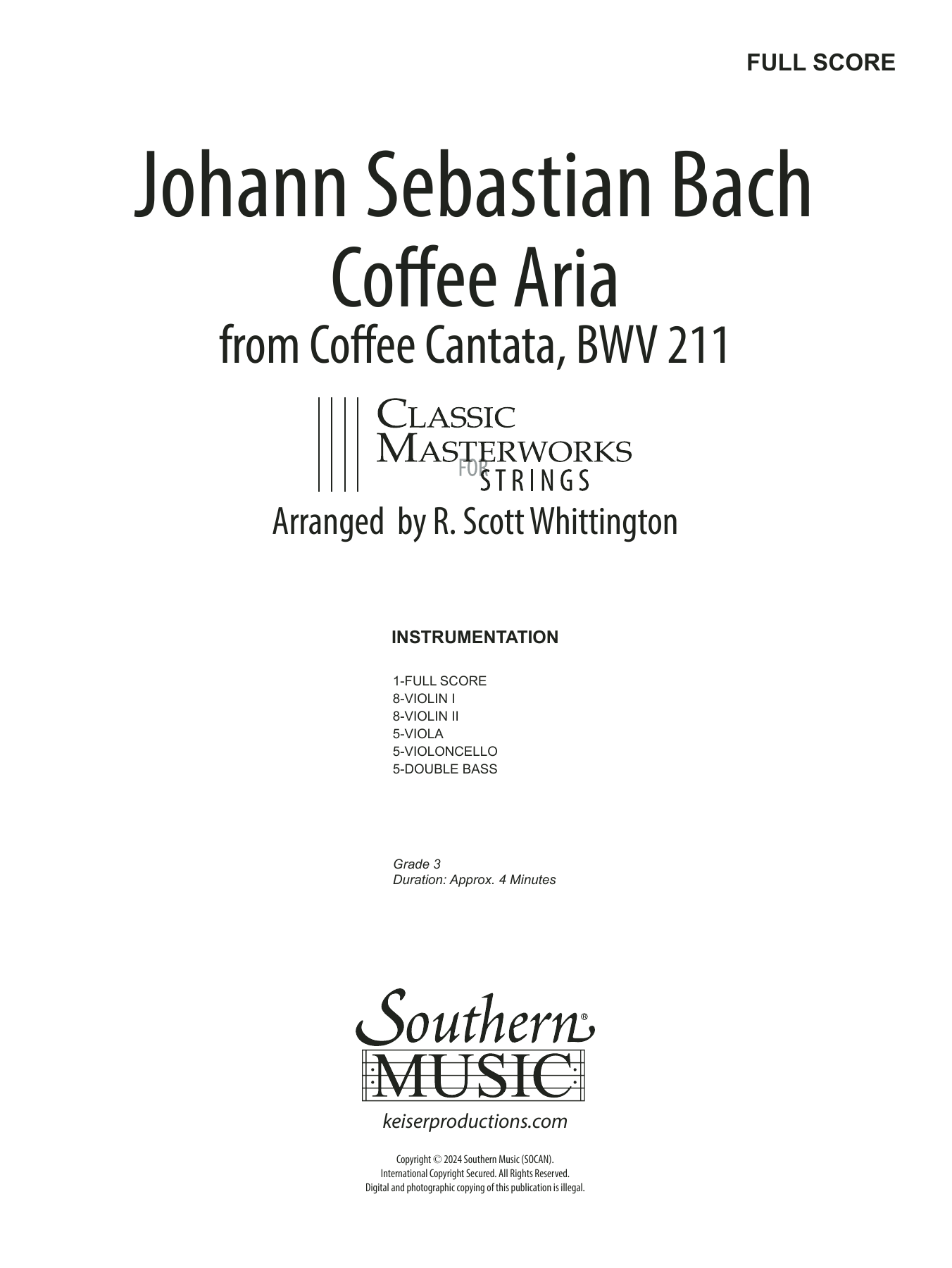

Coffee Aria from Coffee Cantata, BWV 211: String Orchestra Conductor Score & Parts
By Johann Sebastian Bach / Arranged by R. Scott Whittington
Grade: 3
Item: 35-PK01523694
$55.00
Pickup currently not available
Buy Extra Parts (Digital PDF Download)
Parts Added to Cart!
Description
Written between 1732 and 1735, J.S. Bach's COFFEE CANTATA is one of his few secular cantatas. ARIA No. 8, is joyous and uplifting; a wonderful example of the mature baroque compositional style. The plot of the CANTATA centers around Lieschen (soprano), who vows to her father that she will give up drinking coffee if she can find true love. Scored for intermediate string orchestra at a medium difficulty, this arrangement uses many of the voicings of the original score, but has been shortened to keep the performance time at a manageable length. Suggested dynamics, articulation and bowings have been included for ease of performance.


Coffee Aria from Coffee Cantata, BWV 211: String Orchestra Conductor Score & Parts isn't in MakeMusic Cloud just yet...but it could be. Let us know you'd like to see it, and you'll help shape what comes next. In the meantime, start a free trial and dive into thousands of interactive titles your students can play along with today.
Request This Title
Tell us you want it.
Start Your Free Trial
Explore everything that's ready to play right now.
Sample Audio
No sample audio found.
Sample Video
No sample videos found.
Additional Details
Publisher:
Hal Leonard
SKU:
35-PK01523694
More about this title
About the Composer: Johann Sebastian Bach
Johann Sebastian Bach (1685-1750) shaped the trajectory of Western music through his mastery of counterpoint, harmonic language, and structural invention. His output spans every genre of his era except opera, and his works remain foundational to music education because they teach musicians how to think in multiple lines simultaneously while maintaining clarity and purpose.
Why we love this
This aria captures the wit and melodic charm that Bach brought to secular music, offering intermediate orchestras a chance to play mature baroque writing without the density of his more rigorous fugal works. The arrangement respects Bach's original voice leading while scaling it sensibly for young players, and the narrative context of the Coffee Cantata gives students a reason to care about the music beyond its technical demands.
What to expect
Buoyant and lighthearted, with the kind of melodic warmth that makes baroque style feel immediate rather than historical. The pacing builds energy without rushing, and the harmonic movement creates a sense of resolution and satisfaction at each phrase ending.
Who it's for
Intermediate string orchestras with solid intonation and basic ensemble skills will find this piece both accessible and rewarding. It works well for groups ready to move beyond folk song arrangements into genuine baroque repertoire with dramatic context.
How to get the most out of it
- Attend to articulation and bowing markings as guides to phrasing; they shape how each line breathes and connects, preventing the orchestra from sounding choppy or inert.
- Balance the inner voices carefully during tutti passages. Bach's voicings rely on transparent part writing, so weak second violins or violas will obscure the harmonic progression.
- Approach the tempo with dance-like buoyancy rather than heavy formality. The joyous character depends on light articulation and forward motion through the phrase.
How to use it
Program this alongside other secular baroque works or classical period pieces for a concert exploring how composers of the 1730s wrote for entertainment and court life. It also pairs naturally with other string arrangements of vocal music, giving students practice in bringing sung lines to instrumental life.
Skills your students will build
- Reading baroque articulation and bowing conventions
- Balancing multiple melodic lines while maintaining ensemble unity
- Shaping phrase direction through dynamic control and tempo stability
- Understanding harmonic function in tonal baroque voice leading