
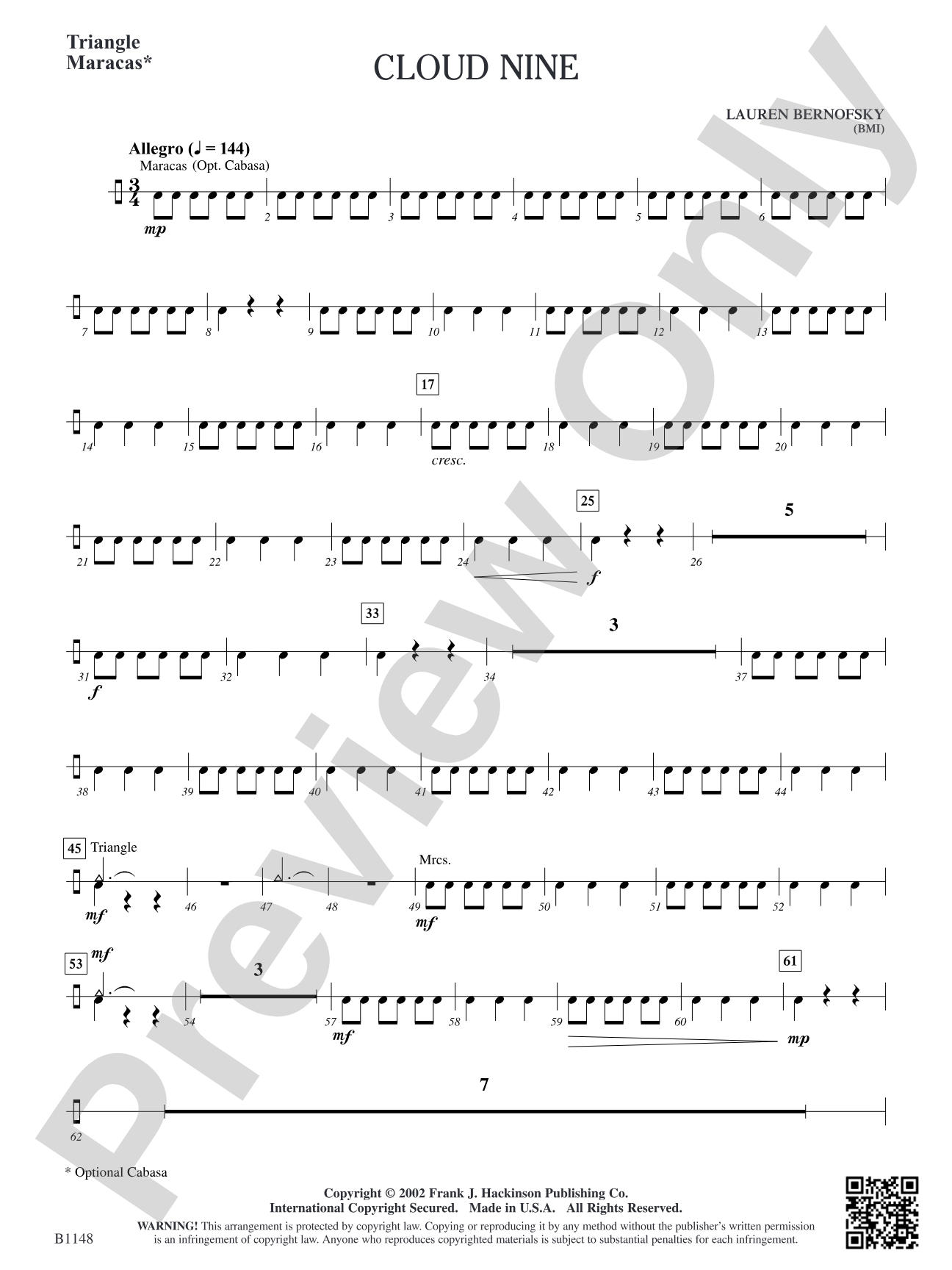

Cloud Nine: Triangle/Maracas (Opt. Cabasa)
By Lauren Bernofsky
Grade: 2.5
Item: 98-PC-DB1148_TR
$7.00
Pickup currently not available
Description
This spirited work, in 3/4, maintains a quick tempo throughout. The opening, rhythmic motif builds steadily before the full band states the main theme. A lightly scored middle section leads into a restatement of the beginning material. A wonderful piece to challenge your group, as Lauren makes use of some independent lines while staying well within the grade level. (3:15)


Cloud Nine: Triangle/Maracas (Opt. Cabasa) isn't in MakeMusic Cloud just yet...but it could be. Let us know you'd like to see it, and you'll help shape what comes next. In the meantime, start a free trial and dive into thousands of interactive titles your students can play along with today.
Request This Title
Tell us you want it.
Start Your Free Trial
Explore everything that's ready to play right now.
Sample Audio
1
Audio File
--:--
0:00
0:00
Sample Video
No sample videos found.
Additional Details
Series:
FJH Young Band
Publisher:
The FJH Music Company, Inc.
SKU:
98-PC-DB1148_TR
More about this title
About the Composer: Lauren Bernofsky

Lauren Bernofsky brings a distinctive voice to concert band literature, drawing on a career that spans orchestral, operatic, choral, and chamber works. Recognized by Lukas Foss as "a master composer," she has created over a hundred compositions that balance emotional resonance with intellectual rigor. Her work has earned major recognition: her Sonatine won the National Flute Association's Newly Published Music Competition, her opera Mooch the Magnificent received the Opera Puppets Award at Boston Metro Opera, and her choral work Prayer of Shantideva won the Dalai Lama Composition Contest and was premiered at a prayer service honoring the Dalai Lama himself.
Bernofsky holds degrees from The Hartt School, New England Conservatory, and Boston University, and has taught at the Peabody Institute and Interlochen Center for the Arts. Her compositions have been commissioned by orchestras, chamber ensembles, and opera companies across the country, and her work has appeared on PBS, in the International Trumpet Guild journal, and in numerous festival performances worldwide.
Why we love this
Cloud Nine strikes the rare balance of being genuinely engaging to play while offering real compositional substance. The rhythmic opening hooks listeners immediately, and the independent lines Bernofsky writes give each section meaningful material to own, which band students find far more rewarding than typical filler parts at this grade level. Its three-and-a-quarter-minute runtime makes it ideal for festivals without eating up your program, yet it sounds far more substantial than its length suggests.
What to expect
Buoyant and propulsive from the first measure, Cloud Nine maintains an infectious energy throughout its arc. The rhythmic foundation gives it a contemporary, almost dance-like quality, while the orchestration shifts between full-bodied moments and more intimate textures that keep the ear engaged.
Who it's for
Intermediate concert bands looking for a rhythmically sophisticated opener or showcase piece that doesn't require advanced technical facility. The Grade 2.5 designation reflects accessible ranges and rhythms, making it suitable for developing ensembles that are ready to move beyond unison passages but still building independence across all voices.
How to get the most out of it
- Lock the opening rhythmic motif with precision before adding harmonic layers. This pattern is your structural anchor; once it's solid, the gradual build will happen naturally.
- Shape the middle section's lighter texture by pulling back dynamic intensity without losing forward motion. Maintain the tempo and let the thinner scoring breathe.
- Balance the independent lines by having each section find its countermelodic role in relation to the main theme, rather than treating secondary parts as accompaniment.
- Emphasize the tempo throughout; the "quick tempo" is part of what gives this piece its spirited character, so resist the urge to broaden or settle into a heavier feel on the restatement.
How to use it
Open a concert with this piece to establish momentum and set a confident tone for your group. Its moderate length makes it an excellent fit before or after a longer work, allowing you to frame more substantial repertoire without sacrificing pacing.
Skills your students will build
- Maintaining steady tempo in 3/4 while executing syncopated rhythmic patterns
- Reading and executing independent lines within a homogeneous ensemble texture
- Dynamic shape and balance when scoring changes from full band to lighter instrumental combinations
- Sectional entrances with rhythmic precision after rests