
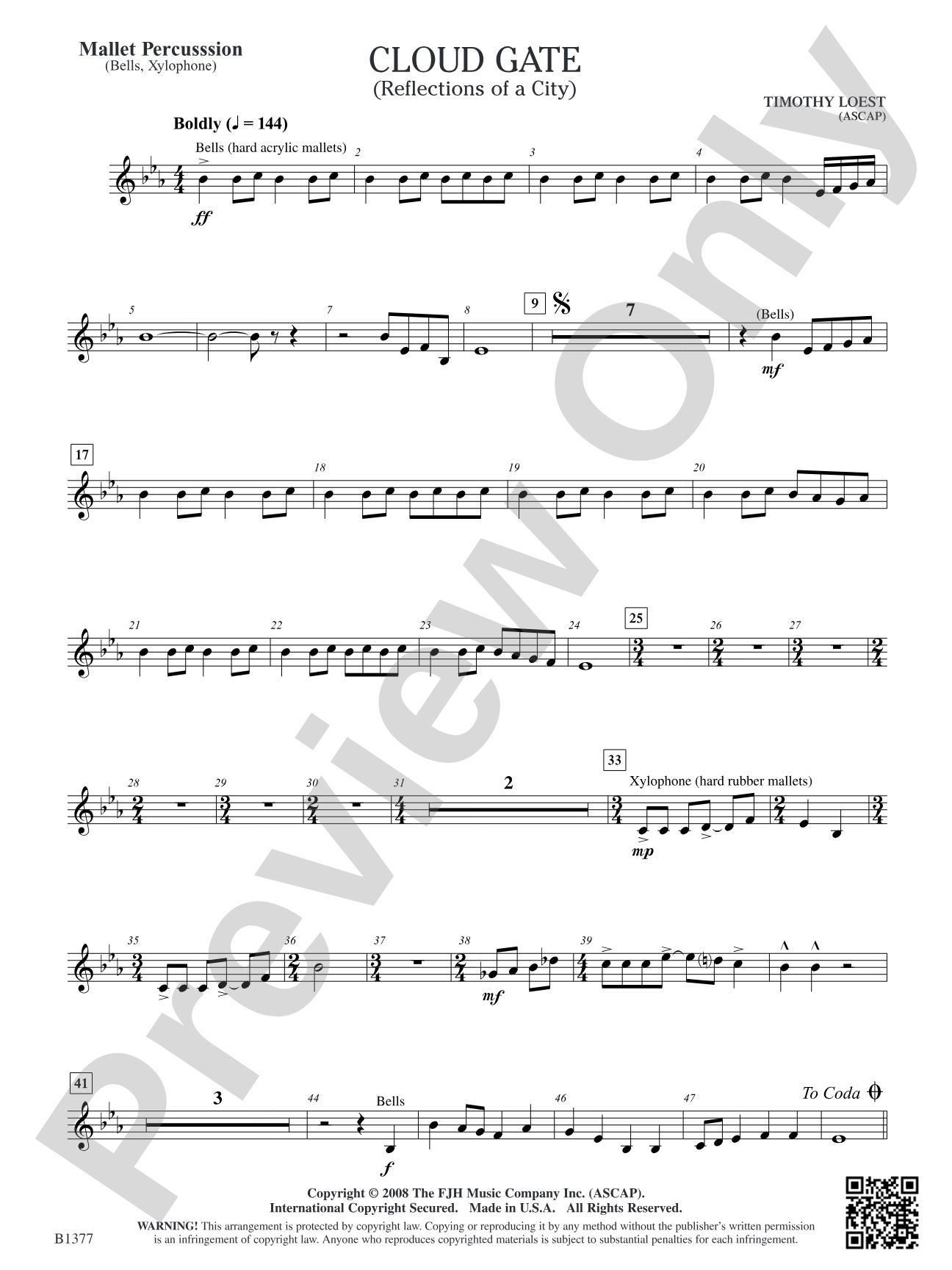

Cloud Gate (Reflections of a City): Mallet Percussion
Reflections of a City
By Timothy Loest
Grade: 2.5
Item: 98-PC-DB1377_M1
$7.00
Pickup currently not available
Description
Inspired by an enormous, mirror-like elliptical sculpture by British artist Anish Kapoor, this festival work reflects the spirit of Chicago's busy streets, vibrant people, and magnificent architecture. A bold opening moves into an invigorating theme that occurs under a moving woodwind ostinato figure. A festive mixed-meter section continues to drive the work forward before a seamless transition into a slower bluesy section reminiscent of George Gershwin. Students experience urban energy once more as the final thematic statement leads to a dynamic close!


Cloud Gate (Reflections of a City): Mallet Percussion isn't in MakeMusic Cloud just yet...but it could be. Let us know you'd like to see it, and you'll help shape what comes next. In the meantime, start a free trial and dive into thousands of interactive titles your students can play along with today.
Request This Title
Tell us you want it.
Start Your Free Trial
Explore everything that's ready to play right now.
Sample Audio
1
Audio File
--:--
0:00
0:00
Sample Video
No sample videos found.
Additional Details
Series:
FJH Young Band
Publisher:
The FJH Music Company, Inc.
SKU:
98-PC-DB1377_M1
More about this title
About the Composer: Timothy Loest

Timothy Loest has shaped the landscape of young band music through compositions that balance artistic integrity with genuine accessibility. His works are performed by student ensembles across the country, and his influence extends beyond the concert hall through pedagogical partnerships with leading method book publishers, including his association with Measures of Success and the Beyond series. In 2017, Cloud Gate drew an audience of over 5,000 at Chicago's Millennium Park, the same year he received the Illinois Grade School Music Association's Cloyd Myers Memorial Award for Excellence in Music Education.
With more than three decades of classroom experience at F.E. Peacock Middle School in Illinois, Loest understands what young musicians need to grow musically and what directors need to engage their ensembles. His catalog spans publications with major houses including FJH Music Company, C.L. Barnhouse, and his own Fanfare Music Press, founded in 2022. His music has also reached national audiences through television appearances on shows including The Tonight Show Starring Jimmy Fallon and Good Morning America. Loest holds degrees from Illinois State University and Northwestern University, maintains ASCAP membership, and continues to accept commissions.
Why we love this
Loest captures genuine urban vitality here without resorting to shallow program music. The mixed-meter section and the Gershwin-tinged blues passage give your ensemble real musical material to sink into, not just a parade of colors. At Grade 2.5, this sits in that sweet spot where students tackle genuine compositional sophistication while still building fundamental skills.
What to expect
Cloud Gate opens with architectural boldness, then pulls you into the hum and pulse of a living city. The energy stays kinetic through the mixed-meter section until the temperature drops into a warm, introspective blues passage that feels like stepping into a quieter room. By the final statement, the city's rhythm returns with accumulated momentum.
Who it's for
Grade 2.5 concert bands looking for a programmatic work that delivers musical substance alongside approachability. This is equally suited to festival performance or concert programming when you need a piece that showcases your band's range from crisp articulation to expressive playing.
How to get the most out of it
- Shape the opening bold statement with clear articulation from the brass section; this sets the architectural confidence the rest of the work depends on.
- Let the woodwind ostinato breathe naturally under the main theme rather than locking it into metronomic rigidity; it's meant to suggest constant motion.
- Prepare your band for the meter shifts by rehearsing the transition passages slowly and deliberately before working them up to tempo.
- The blues section invites some interpretive freedom in the inner voices. Encourage your reed and lower brass players to find the lyrical quality underneath Gershwin's harmonic language.
How to use it
Program this as a contrast piece in a concert that includes a march or traditional overture; the bluesy middle section and contemporary compositional voice create welcome variety without jarring your audience. It also works exceptionally well as a festival showcase piece, where the bold opening and energetic close leave a memorable closing impression.
Skills your students will build
- Reading and performing mixed meters within a continuous musical narrative
- Balancing independence in ostinato figures against thematic content
- Interpreting stylistic shifts from contemporary classical to jazz-inflected harmonic language
- Achieving articulate, rhythmic precision in fast-moving sixteenth-note passages
- Sustaining lyrical phrase shape in slower sections with complex harmonic movement