
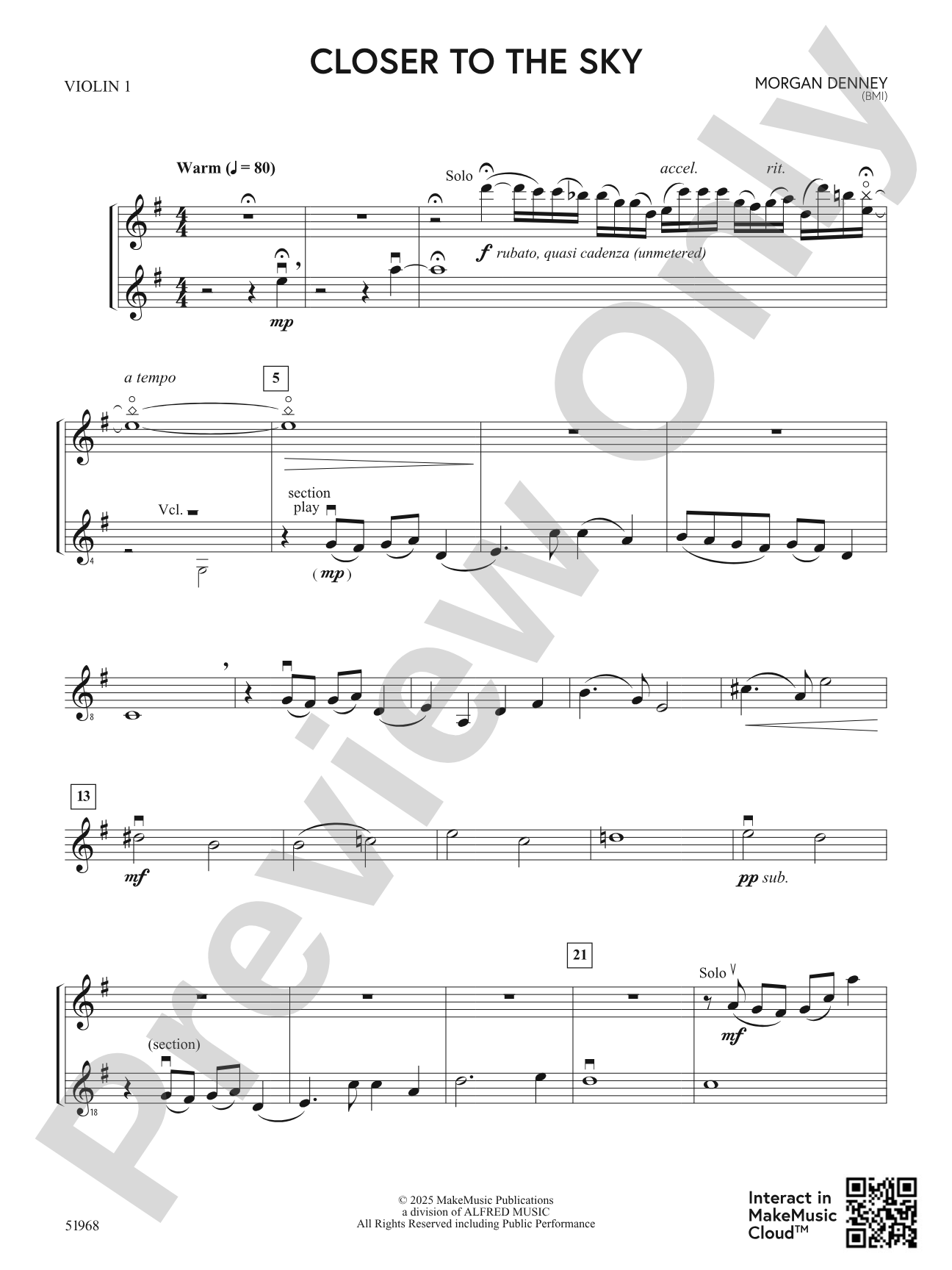

Closer to the Sky: 1st Violin
By Morgan Denney
Grade: 3
Item: 00-PC-0019536_VN1
$3.00
Pickup currently not available
Description
Explore an array of emotions with Closer to the Sky, a work that pays homage to the breathtaking beauty of the Rocky Mountains. Lyrical and thrillingly energetic sections include melodic motives that are developed and layered, evoking a feeling of ascension while alluding to the grandeur of nature. A captivating and powerful work by Morgan Denney! (3:15)


Closer to the Sky: 1st Violin isn't in MakeMusic Cloud just yet...but it could be. Let us know you'd like to see it, and you'll help shape what comes next. In the meantime, start a free trial and dive into thousands of interactive titles your students can play along with today.
Request This Title
Tell us you want it.
Start Your Free Trial
Explore everything that's ready to play right now.
Sample Audio
1
Audio File
--:--
0:00
0:00
Sample Video
Additional Details
Series:
MakeMusic Symphony Strings
Publisher:
MakeMusic Publications
SKU:
00-PC-0019536_VN1
More about this title
About the Composer: Morgan Denney

Morgan Denney composes and arranges music across concert, theatrical, educational, film, and dance settings. Her work is distinguished by inventive textural layering and an ability to balance lyrical expression with visceral energy, earning recognition on JW Pepper's Editors' Choice List and the Texas UIL Prescribed Music List. Her compositions have been featured at the Midwest Clinic and appear in publications from multiple outlets.
Denney holds a Master's degree in music composition from the University of Miami and a Bachelor's degree from the University of Colorado-Boulder. Based in South Florida, she maintains an active career as a freelance violinist and serves as a Production Editor for Alfred Music, bringing both compositional vision and practical music publishing expertise to her work.
Why we love this
Denney crafts a piece that speaks directly to the string orchestra's lyrical strengths while demanding genuine musicality from young players. The programmatic arc from ascension to grandeur gives students a tangible narrative to interpret, transforming technical passages into emotional storytelling rather than exercises. At Grade 3, this work respects the ensemble's capabilities while resisting the temptation toward oversimplification.
What to expect
Closer to the Sky captures the emotional pull of ascending a mountain, moving from quiet wonder into moments of soaring exhilaration. The melodic writing invites players into a landscape of natural grandeur, combining sustained, resonant passages with bright, energetic sections that feel like breaking through the clouds.
Who it's for
This piece engages Grade 3 string orchestras ready to move beyond technical drills into interpretive work with programmatic depth. Conductors seeking contest or festival repertoire will find a work that balances accessibility with genuine artistic substance, giving young musicians something meaningful to rehearse and perform.
How to get the most out of it
- Shape the melodic motives across phrases rather than treating them as isolated statements. The development sections rely on your section leaders recognizing how earlier ideas transform, so highlighting those connections in rehearsal pays immediate dividends.
- Balance the layering of textures carefully during the energetic sections. When multiple melodic lines intersect, ensure that no single voice dominates unless the score explicitly calls for prominence.
- Let the dynamic contrasts breathe. The piece moves between lyrical and thrilling moments, and rushing transitions between these characters flattens the emotional journey.
- Attend to intonation in the sustained, quieter passages. Without the rhythmic drive of faster sections, any tuning drift becomes immediately audible and undermines the evocative quality.
How to use it
Position this work as a centerpiece for a concert celebrating the natural world or American landscapes. It also serves excellently as a competition selection, where its three-minute length and programmatic arc allow adjudicators to hear both the ensemble's lyrical control and rhythmic precision. Consider pairing it with lighter character pieces to showcase the versatility of your orchestra.
Skills your students will build
- Shaping melodic lines across multiple phrases and recognizing thematic development
- Balancing independent melodic lines within layered textures
- Executing dynamic contrasts with clarity and intention
- Sustaining pitch with consistent intonation in slower, lyrical passages
- Interpreting programmatic content through instrumental color and phrasing