Close Your Eyes: Piano Digital Sheet Music

Close Your Eyes: Piano Digital Sheet Music

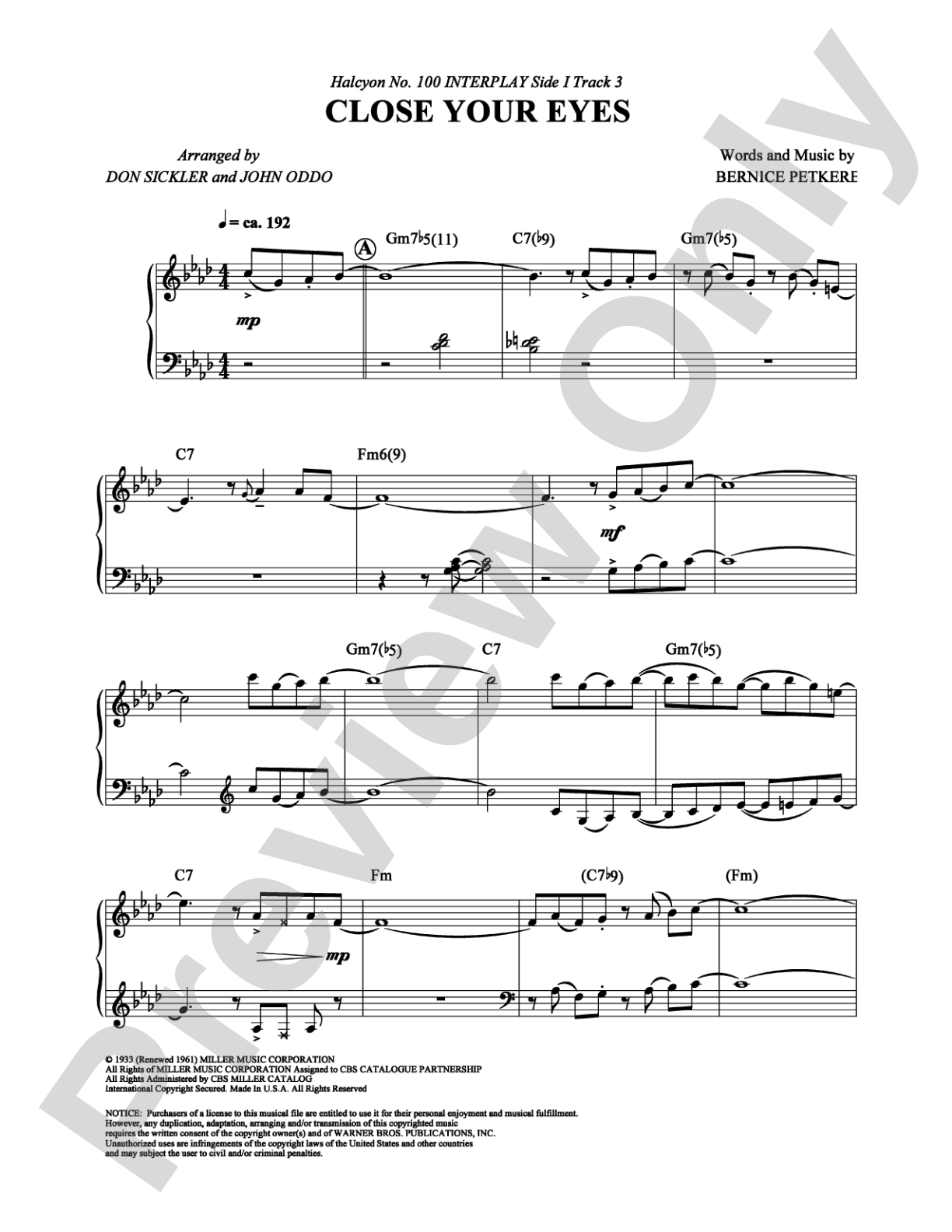
Marian McPartland, Bernice Petkere

Item: 00-PS-0000699

Digital Download
$3.99
Description

Close Your Eyes: Piano Digital Sheet Music isn't in MakeMusic Cloud just yet...but it could be. Let us know you'd like to see it, and you'll help shape what comes next. In the meantime, start a free trial and dive into thousands of interactive titles your students can play along with today.

Sample Audio
No sample audio found.
Sample Video
Additional Details
SKU: 00-PS-0000699

More about this title

About the Artist: Marian McPartland

Marian McPartland (1918-2011) was a pioneering jazz pianist and composer who shaped the sound of modern jazz for more than six decades. A British-born artist who moved to the United States, she became known for her lyrical touch, harmonic sophistication, and ability to blend stride piano tradition with contemporary jazz sensibilities. Beyond her recording career, McPartland became a cultural ambassador for jazz through her long-running radio program "Piano Jazz," where she interviewed and performed alongside countless jazz artists, helping to elevate the genre's visibility and respect in American music education.

Why we love this

McPartland's interpretation of this standard captures what makes her playing so compelling for students: a balance between technical command and emotional directness. The piece shows how a mature jazz musician voices chords, manages rubato, and creates space for conversation with the harmony rather than racing through changes.

What to expect

Intimate and reflective, with the warmth of someone who has lived with a song long enough to know its emotional core. McPartland's touch brings a gentle sophistication to the melody, never sentimental but always human. The piece unfolds like a conversation with an old friend, unhurried and full of quiet assurance.

Who it's for

Advanced jazz pianists and serious students who want to understand how a master musician approaches a standard. This works well for private lesson contexts, jazz combo rehearsals, or recital preparation at the intermediate-to-advanced level. Educators can use it as a listening reference for discussing jazz arranging and interpretation.

How to get the most out of it

  • Pay attention to McPartland's use of space and silence; she doesn't fill every beat. Let the harmony breathe between phrases.
  • Study her left-hand voicings and how she supports the melody without overshadowing it. Notice where she simplifies and where she embellishes.
  • Work the tempo gradually. McPartland's relaxed feel comes from knowing exactly where the pulse lives, not from rushing or dragging.
  • Experiment with your own harmonic choices once you learn her arrangement. Use it as a conversation starter, not a transcription to memorize note-for-note.

How to use it

Include this in a jazz recital alongside other standards to show the range of a single tune across different interpretive approaches. It pairs well with contemporary works that also explore space and harmonic simplicity. For students studying jazz history and women composers in jazz, this serves as both a performance model and a listening reference.

Skills your students will build

  • Interpreting jazz rubato and phrasing
  • Reading and voicing jazz harmonies
  • Creating dynamic contrast through texture and register
  • Building confidence with standards as vehicles for personal expression

You May Also Like