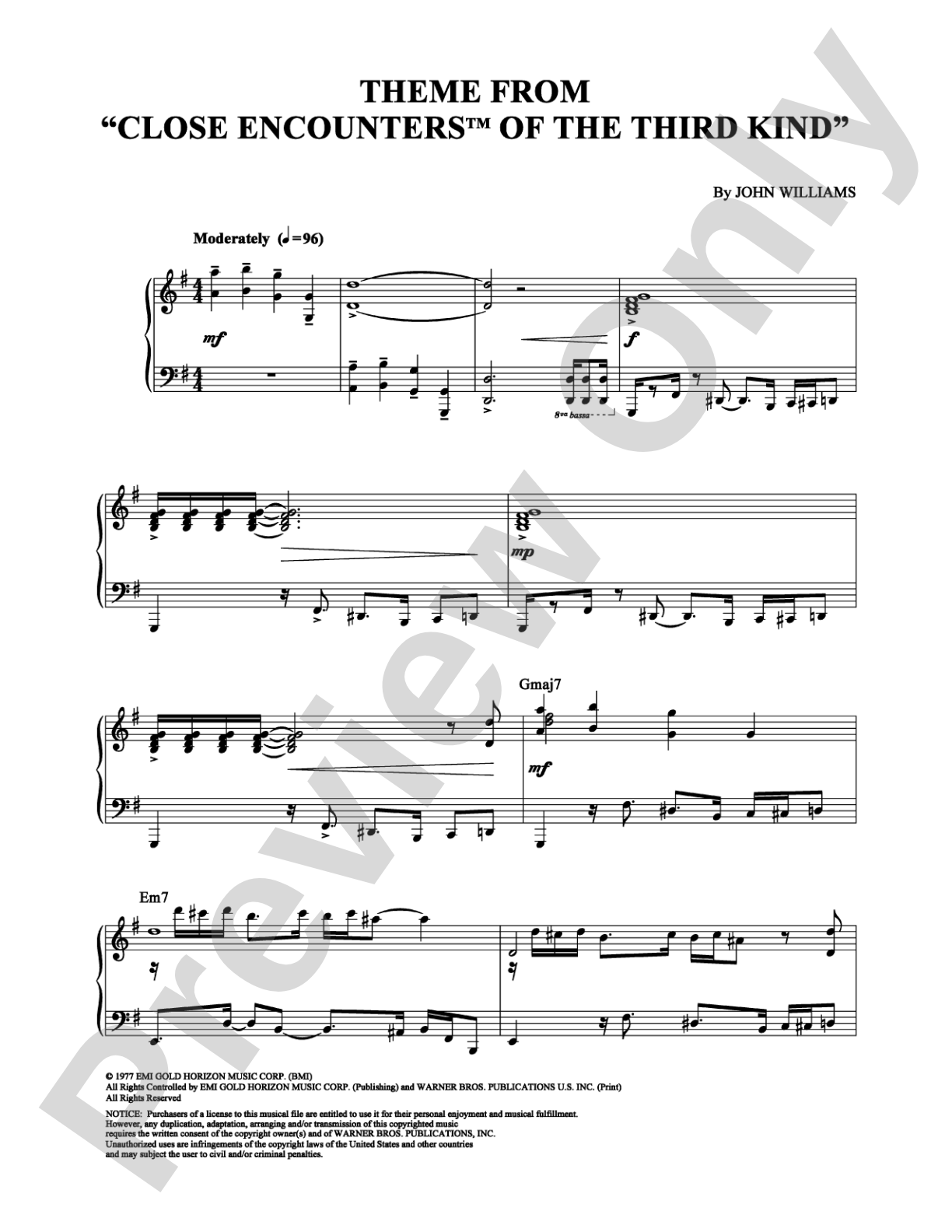
Close Encounters of the Third Kind (theme): Piano Digital Sheet Music

Close Encounters of the Third Kind (theme): Piano Digital Sheet Music

John Williams

Item: 00-PS-0005736

Digital Download
$3.99
Description

Close Encounters of the Third Kind (theme): Piano Digital Sheet Music isn't in MakeMusic Cloud just yet...but it could be. Let us know you'd like to see it, and you'll help shape what comes next. In the meantime, start a free trial and dive into thousands of interactive titles your students can play along with today.

Sample Audio
No sample audio found.
Sample Video
Additional Details
SKU: 00-PS-0005736

More about this title

About the Creator: John Williams

John Williams has spent over six decades composing some of cinema's most iconic scores, from Star Wars to Schindler's List. His 1977 Close Encounters of the Third Kind theme remains one of the most recognizable five-note motifs in film history, instantly evoking wonder and the unknown.

Williams' approach to orchestration translates remarkably well to solo piano, where the spare elegance of the original theme can shine through without loss of its otherworldly quality. His gift for melody that sticks with listeners while maintaining compositional sophistication makes his work endlessly rewarding to teach and perform.

Why we love this

This iconic five-note motif translates beautifully to solo piano, capturing the wonder and mystery of Spielberg's film without requiring a full ensemble. Students at all levels recognize the melody instantly, which builds immediate engagement and motivation during practice.

What to expect

Otherworldly and contemplative, the theme conjures a sense of peaceful wonder mixed with uncertainty. The sparse, deliberate phrasing creates an almost hypnotic quality that draws the listener into an intimate moment of first contact.

Who it's for

Pianists of intermediate level who enjoy popular film themes will find this arrangement accessible and rewarding. This works equally well for students seeking repertoire that bridges classical technique with contemporary music they know and love.

How to get the most out of it

  • Let the opening notes breathe with space between them; the silence is as important as the sound in establishing the alien communication theme.
  • Shape each phrase with dynamic control, allowing the melody to swell slightly at its peak before settling back down.
  • Maintain steady tempo even when the arrangement adds accompanying figures; rhythmic precision reinforces the mechanical precision of the spacecraft's signal.

How to use it

Position this as an encore or lighter moment in a recital program, especially alongside other film or contemporary music. It also serves as an excellent teaching tool for demonstrating how minimalist harmonic and melodic ideas can carry profound emotional weight.

Skills your students will build

  • Controlling dynamics and phrasing over a simple melodic line
  • Maintaining steady tempo while adding rhythmic accompaniment patterns
  • Interpreting sparse notation to create emotional depth
  • Balancing melody and accompaniment on a single instrument

You May Also Like