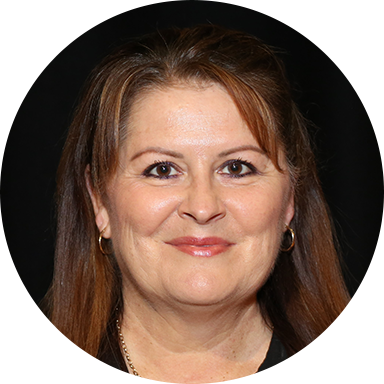
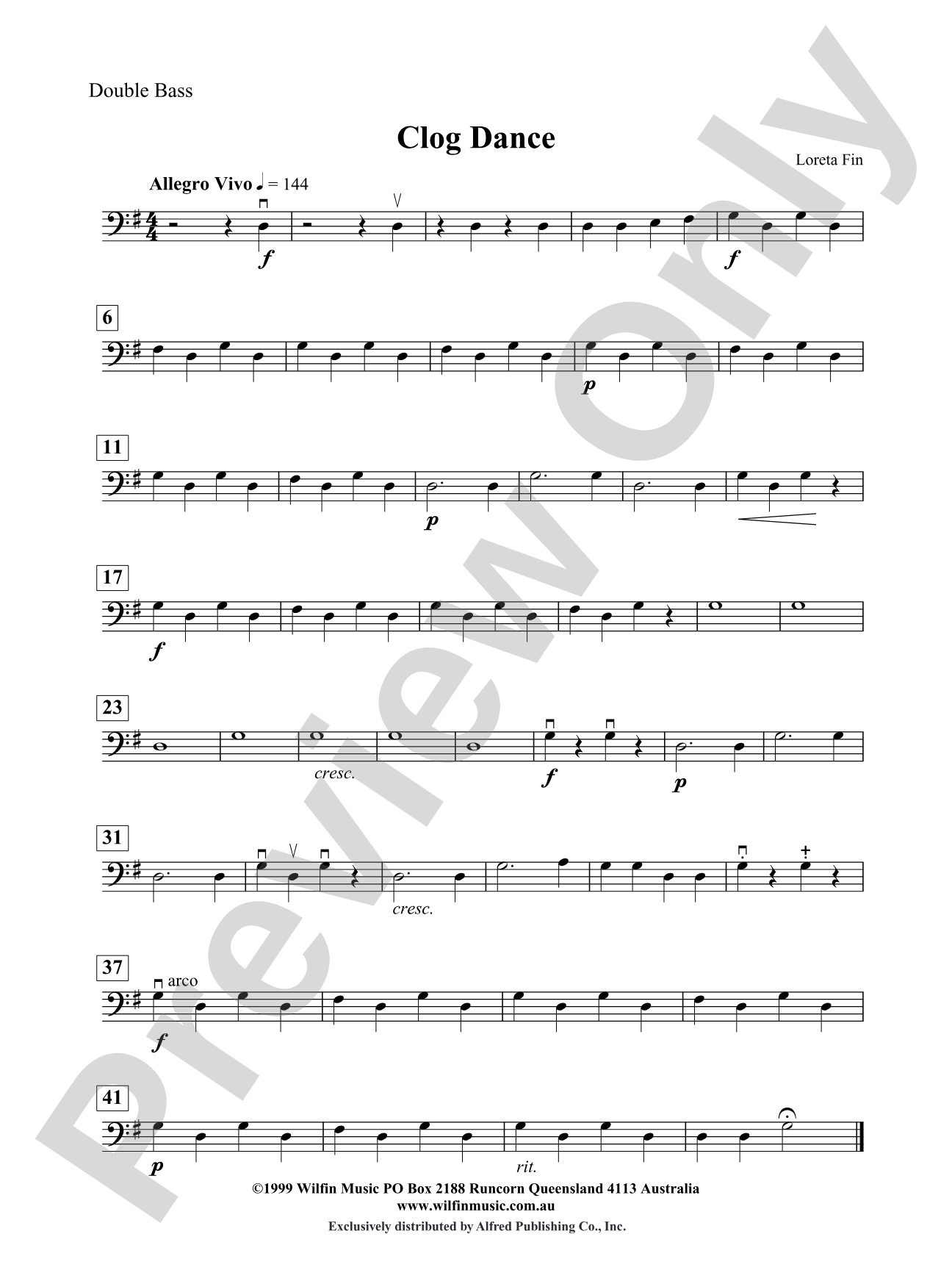
Clog Dance: String Bass Sheet Music Preview

Clog Dance: String Bass

By Loreta Fin

Grade: 1-1.5

Item: 76-PC-0000003_SB

Digital Download
$5.99
Description
In rondo form and requires the players to control the bow retakes without bouncing. The bow should be placed back on the string before the next phrase has begun. The smaller the rest, the closer the lift needs to be to the string.

Clog Dance: String Bass isn't in MakeMusic Cloud just yet...but it could be. Let us know you'd like to see it, and you'll help shape what comes next. In the meantime, start a free trial and dive into thousands of interactive titles your students can play along with today.

Sample Audio
No sample audio found.
Sample Video
Additional Details
Series: Wilfin String Orchestra: Young String Ensemble Series
Publisher: Wilfin Music
Page Count: 66
SKU: 76-PC-0000003_SB

More about this title

About the Composer: Loreta Fin

Loreta Fin

Loreta Fin AM is an Australian string educator and composer with deep roots in orchestral performance and music instruction. A first violinist with the Sydney Youth Orchestra and principal viola player with the Queensland Pops Orchestra for over 25 years, she has performed alongside world-class artists while maintaining an active teaching career. Since 1993, she has directed the strings program at Somerville House School in Brisbane and served as State Advisor for Strings with the Australian Music Examinations Board.

Fin has shaped Australian string education through her work with the Australian Strings Association, where she held both state and national leadership roles, and through conducting the State and National Honours Ensembles Programs since 2015. Her compositional output exceeds 100 published works for string orchestra, distributed internationally through Alfred Music. She received the National Award for Services to Music and String Teaching in Australia and was nominated for the inaugural ARIA "Best Teacher" award, recognizing her lasting impact on the profession.

Why we love this

Fin writes with a keen understanding of early ensemble development, and this rondo showcases her gift for balancing musical joy with genuine pedagogical challenge. The focused bow control work specified in the score transforms a brief piece into an extended teaching opportunity; younger players must think critically about every lift and placement rather than defaulting to habitual bouncing. The multicultural context provides musical interest without demanding advanced rhythmic or harmonic literacy.

What to expect

Spirited and rhythmic, with the character of a folk dance. The rondo form gives the piece natural momentum and satisfying returns, creating a sense of arrival that motivates young players through the technical work required.

Who it's for

Young string orchestras at the early elementary level seeking repertoire that develops fundamental bow technique alongside ensemble cohesion. String directors will find this especially valuable for teaching controlled bow lifts and retakes as deliberate musical gestures rather than technical afterthoughts.

How to get the most out of it

  • Establish the bow placement work as a shared language before the piece begins. Have the ensemble watch each other's lifts and rests as a group exercise, treating bow management like a sectional rhythm activity.
  • Use the rondo structure to your advantage: after the A section is secure, the returns give you natural opportunities to refine the technical demands without starting from scratch.
  • Work the shortest rests first. Ask players to place the bow on the string during the pause and hold it there until the next phrase begins; this prevents the unconscious lift and bounce that undermines the control you're building.

How to use it

Include this in a concert celebrating multicultural repertoire or as part of a program showing string orchestra growth across the year. The piece works well alongside other early ensemble literature that emphasizes foundational technique; it demonstrates genuine musical progress without requiring dramatic leaps in difficulty.

Skills your students will build

  • Controlled bow lifts and retakes without bouncing
  • Precise bow placement during rests of varying lengths
  • Recognition and performance of rondo form (A-B-A-C-A)
  • Rhythmic precision in ensemble contexts

You May Also Like