

Climbing Quandary: Bass Clef Educational Pack
By Robert Sheldon
Grade: 2
Item: 00-PC-0019408_BC_EDPAK
$3.00
Pickup currently not available
Description
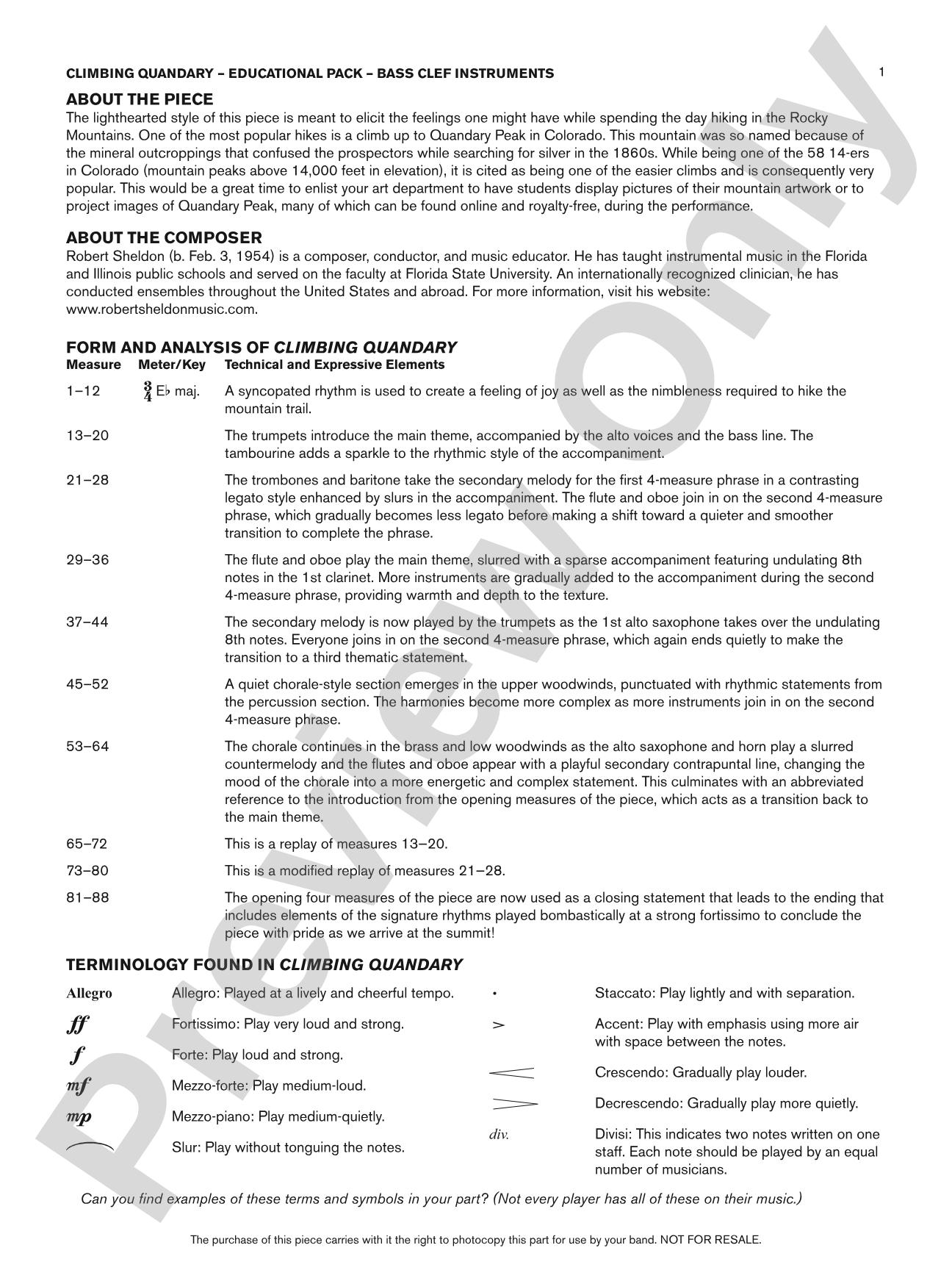
Climbing Quandary, by Robert Sheldon, is meant to elicit the feelings one might have while spending the day hiking in the Rocky Mountains. One of the most popular hikes is a climb up to Quandary Peak in Colorado. This mountain was so named because of the mineral outcroppings that confused the prospectors while searching for silver in the 1860s. While being one of the 58 14-ers in Colorado (mountain peaks above 14,000 feet in elevation), it is cited as being one of the easier climbs and is consequently very popular. This would be a great time to enlist your art department to have students display pictures of their mountain artwork or to project images of Quandary Peak, many of which can be found online and royalty-free, during the performance. (1:50)
Correlates to Sound Innovations, Book 2, Level 2.


Correlates to Sound Innovations, Book 2, Level 2.
Climbing Quandary: Bass Clef Educational Pack isn't in MakeMusic Cloud just yet...but it could be. Let us know you'd like to see it, and you'll help shape what comes next. In the meantime, start a free trial and dive into thousands of interactive titles your students can play along with today.
Request This Title
Tell us you want it.
Start Your Free Trial
Explore everything that's ready to play right now.
Sample Audio
1
Audio File
--:--
0:00
0:00
Sample Video
Additional Details
Series:
Sound Innovations Series for Band
Publisher:
Alfred Music
SKU:
00-PC-0019408_BC_EDPAK
More about this title
About the Composer: Robert Sheldon

Robert Sheldon's wind band compositions appear on contest and concert programs across the globe with remarkable frequency. Recognized with awards from the American School Band Director's Association, Phi Beta Mu, and ASCAP, he has established himself as a voice that speaks directly to student ensembles and their audiences. His works balance musicality with accessibility, a philosophy evident in his role as lead author of Sound Innovations for Concert Band.
Sheldon maintains an active schedule as guest conductor, clinician, and educator, appearing at honor bands, universities, and music education conferences throughout North America, Europe, Asia, and Australia. His compositions have been performed at Carnegie Hall, Boston Symphony Hall, the Sydney Opera House, and the Kennedy Center. In 2020, VanderCook College of Music granted him an honorary doctorate in recognition of his contributions to music education.
Why we love this
Sheldon crafts an immediately engaging narrative arc here, moving your band through the physical and emotional progression of a mountain ascent without resorting to obvious dramatic gestures. The programmatic frame invites visual collaboration with your art department, transforming a single concert piece into a multimedia moment that deepens student investment in the performance.
What to expect
Climbing Quandary captures the steadiness and quiet determination of a mountain day. The music breathes with the rhythm of footfalls and shifting perspective, moments of exertion balanced by passages of open sky and reflection. It never loses sight of joy, the satisfaction that builds as the climb progresses.
Who it's for
Grade 2 bands that have solidified foundational technique and are ready to explore programmatic storytelling. This works equally well for contest preparation and concert programming, offering students an early experience with linking musical gesture to extramusical imagery.
How to get the most out of it
- Build the climb gradually across the ensemble; resist the urge to play all dynamic shifts at full volume. Let the landscape emerge through careful voicing and balance rather than sheer weight.
- Coordinate the visual projection or artwork display with your rehearsals early on so students understand how their musical choices support the overall presentation.
- Mark phrase endpoints clearly in parts so players understand where the melodic "ascent" happens and can shape accordingly. Sheldon's architecture rewards intentional phrasing over busy playing.
- Use the compact 1:50 runtime to full advantage in programming; the piece sits comfortably before a larger work without feeling like an opener in need of more substance.
How to use it
Position this mid-concert as a tonal and textural contrast to heavier works. Its 1:50 length makes it an ideal pairing with a longer contemporary piece or classical arrangement on the same half, and the visual element transforms it into a program highlight without requiring extended performance time.
Skills your students will build
- Shaping phrases to support programmatic narrative
- Maintaining forward motion through gradual dynamic and textural change
- Ensemble balance in sectional voicing
- Connecting musical gesture to extramusical imagery
- Precision in articulation across the band to create cohesive melodic momentum