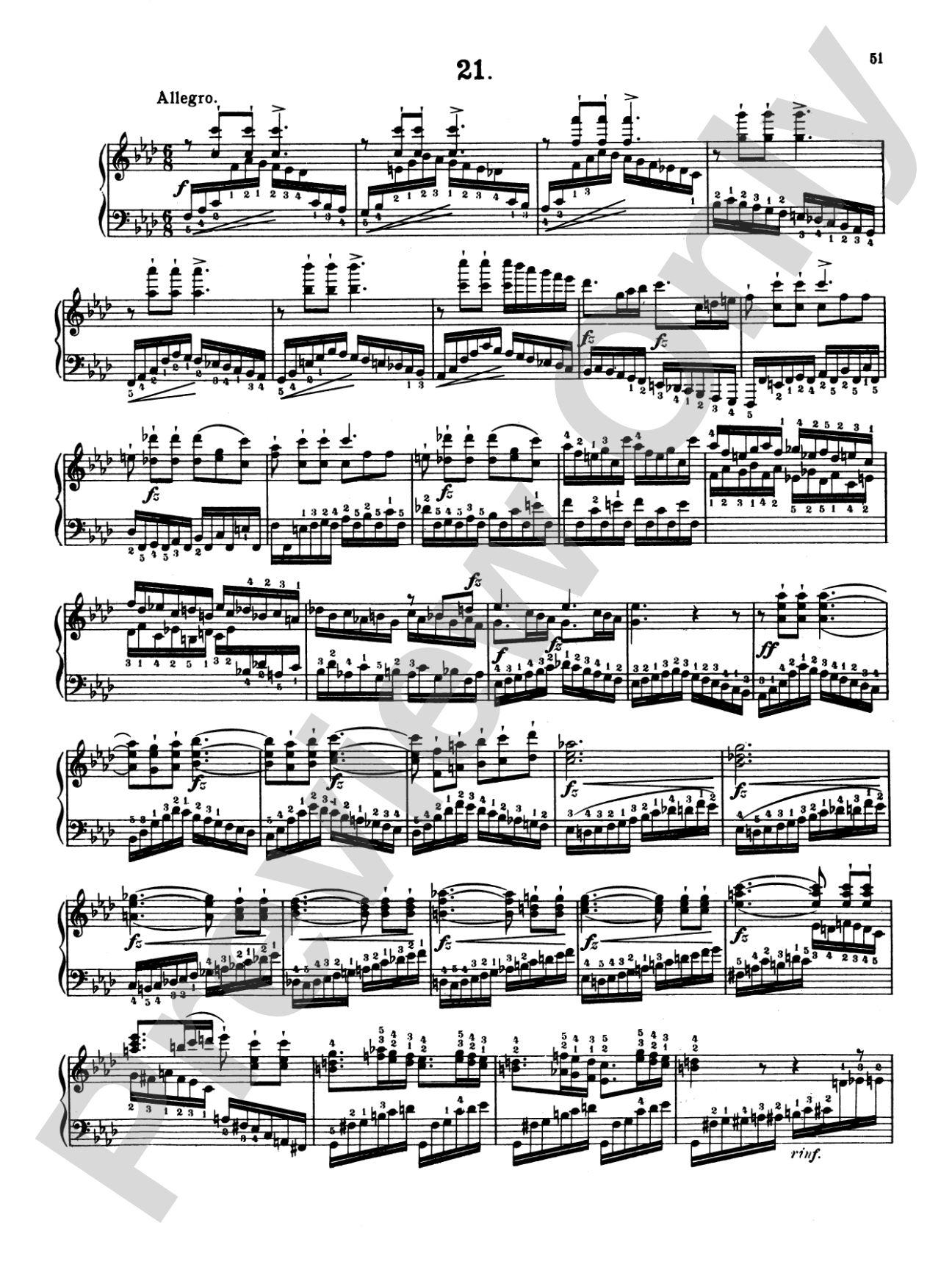
Clementi: Gradus ad Parnassum (Twenty-nine Selected Studies) Sheet Music Preview

Clementi: Gradus ad Parnassum (Twenty-nine Selected Studies)

By Muzio Clementi and Carl Tausig

Item: 00-PC-0006138

Digital Download
$0.99
Description
This is a collection of 29 progressive studies for piano by Muzio Clementi and Carl Tausig. 76 pages.

Clementi: Gradus ad Parnassum (Twenty-nine Selected Studies) isn't in MakeMusic Cloud just yet...but it could be. Let us know you'd like to see it, and you'll help shape what comes next. In the meantime, start a free trial and dive into thousands of interactive titles your students can play along with today.

Sample Audio
No sample audio found.
Sample Video
Additional Details
Series: Kalmus Edition
Publisher: Alfred Music
Page Count: 76
SKU: 00-PC-0006138

More about this title

About the Composer: Muzio Clementi

Muzio Clementi (1752-1832) was a composer, pianist, and pedagogue whose technical innovations shaped the future of keyboard writing. His studies and sonatas bridged the Classical and Romantic eras, establishing new standards for piano technique and musicality. Clementi's influence extended far beyond his own compositions; he was a publisher, piano manufacturer, and mentor whose teaching methods influenced generations of musicians across Europe.

The Gradus ad Parnassum ("Steps to Parnassus") represents Clementi's synthesis of artistic depth and practical instruction. Unlike mere finger exercises, these studies demand interpretive maturity alongside technical command, making them essential repertoire for pianists serious about both their craft and their musicianship.

Why we love this

Clementi's studies possess a rare quality: they are genuinely musical pieces, not mere technical drilling grounds. Each study isolates a specific pianistic challenge while maintaining artistic integrity, so students develop technique in service of actual composition rather than in abstract. The progression from moderate to considerable difficulty gives pianists a sustainable path toward the virtuosity required for later Romantic repertoire.

What to expect

These studies inhabit a world of disciplined elegance. You encounter rapid passagework that sparkles without fussiness, harmonic progressions that feel inevitable, and moments of genuine lyricism woven through technical demonstrations. There is a Classical restraint here, yet hints of Romantic character color many of the middle and advanced studies, creating a listening experience that rewards both the player and anyone hearing them performed.

Who it's for

Intermediate to advanced pianists (roughly Grades 7-8 and beyond) who need bridge repertoire between elementary studies and the concert literature of the 19th century. Teachers will find these 29 selections invaluable for targeting specific technical challenges while building interpretive maturity. These studies suit serious students preparing for auditions, competitions, or simply seeking the historical foundation that Clementi's work provides.

How to get the most out of it

  • Balance clarity with legato in the hand-crossing and rapid passage work; Clementi expects both precision and singing tone, never mechanical display.
  • Listen carefully to the harmonic structure beneath the figurations; understanding the underlying chords will anchor your phrasing and prevent the studies from dissolving into aimless passage work.
  • Approach the more ornamental sections with restraint; these studies predate 19th-century Romantic excess, so let the Classical proportions remain evident in your ornamentation choices.
  • Practice the most technically demanding passages slowly enough to lock in finger independence and control; speed without accuracy will obscure the musical intent.

How to use it

Include individual studies in student recitals as standalone pieces rather than merely as preparatory work; their musical substance deserves public presentation. Pair them with later Romantic or contemporary works to highlight the historical evolution of piano technique and style. They also serve well as audition selections for high school or college entrance, since examiners recognize them as substantial repertoire that demonstrates serious study.

Skills your students will build

  • Rapid scalar and arpeggio work across the full keyboard
  • Hand independence and coordination in two-handed figurations
  • Legato touch and voice leading through ornamental passages
  • Control of dynamics and tone color within extended technical sections
  • Understanding of Classical harmonic structure and phrasing
  • Transitioning between technical display and musical expression

You May Also Like