
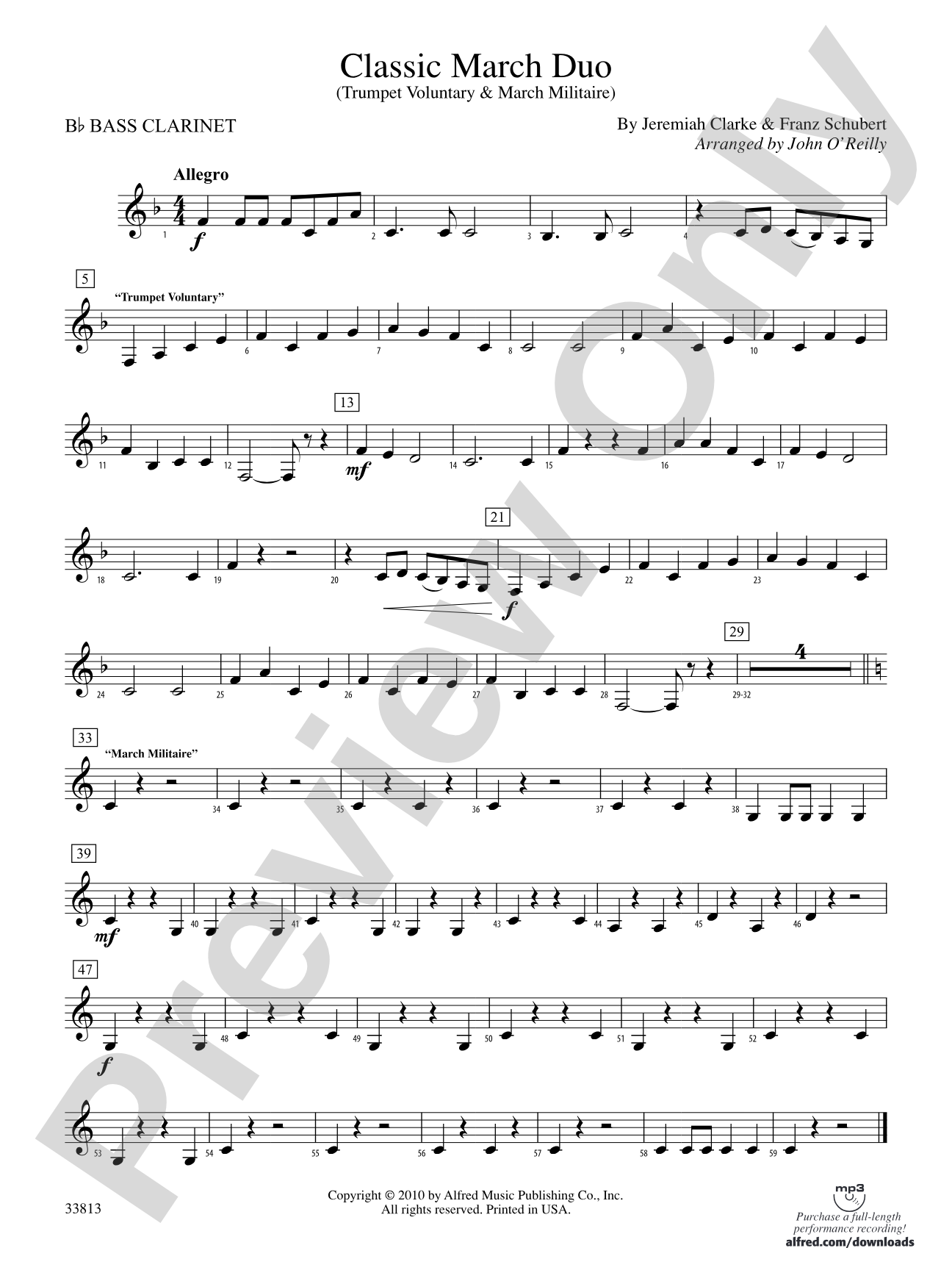

Classic March Duo: B-flat Bass Clarinet
Music by Jeremiah Clarke and Franz Schubert / arr. John O'Reilly
Grade: 1 (Very Easy)
Item: 00-PC-0014545_BC
$3.00
Pickup currently not available
Description
Two popular marches from the classical repertoire are paired together in this wonderful new arrangement. Jeremiah Clarke's (1674--1707) "Trumpet Voluntary" was originally written for organ and trumpet and is frequently heard as a processional at wedding ceremonies. Franz Schubert's (1797--1828) "Marche Militaire" was originally written as a piano duet but has been reset for various instrumental ensembles. This effective arrangement gives the young band student an opportunity to perform two of the most famous marches of all time. (Correlated to Accent on Achievement, Book 1, Page 30)


Don't just read it, hear it, play along with it, and watch your students grow with it. In MakeMusic Cloud, Classic March Duo: B-flat Bass Clarinet comes alive with professional accompaniment, adjustable tempo, and built-in practice tools that turn solo practice into real progress.
Open in the Player
Jump straight in and assign it today.
Start Your Free Trial
Open this title and explore the full library in minutes.
Sample Audio
1
Audio File
--:--
0:00
0:00
Sample Video
No sample videos found.
Additional Details
Series:
Accent on Achievement
Publisher:
Alfred Music
Page Count:
118
SKU:
00-PC-0014545_BC
More about this title
About the Composer: Jeremiah Clarke
Jeremiah Clarke (1674-1707) was an English Baroque composer and organist whose career spanned the final decades of the 17th century. Though his life was cut short at 33, he left behind a body of keyboard and vocal music that remains central to early English Baroque repertoire. His "Trumpet Voluntary" has endured as one of the most recognizable processional pieces in Western music, performed at ceremonies and formal occasions for over three centuries.
Clark served as a lay vicar and later as organist at St. Paul's Cathedral in London during a period of significant musical development in England. His gift for memorable melody and clear harmonic writing made his works immediately appealing to performers and audiences alike, and many of his compositions remain teachable and rewarding for young musicians today.
Why we love this
Two unassailable masterworks in one Grade 1 package removes the question of what to program for young bands. The "Trumpet Voluntary" alone carries enough ceremonial weight and recognition that students feel they're performing something truly significant, while the "Marche Militaire" offers rhythmic drive and contrast. O'Reilly's arrangement respects both pieces' original character while making them accessible to developing ensembles.
What to expect
The "Trumpet Voluntary" brings ceremonial nobility and processional pageantry; its opening is stately and dignified, unfolding with the formality of a grand entrance. The "Marche Militaire" shifts the mood to brisk, purposeful march character with clear rhythmic momentum and a lighter, more playful energy that contrasts beautifully with the opening piece.
Who it's for
Young concert bands at Grade 1 level, particularly those preparing repertoire correlated to the Accent on Achievement curriculum. This package works equally well for beginning bands looking for recognizable, historically grounded material that builds student confidence through familiar melodies.
How to get the most out of it
- Shape the "Trumpet Voluntary" as a processional: allow the opening phrases to unfold with natural breathing space and let the melody sing through without rushing the tempo.
- Balance the upper melody line against the harmonic foundation in both marches. Young players often focus only on their own part; conductor-led rehearsals that highlight how lines support the tune will deepen musical understanding.
- Emphasize the rhythmic precision of the "Marche Militaire"—its military character depends on clean articulation and steady pulse, not on playing loud.
How to use it
Open a concert or ceremony with the "Trumpet Voluntary" for immediate impact and audience recognition, then transition into the "Marche Militaire" as a palate cleanser before moving to contrasting repertoire. Alternatively, program them as an opening concert pair that demonstrates young players' ability to handle both lyrical and rhythmic material with maturity.
Skills your students will build
- Balanced harmonic support and melody writing in Grade 1 ranges
- Processional conducting and phrasing in sustained passages
- Rhythmic precision and articulation in march style
- Historical awareness of Baroque and Classical compositional intent